















 Facebook
 Twitter
 Pocket
 Reddit
 Email
Email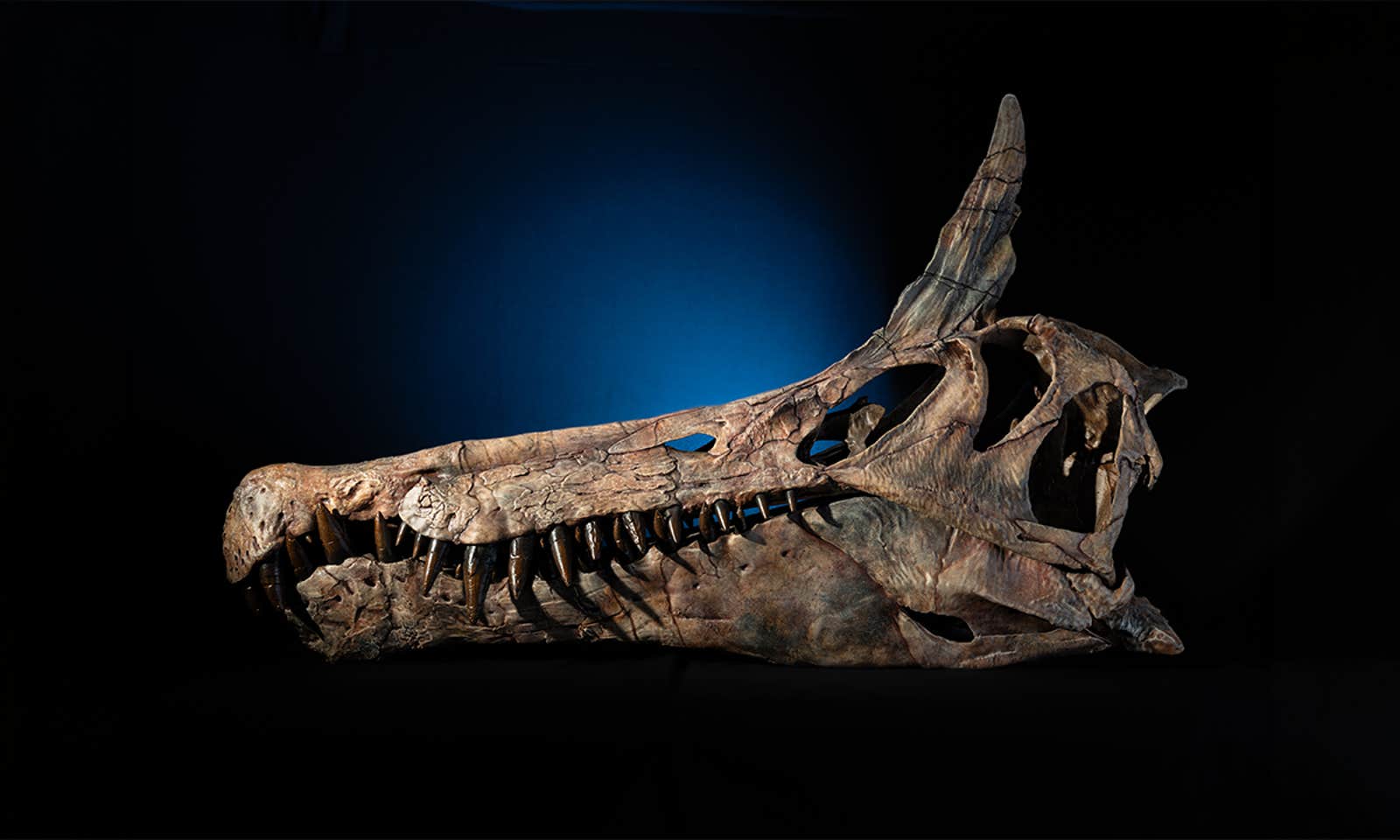


It’s not every day that a new dinosaur is discovered, but it is a great day. Paleontologist Paul Sereno experienced one in Niger when his team unearthed what turned out to be a new species of spinosaurus: Spinosaurus mirabilis. They published their findings in the latest issue of Science.
Sereno’s journey started with the writings of a French geologist in the 1950s who mentioned finding a dagger-like tooth in Egypt’s Western Desert. No one had ventured so far into the Sahara to follow up, until Sereno’s 2019 expedition. There, the team met a local man with a motorbike who agreed to lead them to a spot where he’d glimpsed giant fossilized bones.
“It was an adventure and a half wandering into the sand seas to search for this locale and then find an even more remote fossil area with the new species,” Sereno said in a statement.
Over the course of two expeditions, Sereno and his team discovered jawbones and a trio of sweeping scimitar-like crests belonging to S. mirabilis. Based on the exterior texture and interior structures, the researchers believe the crests were covered in keratin and could have been brightly colored to serve as a display. The jaws of S. mirabilis contained fearsome rows of teeth, the lower of which protruded outward between the upper to help it catch slippery fish.
Read more: “How Tycoons Created the Dinosaur”
“This find was so sudden and amazing, it was really emotional for our team,” Sereno explained. “I’ll forever cherish the moment in camp when we crowded around a laptop to look at the new species for the first time, after one member of our team generated 3D digital models of the bones we found to assemble the skull—on solar power in the middle of the Sahara. That’s when the significance of the discovery really registered.”
While the crest was the most dramatic feature of the skull, the location where it was discovered was remarkable as well. Previous spinosaur finds have been restricted to prehistoric coastal areas, but S. mirabilis was discovered in an inland area 300-600 miles from the ocean—much farther inland.
“I envision this dinosaur as a kind of ‘hell heron’ that had no problem wading on its sturdy legs into two meters of water but probably spent most of its time stalking shallower traps for the many large fish of the day,” Sereno said.
After cleaning, scanning, and creating a digital rendering of the S. mirabilis skull, Sereno tasked paleoartists with bringing the majestic creature to life. The team created a replica of the skull and a touchable crest, which will be put on display at the Chicago Children’s Museum beginning March 1st.
“Letting kids feel the excitement of new discoveries—that’s key to ensuring the next generation of scientists who will discover many more things about our precious planet worth preserving,” Sereno argued. 
Enjoying Nautilus? Subscribe to our free newsletter.
Lead image: Skull cast of the new scimitar-crested spinosaurid Spinosaurus mirabilis. Credit: Keith Ladzinski.