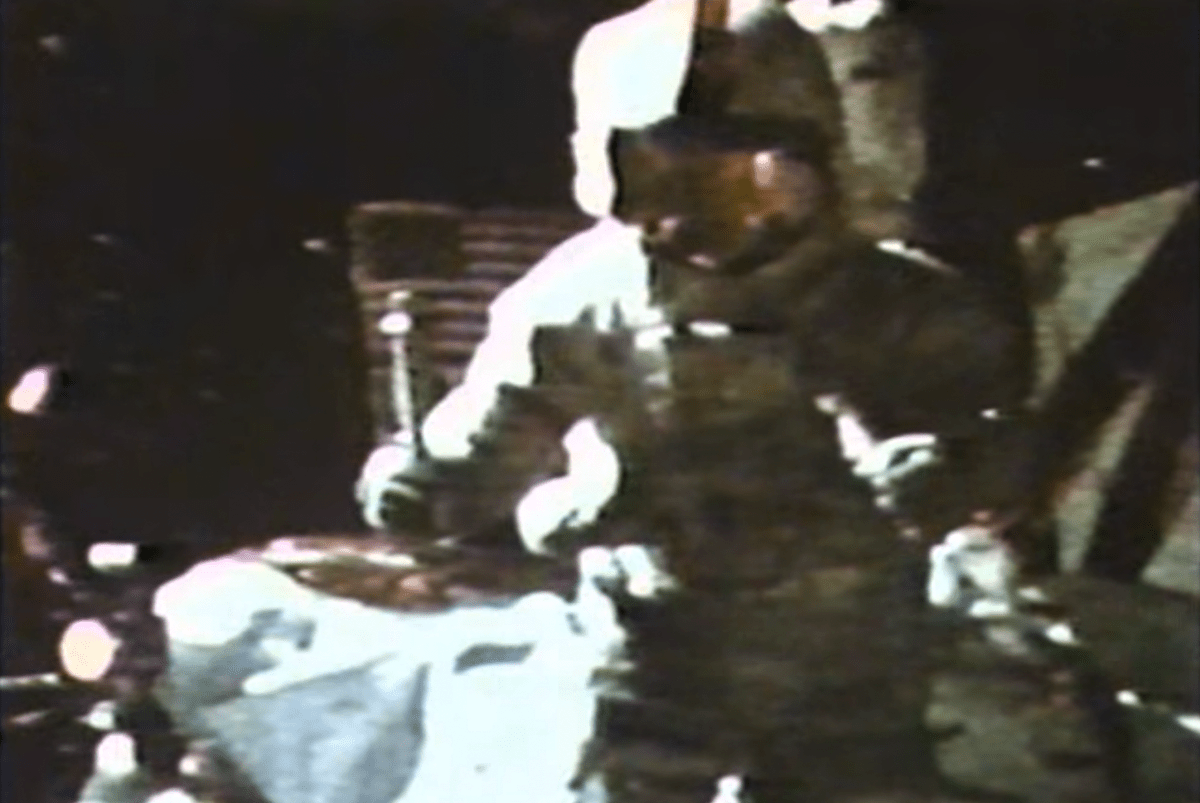
On Aug. 2, 1971, United States astronaut David Scott ran one of the most famous experiments ever carried out in the lunar atmosphere. He dropped a geologic hammer and a feather from the same height at the same time, showing that they both fell at the same exact speed despite their differing weights, and providing the first extraterrestrial proof of Galileo’s theory of falling bodies—that unequal weights fall with the same speed in a vacuum (like the moon’s atmosphere).
On Earth, a feather and a hammer will fall at different speeds, but because of air resistance, not because of gravity or acceleration. And so, on the moon, the principle can be more clearly observed.
For his own experiments toward the end of the 16th century, Galileo actually made use of inclined planes rather than straight drops, reducing the impact of air resistance and making his timings easier to manage.
Galileo was, of course, a keen astronomer, too, and would no doubt have been delighted to learn that his ideas had been verified on the moon almost four centuries later.
Read more: “Will Plants Grow on the Moon?”
The lunar demonstration was broadcast live on television, and while the result was not in doubt, seeing the objects hit the lunar dust simultaneously was “reassuring considering both the number of viewers that witnessed the experiment and the fact that the homeward journey was based critically on the validity of the particular theory being tested,” Mission Controller Joe Allen noted in his Apollo 15 Preliminary Science Report (the experiment was actually Allen’s idea).
As part of the Apollo 15 mission, Scott and fellow astronaut James Irwin managed three extravehicular activity (EVA) sessions, including the moonwalk that featured the hammer and feather experiment. Scott and Irwin also were able to collect rock samples—including one named Great Scott after the crew commander—and set up a small tribute to astronauts and cosmonauts who had previously died during space exploration missions.
The Apollo 15 mission is notable as well for featuring the first and only stand-up EVA on the moon, when Scott stood up inside the lunar module Falcon, lifting his head and upper body out of the craft, to take in his surroundings (albeit still in his spacesuit).
And while Neil Armstrong’s words about stepping on the moon became iconic, Scott settled for something a little less grand for his falling bodies experiment: A quick tribute to Galileo, and then an understated “How about that?” as the feather and hammer touched down together. 
Enjoying Nautilus? Subscribe to our free newsletter.
Lead image: Astronaut David Scott holds a hammer and a feather ready to test Galileo’s theory of falling bodies. Credit: NASA.