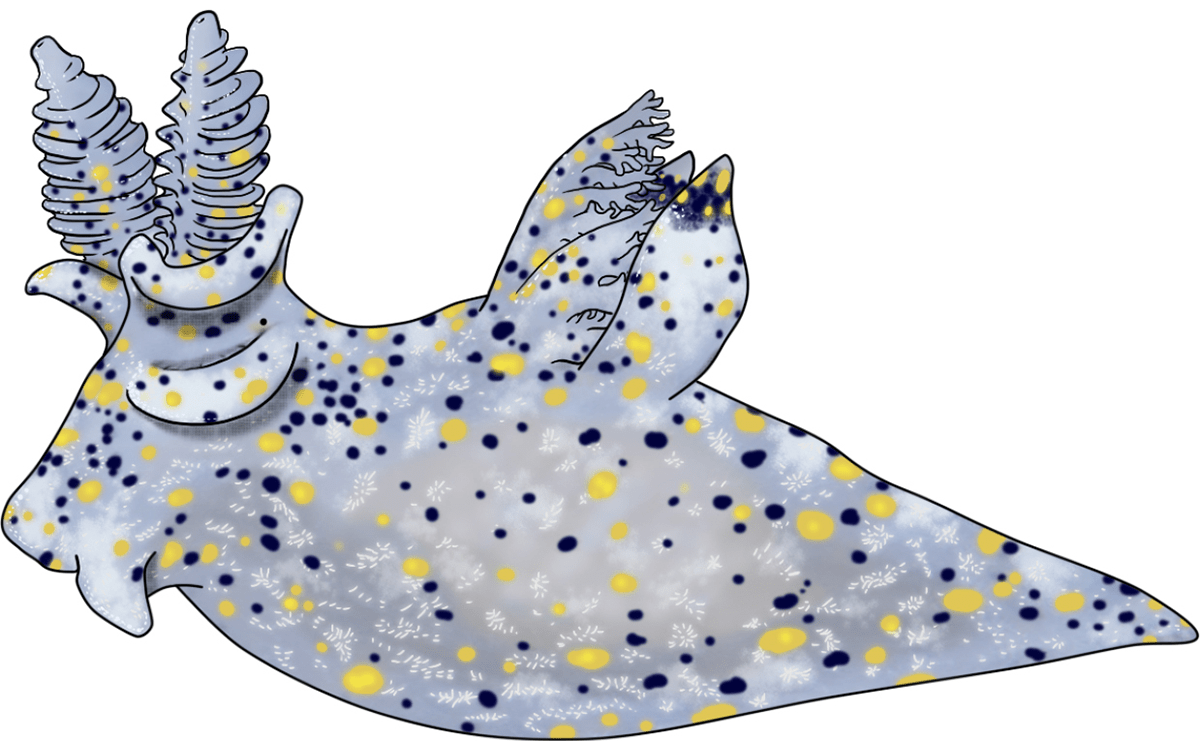
Diving in the North China Sea off the coast of Taiwan is challenging. Between chilly waters and strong waves, conditions are prohibitive from October to April, and the short diving season of May to September is when tropical cyclones get stirred up. Thus, knowledge of the organisms inhabiting this portion of the biodiverse Indo-Pacific coral triangle is limited. Despite such challenges, though, a team of researchers led by the National Taiwan Ocean University recently discovered a new species of sea slug there.
Finding Thecacera sesame was like finding a proverbial needle in a haystack. With a body no more than 0.1 inches long, it’s about the size of a sesame seed (hence the name). Sea slugs, also known as nudibranchs (scientific order Nudibranchia), are patterned with bright colors, but the research team explained in a statement that many nudibranchs are still “extremely difficult to spot underwater with the naked eye.”
During a recreational dive in 2019, lead author Ho-Yeung Chan, then an undergraduate student, accidentally collected a T. sesame without realizing it was a new species. He and his coauthors subsequently returned to the volatile ocean of northern Taiwan to look for more. In their paper, they describe the original plus six additional specimens of T. sesame, all of them collected on colonial groups of marine organisms called bryozoans.
Read more: “Sea Slug, Climate Change Warrior”
“Nudibranchs are one of the key players in the marine food web,” they explained. Nudibranchs are known to prey on bryozoans, typically specializing on particular species for the nudibranch cycle of feeding, mating, and laying eggs.
A microscopic view of the nudibranch specimens showed creatures that are translucent from head to tail, each finely speckled with a scattering of black and yellow dots. Their transparency may confer camouflage when viewed by predators against the backdrop of bryozoans.
Tissue samples for molecular analysis were taken from the muscular “foot” of each preserved nudibranch, or the structure used to cling to or move over substrates. Analysis of mitochondrial genes confirmed their identity as a new species. T. sesame is genetically separated from its closest relative, T. picta, found in Japanese waters, by a significant amount of 6.7 percent. They differ subtly in appearance, too: T. picta has black feathery appendages with orange tips on its gills, while T. picta’s are transparent white with spots.
Given how hard it is to find such minuscule creatures, there may be a whole world of nudibranch species out there that we’ve still yet to discover. 
Enjoying Nautilus? Subscribe to our free newsletter.
Lead image: Chan, H.-Y., et al. ZooKeys (2026).