The Curiosity rover has been trundling over the red rocks and sand of Mars since August 2012, and it continues to make fascinating discoveries.
In fact, it just uncovered evidence of a Martian sandstorm that lasted for hours and happened billions of years ago—the first direct physical evidence of such an event on the planet that we’ve found so far.
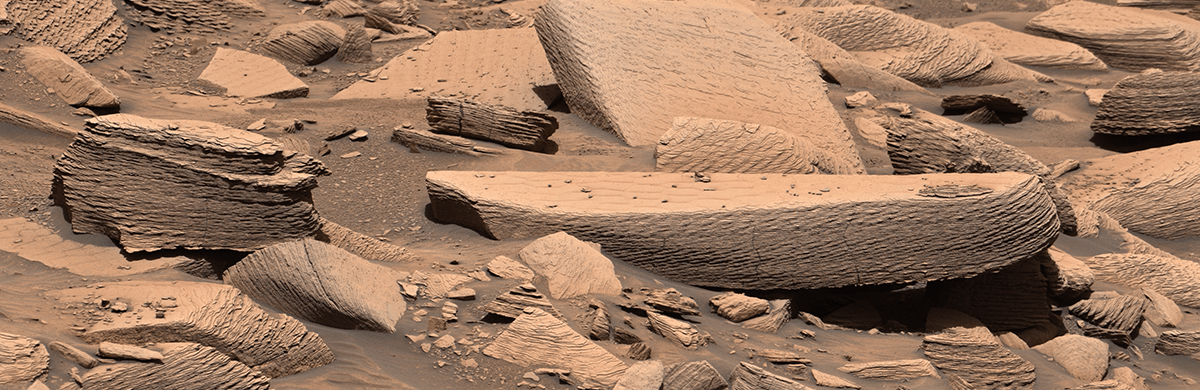
What Curiosity spotted was ripples on ripples: Sand pushed so hard by the wind that the ripples are climbing over each other. These layers then hardened into rock over eons, leaving behind the geological patterns shown in this image, snapped by Curiosity on Dec. 12, 2024 in the Gale crater.
Read more: “Hear the Wind on Mars”
An interpretation of these patterns, more technically known as supercritical climbing translatent strata, has now been published in a study in Geology. Using the angles and volumes that sediment was deposited in, scientists can work backward to figure out the wind conditions at the time.
“These conditions caused rapid deposition of sediment onto migrating wind ripples, occasionally resulting in supercritical angles of climb, recording gusting winds that originated from the south,” write the researchers.
The analysis floats two hypotheses to fit the data: Either the sand grains were forced up dune and rock edges before falling over and accumulating, or they were being pushed down a slope with slight imperfections in the terrain, causing ripples to build up. The fact that these “climbing” ripples are interspersed with more ordinary, flat wind ripples suggests intense bursts of wind that came and went, giving us invaluable insight into meteorological conditions on the Red Planet billions of years ago that could help us understand more about what led to its current state.
“These are the shortest duration fluctuations in wind speed identified for ancient Mars thus far, recording extremely transient atmospheric conditions during a time when the Martian climate was becoming increasingly arid,” write the researchers.
The thinking is that while Mars was once home to a vast network of rivers and oceans, its surface has now been dry for several billion years—with solar winds stripping liquid off the planet, left vulnerable by a weakening magnetic field.
As Curiosity will be experiencing (and anyone who’s seen The Martian knows), there are still large, intense dust storms on Mars today. They can be the size of continents—big enough to be seen from Earth, via telescope—and last for weeks. Every three Mars years or so, one gets big enough to envelope the entire planet. Now we can start to compare those conditions to ancient Mars, through a reverse weather forecast stretching over billions of years. 
Enjoying Nautilus? Subscribe to our free newsletter.
Lead image: NASA