As the only mammals that have evolved the ability to fly, bats need a lot of calories to get off the ground. That means they have to eat well over their body weight each day, which adds up to a lot of flying insects for predatory bats.
Of course, there’s another, more calorie-rich food source that shares the skies with bats: birds.
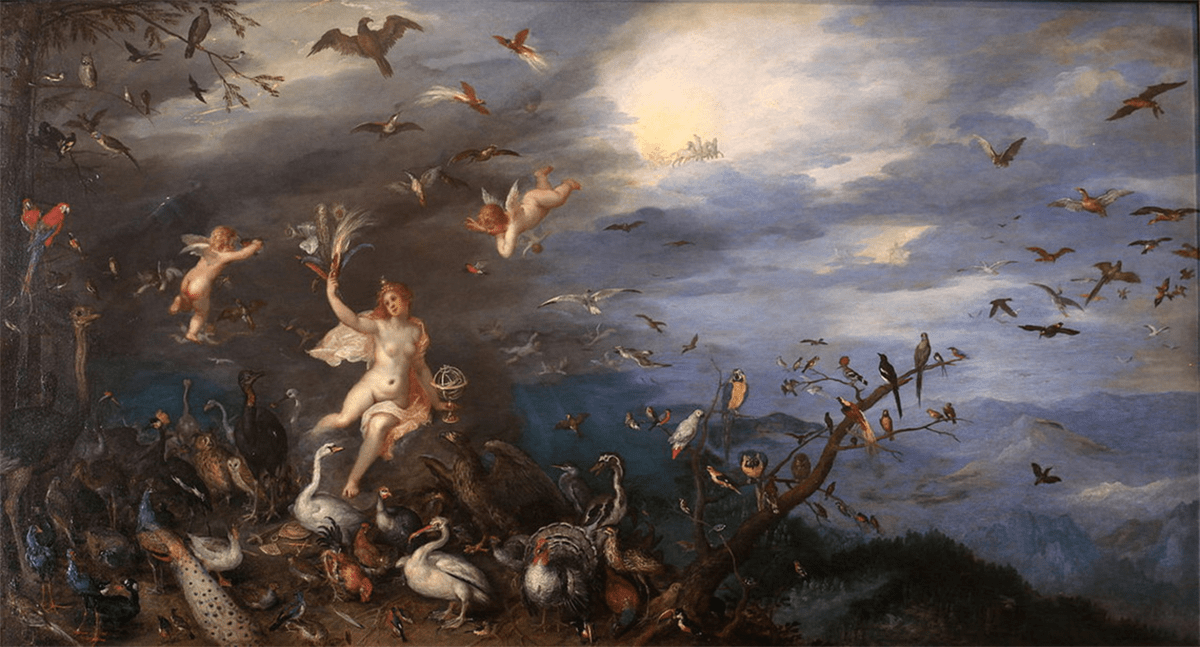
In Europe, for example, large groups of birds migrate primarily at night during the peak activity of the greater noctule bat, and in 2001, an analysis of their droppings turned up evidence of bird feathers. Before that, bats feeding on birds was considered rare (and likely still is for other bat species). But according to a new paper published in the Proceedings of the National Academy of Sciences, at least someone knew about the behavior four centuries earlier—the Flemish painter Jan Brueghel the Elder.
Read more: “The Social Life of Bats”
Brueghel was quite prolific during the Renaissance, painting rich landscapes and floral still lifes with a keen eye toward realistically capturing and ordering the natural world. He was also obsessed with creating allegorical paintings of the elements (earth, water, air, and fire). His 1611 allegory of air, featured the Greek muse Urania surrounded by more than 60 species of birds, including exotic avians like the ostrich and the scarlet macaw.
And that’s not all: Tucked away in the upper righthand corner of the canvas is what appears to be a greater noctule bat; in its mouth is a small bird.
Per the study authors, Brueghel may very well have been documenting this bird-eating behavior for the first time. While the bats aren’t common in Brueghel’s home country of Belgium, he did spend some time in Italy prior to creating the work, and the species is much more prevalent there. They note that the painter included several other bats in his paintings, but only the greater noctule is depicted feasting on birds. “The fact that a noctule bat, and no other bat species, is represented in the scene suggests an observational inspiration rather than purely symbolic convention,” they explained.
Artists have long drawn inspiration from the natural world, maybe scientists should spend more time scouring art museums for their own. 
Enjoying Nautilus? Subscribe to our free newsletter.
Lead image: Jan Brueghel