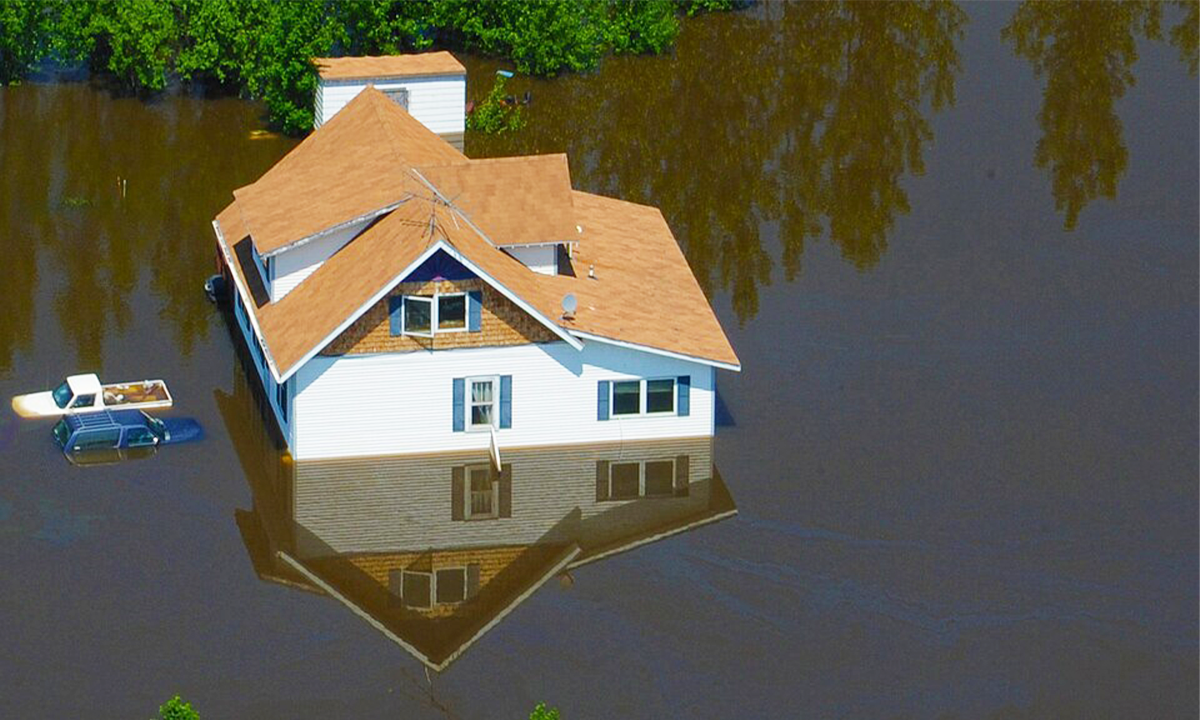
It’s tough to convince people to act when we won’t reap immediate rewards—researchers have found that this psychological barrier applies to managing our finances, looking out for our long-term health, and reducing the impacts of climate change. The latter is particularly urgent as climate change intensifies and myriad natural disasters threaten people’s homes around the globe.
Studies have increasingly sought to figure out how to effectively communicate climate risks and encourage people to respond with actions—such as opting for sustainable diets or taking public transportation—that curb emissions in the long run. But few experiments have explored another critical piece of the equation: How government officials and insurers can convince people to make their homes more resilient to rising risks from floods, wildfires, and other hazards exacerbated by climate change. Now, researchers say they have identified a winning tactic: make things personal.
A team from Harvard University and the Stockholm School of Economics in Sweden sent emails to nearly 13,000 homeowners in parts of Australia vulnerable to wildfires. The messages offered tips to protect their properties, including cleaning gutters and cutting back trees. The homeowners were randomly placed into two groups of roughly equal size: The test group received emails that mentioned their specific suburb several times, and the control group received emails that didn’t mention any specific location. Ultimately, people who received the personalized email were nearly twice as likely to click on a link to learn more about preventive measures ahead of wildfires.
Read more: “Crying Wolf in an Age of Alarms”
“We know climate threats often feel distant and abstract,” said study co-author Nurit Nobel, a behavioral scientist at the Stockholm School of Economics, in a statement. “This simple localization helped people connect the message to their own lives, and therefore nudged them toward action.”
The study subjects, who were customers of a large Australian bank, received these emails a few weeks before the 2023 summer wildfire season. The researchers kept close tabs on how people interacted with these emails. In addition to link engagement, they also measured the difference in email open rates and found that more people opened emails when the subject lines mentioned their suburb—around 55 percent versus 53 percent—but the result wasn’t statistically significant.
Overall, the “intervention in this study produced a modest impact in absolute numbers,” the statement noted, which is typical in this type of large-scale experiment. But “in real-world settings, even modest changes in behavior can have meaningful impact when applied across thousands or even millions of people,” said co-author Michael Hiscox, a professor of international affairs at Harvard University.
Nobel and Hiscox wrote that the insights generated by this research can be used to prepare for other types of climate risks, including floods and hurricanes. They added that they hope that future work focuses on varying cultural contexts—enabling communities around the world to act as disasters loom. 
Enjoying Nautilus? Subscribe to our free newsletter.
Lead image: Sharida Jackson / Wikimedia