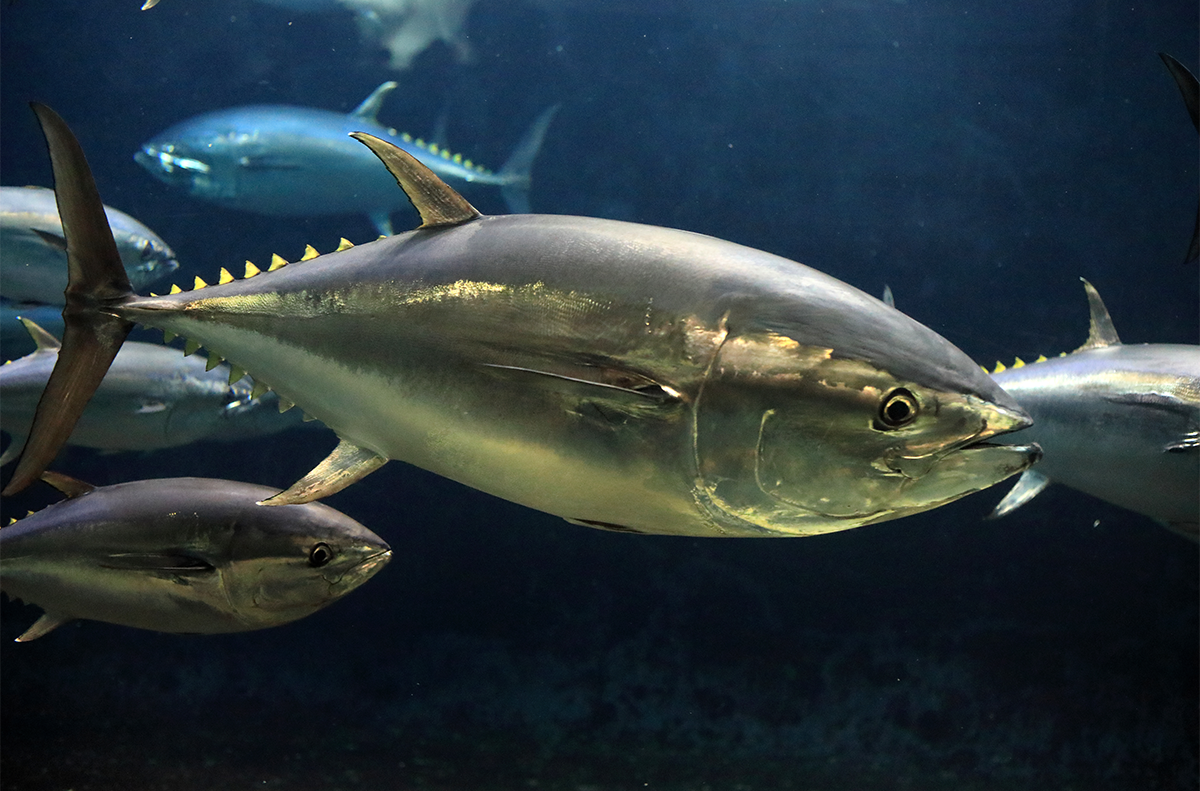
Although they’re fish, tunas count among the rarified group of animals that can keep their bodies warmer than the surrounding environment. Their warm-bloodedness (“endothermy”) gives them a physiological advantage in generating and sustaining energy, helping them serve as top predators. In fact, albacore tuna have been clocked swimming faster than 50 miles per hour and diving to more than 3,000 feet.
How tunas and a few of their relatives in the family Scombridae, which includes mackerels and bonitos, evolved these traits has been a subject of scientific debate. The prevailing hypothesis is that tuna capitalized on an ecological opportunity that surfaced after the dinosaur-killing asteroid strike eliminated all other apex predatory fishes 66 million years ago. A recent study published in Proceedings of the Royal Society B, however, refutes that hypothesis.
Yale University biologists and collaborators used DNA sequence data from more than 50 Scombridae to create a time-calibrated evolutionary family tree. The data showed, as expected, that Scombridae as a group originated close to the time of the asteroid strike that caused the collapse of ocean food webs. But the warm-blooded traits of tunas and some of their relatives didn’t evolve until much later.
Read more: “Enlisting Paparazzi to Save a Gigantic Fish”
“Our results demonstrate the K-Pg extinction didn’t trigger the evolution of tunas and related large, endothermic predators,” said Chase Brownstein, lead study author and graduate student in ecology and evolutionary biology, in a press release.
Indeed, endothermy appears to have evolved three separate times in Scombridae lineages, all of which were at least 5 million years after the asteroid strike, likely closer to 10 to 15 million years later. And so, factors other than the demise of their competitors gave tunas and mackerels a leg up in becoming top predators—and it happened over millions of years.
Case in point: Another tuna trait is large body size, which is thought to help maintain endothermy by reducing surface-area-to-volume ratio, thus buffering against heat gain and loss. But the study results showed that body size increases happened sporadically during the evolution of tunas over a significant time span. In fact, “there is no connection between the origins of endothermy and large body sizes in these lineages,” added Brownstein.
All of which is to say, this apex predator didn’t become a warm-blooded killer overnight—or because the dinosaurs no longer roamed around it. 
Enjoying Nautilus? Subscribe to our free newsletter.
Lead image: feathercollector / Adobe Stock