For biologists around the world, the invention of small, portable acoustic, radio, and satellite tracking tags has revolutionized their understanding of where animals go and how they live. But limitations in the technology mean they’ve only studied a fraction of underwater life, says Robert Lennox, a biologist at Dalhousie University in Nova Scotia.
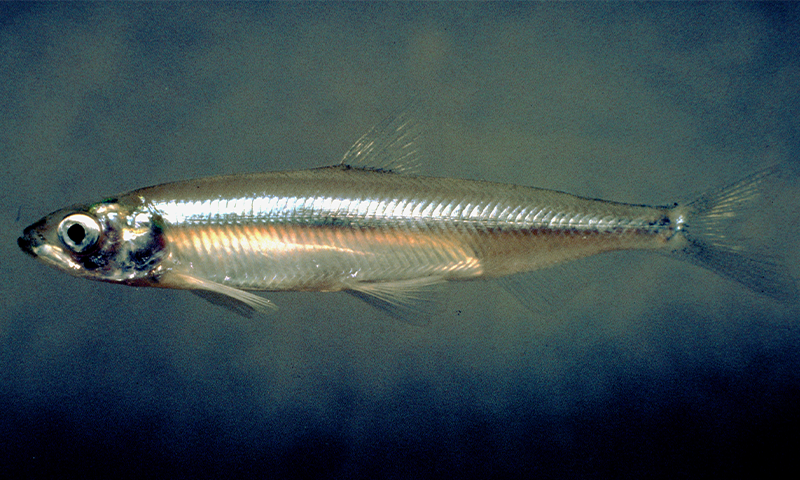
Consider, for instance, the delta smelt (Hypomesus transpacificus). These slender, silvery fish—which average just 6.5-centimeters (2.5-inches) long—are found only in California’s Sacramento-San Joaquin Delta. For millennia, these fish darted in droves through the delta’s murky water and effectively supported the watershed’s entire food web. Over the past century, however, pollution, invasive species, and excessive water pumping have destabilized the ecosystem, pushing the diminutive delta smelt toward extinction.
To help the fish recover, scientists want to restore the delta and manage how water flows across the land, as well as boost the population with hatchery-raised smelt. But to concentrate their efforts on what will benefit the fish the most, scientists still need to answer some pretty fundamental questions about how smelt use their delta.
Existing tracking tags weigh heavily—literally—on the tiny fish.
“We need to know things like, Where are they going? How do they get there? We don’t even know where they spawn,” says Eric Chapman, a fish biologist at ICF, a global applied research firm and technology provider, who is working with the University of California Davis to track delta smelt.
Unfortunately, existing tracking tags weigh heavily—literally—on the tiny fish. In 2016, when researchers tested implanting smelt with the smallest acoustic transmitter then available, the sensitive fish wouldn’t always survive the process, Chapman says.
Now, however, breakthroughs in tagging technology are opening a window into the lives of smelt and other small swimmers—a shift some scientists say could transform our understanding of the underwater world’s more minute creatures.
Though scientists have been using tags that can be worn like a backpack by animals as small as hornets or bees for more than a decade, designing trackers that small that also work underwater is a bigger challenge. Traveling through water weakens radio and high-frequency acoustic signals, meaning trackers designed to be submerged need beefy batteries to pump out more powerful signals, making them more burdensome than their terrestrial equivalents.
To avoid annoying or hurting the tracked animals any more than they have to, researchers suggest that tracking tags should be no heavier than 2 percent of an animal’s mass. For delta smelt, that means a tag no heavier than 0.06 grams (0.002 ounces). That is 10 times less than the weight of the eraser on the end of a pencil and, perhaps more importantly, four times smaller than even the lightest commercially available option.
Over the past several years, though, researchers at the U.S. Department of Energy’s Pacific Northwest National Laboratory (PNNL) have been working toward this tiny target. There, scientists have designed energy-dense micro-batteries. By also implementing advances in transmitter design, the scientists have developed tags that are small and efficient yet powerful enough to send a signal that can be picked up hundreds of meters away.
Despite being roughly the size of a grain of rice, PNNL’s experimental tracking tags can transmit for almost 40 days, says mechanical engineer Daniel Deng, who is leading the team working on tag development. For researchers looking to follow fish through river systems, for instance, the tag will last long enough to track an animal’s migration along the river’s length, he says.
Already, PNNL researchers have started using their tags to study the juveniles of an at-risk species that has suffered from dam construction across its range from Maine to Florida: the American shad. “This will transform how we study them,” says Deng, “because this will be the first time ever we can get all this detailed information.”
Chapman and his colleagues are keen to deploy PNNL’s new tags, too. Assuming delta smelt can bear the weight of these novel, petite parcels, he and his team hope to start releasing tagged delta smelt into the Sacramento-San Joaquin Delta as soon as 2026.
In his own work studying juvenile brook trout and Atlantic salmon, Dalhousie University’s Robert Lennox says there are other barriers to working with miniature tracking tags. As well as their disproportionate power requirement, small acoustic tags transmit at a higher frequency than larger tags. Most existing receiver networks, however, are designed to handle transmissions from the larger, lower-frequency tags.
“Does the future hold a system where there’s going to be high-frequency receivers in a network that could detect movements of very small animals? It would be amazing, but there’s a lot of steps to go,” Lennox says.
Nonetheless, emerging technology has the potential to unlock a new understanding of the small species whose unexamined lives are propping up entire ecosystems.
“If you don’t have the capacity to ask these questions, then of course they don’t really get prioritized,” Lennox says. Now that we have that capacity, he says, “maybe we’ll see that change.” 
This article first appeared in bioGraphic, an independent magazine about nature and regeneration powered by the California Academy of Sciences.
Lead image: Peterson, B. Moose / U.S. Fish and Wildlife Service