There are more than 40,000 asteroids whizzing through space near our planet—and those are just the ones we know about. If one were to pose an extinction-level threat—like the asteroid that wiped out the dinosaurs 65 million years ago—could we mount a defense? It’s a scenario that’s long been a fascination of science fiction, but the results of a recent NASA mission published in Science puts it squarely in the realm of scientific fact.
In November 2021, NASA launched the Double Asteroid Redirection Test (DART) aimed at finding out whether or not we could redirect the trajectory of a near-Earth object simply by crashing into it. The target was a binary asteroid system consisting of a smaller moonlet, Dimorphos, orbiting around a larger asteroid, Didymos. Because the two were linked by gravity, the theory went, knocking little Dimorphos off-kilter would affect both objects.
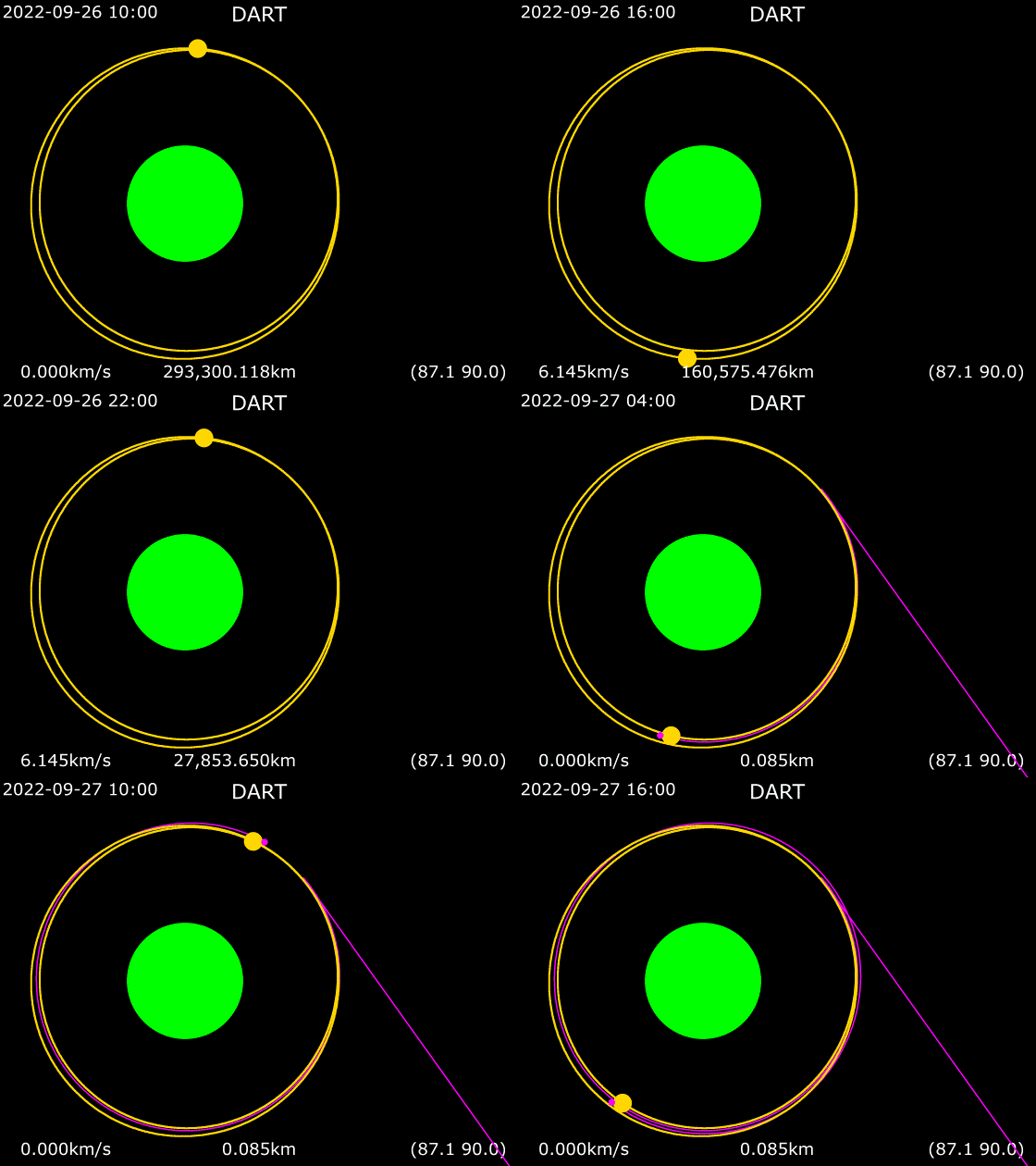
In September of 2022, DART made impact. Weighing in at over 1,000 pounds, the spacecraft’s collision with Dimorphos was as energetic as an explosion of over three tons of TNT. The mission was a success, making it the first time a human-made object has altered a celestial body’s path around the sun, but it would take more time to find out the magnitude of the success. Now, two years later, NASA scientists have calculated that DART’s collision with Dimorphos shortened the orbit of both asteroids by around 33 minutes.
Read more: “Here to Save the Day!”
“This is a tiny change to the orbit, but given enough time, even a tiny change can grow to a significant deflection,” NASA scientist Thomas Statler said in a statement. “The team’s amazingly precise measurement again validates kinetic impact as a technique for defending Earth against asteroid hazards and shows how a binary asteroid might be deflected by impacting just one member of the pair.”
In other words, we’re no longer defenseless against asteroids that could pose a threat to life on Earth, but we still need to identify them early enough to push them off course. That’s where the Near-Earth Object Surveyor comes in. Scheduled for launch in 2027, this space telescope will identify asteroids and comets that could impact our planet, including those that ground-based observation systems might miss.
We’re not as protected as we could be from cosmic annihilation, but it’s comforting to know we’re moving in the right direction. 
Enjoying Nautilus? Subscribe to our free newsletter.
Lead image: Triff / Shutterstock