The waters around Antarctica have suddenly and unexpectedly started getting saltier. This flips a decades-long trend of falling ocean salinity, which had protected southern sea ice against melting.
In the mid-1970s, early satellite imaging showed that massive holes were periodically forming in ice sheets, known as polynyas. One such recurring void—in the Weddell Sea’s ice sheet—got so big that it received a name, the Maud Rise polynya (named after an underwater mountain that rises beneath it). Sometimes this hole was larger than the entire state of California.
But in the intervening decades, the top layers of the Southern Ocean encircling Antarctica have been freshening—becoming less salty. This stratification has helped keep the upper levels of the water cooler, protecting the sea ice like a sort of aqueous shield from warmer, saltier waters below. Tremendous holes in the sea ice became smaller and less common, despite the warming planet. The Maud Rise polynya wasn’t seen again for nearly 40 years.
More recently, the Maud Rise polynya and compatriots have begun returning. Seabound robots and satellites have collected disturbing data: The protective pattern of fresh water at the top of the water column has suddenly switched. Saltier, warmer waters from below are now mixing at the surface, eating away at sea ice much faster.
“The return of the Maud Rise polynya signals just how unusual the current conditions are,” said Alessandro Silvano, an oceanographer from the University of Southampton who led the new research, in a statement. The study appears in the Proceedings of the National Academy of Sciences.
The findings flip certain climate assumptions on their heads. Most prior models anticipated that the strongly layered Southern Ocean pattern would continue, helping to protect the store of sea ice in the southern ocean, which is crucial for maintaining Earth’s climate as we know it. “Instead, a rapid reduction in sea ice—an important reflector of solar radiation—has occurred, potentially accelerating global warming,” said Aditya Narayanan, a co-author of the paper and postdoctoral research fellow also at the University of Southampton, in a statement.
It's still unclear why this protective trend has reversed.
The work, funded in large part by the European Space Agency, demonstrates how little we know about the complex workings of our planet’s dynamic, life-as-we-know-it-sustaining systems.
“If this salty, low-ice state continues,” Silvano said, “it could permanently reshape the Southern Ocean—and with it, the planet.” 
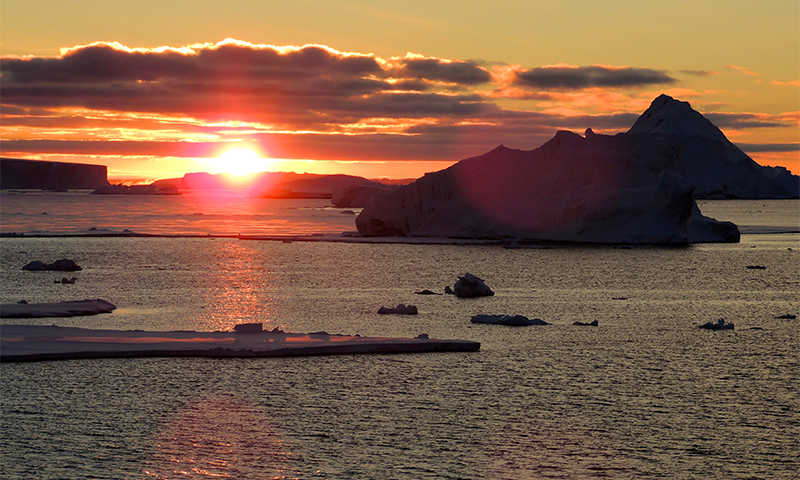
Lead photo courtesy of the University of Southampton