
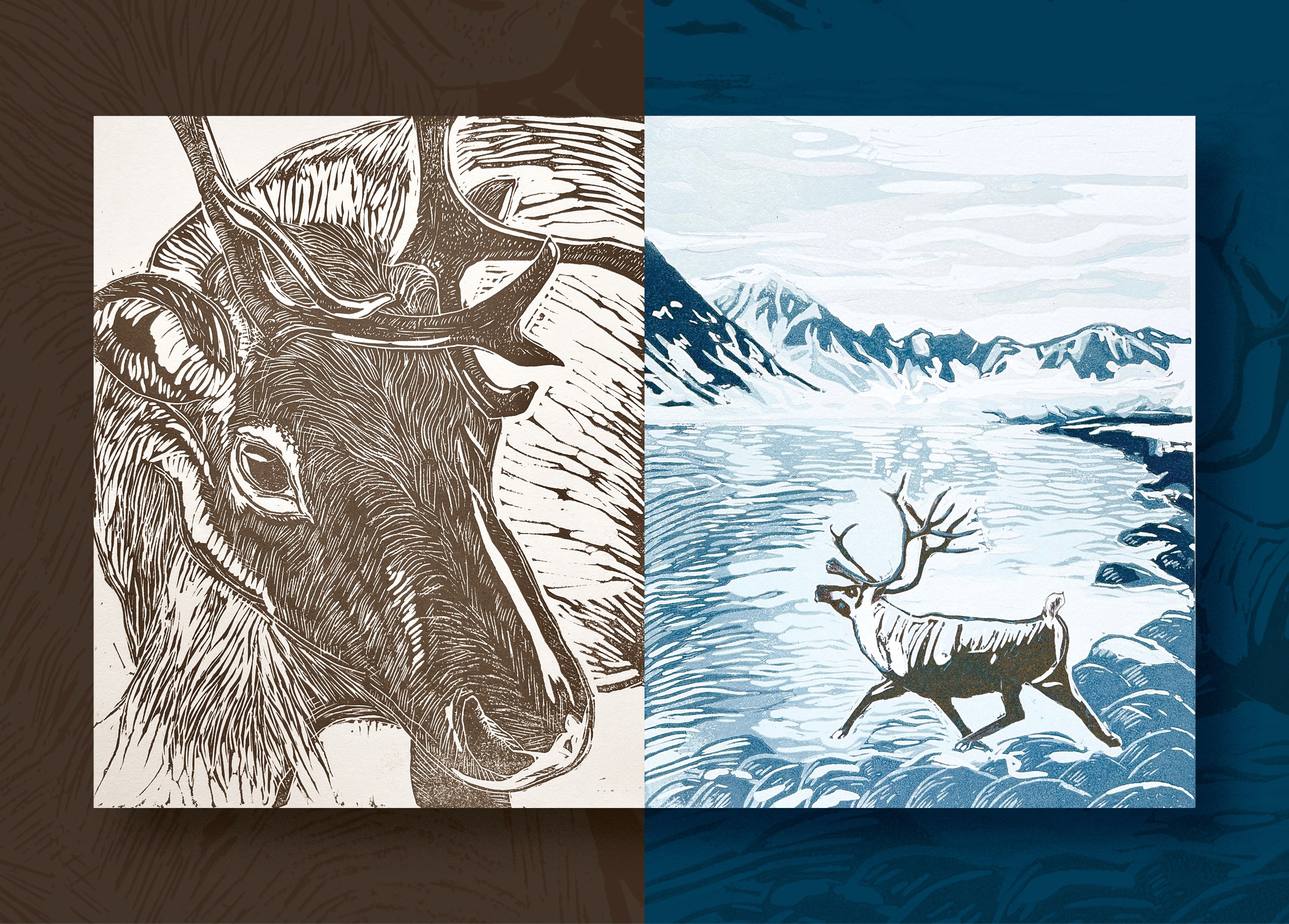
On my first afternoon in Arctic Svalbard in June 2024, two filmmakers in my guesthouse tell me that reindeer are just outside. I have flown halfway around the world to witness these reindeer, and here they are, under our window. I grab my binoculars and boots, walking into a sudden spring snowstorm to see a small herd of reindeer munching on the tundra.
These are not the majestic flying reindeer of Christmas cards. They are stocky, goat-sized, roly-poly survivors—evolutionary success stories that sparked the central questions of my journey: Why would reindeer come to this inhospitable archipelago where glaciers still cover more than 60 percent of the land? How did they transform their bodies and behaviors to thrive in one of Earth’s harshest environments? And as climate change warms Svalbard faster than almost anywhere on Earth, what hope do they have?
We often tell a simple story about Arctic wildlife: as the climate warms, cold-adapted animals disappear. Svalbard’s reindeer suggest a more hopeful and more complicated one. They are not passive victims of climate change. They explore new foods, shift their movements, pass knowledge to their young, and change their bodies over generations. They appear to have agency. And if that’s true, it changes what we might do to help them.
I spent a month on the archipelago, part of it aboard the three-masted Antigua with the Arctic Circle Residency, a floating gathering of artists, scientists, filmmakers, and journalists reflecting on climate and environmental futures. Before and after the residency, I stayed at Mary-Ann’s Polarrig, a funky guesthouse decorated with walrus penises and old mining photographs, where Polish glaciologists waited for the waves to calm and the daughter of a Chukchi reindeer herder staffed the front desk.
At first glance, Svalbard seems like a poor bet for any land mammal. The soil is thin and starved of nutrients, and the sparse browse can’t feed many mouths. In the brief summer that punctuates the winter darkness, reindeer roam through High Arctic valleys in small groups, grazing on grasses, forbs, and tiny willow shrubs in the few ice-free lowlands. Winter is particularly challenging. Polar bears and whales can dive beneath the pack ice to find food, but when the darkness comes, reindeer must crater through the snow for mosses and lichens.
Svalbard’s food web is pared down to the basics. Little auks fertilize the tundra with their droppings, reindeer eat the resulting vegetation, and when they die, Arctic foxes feast on the carcasses. With few predators, weather becomes the main variable shaping populations, which turns the archipelago into a natural laboratory for understanding climate impacts elsewhere.
Isolated for millennia, Svalbard reindeer face a climate paradox. Warming temperatures extend summer growing seasons, allowing reindeer to pack on more calories before winter. But although they double their fat during summer and subsist on those reserves for part of winter, eventually they must forage. If winter rain falls and freezes, ice can form a shell three feet thick over lichen. Reindeer hooves, evolved for cratering through snow, cannot pierce this frozen armor. Many starve. In poor years with winter rain, adult females who survive until spring weigh only around 103 pounds—less than some dogs. In winters without rain, they can weigh 126 pounds.
Reindeer have always survived the occasional rainy winter, often by miscarrying a pregnancy to save the mother. But two rainy winters in a row make survival precarious, and the effects ripple outward to voles, ptarmigan, and foxes.
On my third day, I climbed Sarkofagan, one of the mountains ringing Longyearbyen, Svalbard’s main settlement. Polar bears roam, so you must always hike with an armed guide. Mine was Maria, an Italian geologist finishing a master’s thesis on permafrost.
At the summit cairn, Maria pointed across the fjord to ancient shorelines etched nearly 260 feet above today’s coast, relics of an Arctic shaped by the chaotic transition between the most recent expansion of the ice and our current epoch, the Holocene. Around ten thousand years ago, vast ice sheets retreated, meltwater flooded the oceans, and ice-dammed lakes failed catastrophically, sending walls of water across the landscape. The Polish scientists waiting out the waves at my guesthouse have documented 134 glacial lake drainage events.
I asked Maria why reindeer might come to such a volatile place, and she shrugged. Rocks, she told me, change for predictable reasons, which is why she studies them. Mammals rarely follow laws, scientific or political.
What we do know comes from genetics and archaeology. Svalbard’s reindeer originated in what’s now Russia, and perhaps seven thousand years ago, some individuals crossed the 35 miles of the Kara Strait to Novaya Zemlya, the anvil-shaped archipelago curving into the Arctic Ocean. Some later trekked about 220 miles over pack ice to Franz Josef Land. When glaciers advanced thirteen hundred years ago, most of the reindeer died out, but a few migrated again, trekking roughly 160 miles across sea ice to Svalbard, where the Gulf Stream makes the climate slightly milder.
But could reindeer really cross that distance on pack ice? It seemed impossible, until in 1912, a hunter shot a Svalbard reindeer with an ivory gull’s foot tied to its left antler. This individual had walked over from Novaya Zemlya, where Indigenous Nenets herders marked their reindeer that particular way. The decorated reindeer proved reindeer could make the long crossing on pack ice. But it doesn’t explain why they made that journey.
Picture a reindeer in Russia thousands of years ago, on her annual migration north to the Kara Sea. She reaches the coast in May, her body heavy with a calf after seven and a half months of pregnancy. Behind her lie raging rivers swollen with snowmelt, their banks lined with the bodies of other females who drowned as they tried to swim across. Pack ice groans against the coastline, shifting in the spring Arctic winds. Cows who survived the initial journey browse the thawing tundra, pulling up tufts of grass. Males remain distant; females have kept their antlers throughout the winter to drive them away during calving season. Then, for reasons known only to her, one cow steps onto the pack ice. No certainty of food awaits her. Perhaps an island shimmers on the Kara Sea’s horizon, and something in her imagines, “That might be a good place to birth my calf.”
When I had met with reindeer ecologist Sam Dwinnell in a bustling Longyearbyen café the afternoon I arrived, I asked her as well: Why did reindeer come to Svalbard? Like Maria, she considered the question carefully before shrugging. Knowing a reindeer’s mind is all but impossible. Yet I can’t stop wondering: What compelled that reindeer to leave familiar tundra to cross hundreds of miles of treacherous ice? Why journey northward until you reached the fragile edge of an Arctic archipelago still largely glaciated? What prompted enough of her herd to follow that they reproduced and established themselves on the edge of a glacial wilderness?
Trees and people may provide part of the answer. About 10,300 years ago, extensive environmental changes rippled across northern Eurasia and forests expanded. Reindeer faced a dilemma: Adapt to forest life or flee to open tundra landscapes beyond the reach of trees and the human hunters who used forests for cover. Some populations adapted to become forest reindeer, herded by humans. But others apparently moved northward across the pack ice, seeking open tundra habitats.
Reindeer across the globe have been extraordinarily resilient to past climate changes. At the end of the last glacial maximum, as the glaciers retreated, reindeer chased the melting ice north, exploring new environments and expanding their range across the circumpolar north. Unlike most other Pleistocene megafauna, reindeer populations expanded in size at the end of the Pleistocene. Mobility was central to reindeer’s post-Pleistocene resilience.
Reindeer made human life across the Arctic possible as climates changed in the Late Pleistocene, letting people thrive in otherwise uninhabitable ecosystems. People followed the reindeer north in a warming world, and a striking diversity of human–reindeer relationships developed. But on Svalbard, no humans followed the reindeer. Archaeologists have searched for decades without finding a single trace of reindeer people—or other reindeer predators—so for millennia the reindeer evolved in the absence of predation.
Without predation, Svalbard reindeer rapidly developed new adaptations to a cold climate. Annual migrations shrank to a few miles, less than the average American commute. Reindeer’s physical form changed as well as their behaviors. Long legs and speed were less important than conservation of energy, and their bodies became rounder and capable of storing more fat, allowing them to double their weight during the brief summer months. Even their digestive systems transformed, with enlarged rumens that could process a wider variety of the tough plants growing at the edge of glaciers.
Those adaptations would be tested when European ships appeared on the horizon. Whalers arrived in the early 1600s, and crews needed fresh meat, so hunters were sent into the valleys to shoot calving reindeer, the first systematic predation pressure on Svalbard herds.
On the Antigua, we sailed north toward the pack ice, retracing the journeys of whalers. At four in the morning, the engines changed their sound, and when I dressed and went on deck, my compass read 80°20′ N. Pack ice surrounded us. A few hours later, I was painting on deck when Alex, one of the artists, shouted, “Bowhead whale!” We rushed to the railing. I’m not entirely sure I saw her, only a shadow sliding beneath the ice, but knowing she swam under our boat felt like a gift. She could be two hundred years old, a witness to transformations that reshaped this archipelago long before any of us were born, and her ancestors’ songs once tied the Arctic together before whaling emptied the waters along Svalbard’s coast.
Bowheads are the only baleen whale that spends its whole life in the Arctic. Like reindeer, they survived the warming at the end of the Ice Age by following habitat northward. The Dutch built an enormous shore station at Smeerensburg, “Blubber Town,” in 1619, hiring Basque harpooners to run it.
Our Zodiacs drifted across teal water that mirrored black rocks and blue-gray snowfields, and kittiwakes chattered on the icebergs, stark white against the darkening sky. Their grace filled me with joy: life persisting despite three centuries of extraction. Then we walked the beach on Danskøya, near the ruins, falling silent as we realized we were crossing a graveyard of whales and men. Our guide Lars pointed to a ring of red stones: blubber cement, the residue of kettles boiling over. Scraps of blubber were tossed in the fires to render the rest, so the whales fueled their own undoing.
By the end of the seventeenth century, over ten thousand whalers spent part of each year in Svalbard. The coastal bowhead population soon collapsed. Not all the whales died, however. Some seem to have learned from their relatives’ deaths, avoiding the fjords and swimming away from the coast, eventually settling in the northern ice where whalers couldn’t follow.
Later, from a cliff above a fjord, I watched little auks, birds no bigger than sparrows, stream overhead by the hundreds of thousands. They and the bowheads, it turns out, eat much the same food. Here is where the story takes an ecological twist I find hard to stop thinking about. A bowhead weighs five hundred thousand times more than a little auk, yet when the whales vanished from Svalbard’s coasts, the zooplankton they left behind fed a boom in little auks, with the northeast Atlantic population climbing by about 70 percent.
Little auks became ecosystem engineers, comparable to beavers in temperate zones. Where little auks congregate, their nutrient-rich guano creates lush patches of tundra that support reindeer. Those reindeer, in turn, modify the landscape further and provide carcasses that support Arctic foxes. Whaling’s devastation created unexpected ecological opportunities. This doesn’t justify the slaughter, but it does illustrate nature’s ability to reconfigure after disruption. It is an ecological paradox: a human action as devastating as commercial whaling ultimately helped sustain reindeer.
Whaling was only the first wave of European hunters. The Pomors, walrus hunters from Russia’s White Sea, arrived in the 1690s. They were the first Europeans to thrive through the polar night, and reindeer kept them alive: At one archaeological site, reindeer made up 68 percent of the bone fragments, against just 8 percent for walrus. They wore reindeer pelts, walked in boots of reindeer felt, and slept between reindeer furs.
The human dead of whaling and Pomor centuries lie all along the coast, in hand-built coffins lined with fabric, their heads cradled on pillows of cloth scraps stuffed with little auk feathers, buried as deep in the permafrost as their comrades could dig and weighted with cairns against the bears. It was as if the dead were to be kept warm in a world that was otherwise cold and uninviting.
The next wave of hunters were fur trappers, who were seeking out polar bears, foxes, and walrus for European markets. Like the Pomors, they rarely sold reindeer hides, but they relied upon their meat for winter survival. One of them was Wanny Woldstad, whose cabin we visited beneath a bird cliff near Hornsund. In 1932, she talked her way onto a winter crew and returned for five seasons, killing seventy-seven polar bears and countless foxes. Multiplied across Svalbard’s coasts, these hunting pressures devastated reindeer. Yet reindeer were not simply victims. They carried accumulated knowledge about where to calve safely, which valleys sheltered them from storms, how to find plants under deep snow. As predation pressures increased, reindeer retreated to valleys and heights that human hunters couldn’t reach.
And then came coal. John Monroe Longyear, an American who studied at what was then the Michigan College of Mines, founded the Arctic Coal Company in 1906 and built a company town that still bears his name. To feed growing mining communities, managers hired hunters to systematically target the reindeer herd that survived—a cheaper protein source than imported provisions. Miners wanted meat every day, so seasonal hunting shifted to year-round pressure, leaving the animals no respite even during calving. Previous waves of human exploitation—whaling, Pomor hunting, and fur trapping—had stressed Svalbard’s reindeer population, but industrial coal mining delivered a devastating blow.
In 1596, reindeer occupied virtually all unglaciated lands across the archipelago, as fossilized antlers show. When hunting was finally banned in 1925, only four isolated populations remained. For five decades, reindeer recovery was excruciatingly slow. In 1978, scientists tried active translocation, bringing three males and nine females from near Longyearbyen to Brøggerhalvøya, where a former mine was turned into the world’s northernmost research station. Reindeer had been absent from this area for more than a century. The translocation essentially created a controlled experiment: How would these animals fare in suitable habitat with no competition and no predators?
Despite Arctic desert conditions, the reindeer population exploded to 360 individuals in fifteen years. But during the winter of 1993–94, it crashed to just 78 animals. The cause was twofold: systematic overgrazing of preferred plant species and an extreme weather event that brought rain instead of snow. The year after the population crash, the surviving reindeer began to disperse to neighboring areas, becoming the source for those we saw grazing across much of the northwest coast. Their grazing, trampling, and fertilization altered vegetation communities, shifting them from moss-dominated to grass-dominated tundra. But forage alone doesn’t determine reindeer density; history does as well. Areas where reindeer had been extirpated a century earlier still show lower reindeer densities than expected based on vegetation productivity alone, suggesting that the legacies of overhunting persist in the ecosystem.
Having survived waves of human exploitation, Svalbard’s reindeer now face a threat that doesn’t target individuals but reshapes whole habitats. When winter rains fall and ice seals over lichens, some reindeer starve. Others have begun annual migrations again, heading to the coast, where they now feed on kelp—another climate migrant brought north by warming currents. Reindeer are adapting to rapidly changing conditions—just as they did thousands of years ago when they first ventured to these islands. And in doing so, they’re providing food for another mammal that had been expected to become extinct on Svalbard but is instead thriving.
On our way to the pack ice, a crew member cried, “Polar bear!” We crowded the railing and watched a massive male lope down a snowfield, bath in the sea, then stroll unhurried across the cobbles. We weren’t the only ones watching. Six reindeer paused their grazing to track his route.
Polar bears had rarely hunted reindeer in the past, because seals were abundant along the coastal pack ice and a much more rewarding morsel for a hungry bear. But now the coastal ice is dwindling, so polar bears can’t easily hunt seals. Our guide Audun explained to us that even though many news reports suggested Svalbard polar bears were starving and close to extinction, most were not. Instead, they were hunting the reindeer who had begun venturing down to the beaches to eat kelp. Neither eating kelp nor hunting reindeer is a sign of desperation; both are innovative responses that animals craft through exploratory feeding. Individual reindeer who venture to beaches and sample kelp may pass this knowledge on to others, particularly their calves. Polar bears who figure out how to surprise a reindeer are observed by their cubs, who learn new techniques. Both Svalbard reindeer and polar bears defy the catastrophic narratives we often construct about climate change. Behavioral plasticity—the capacity to innovate and share knowledge—may prove critical to their survival.
Reindeer around the globe speak to us not of untouched primordial wilderness but instead of the complex historical relationships between humans and reindeer that still influence modern conservation. Svalbard is far from pristine. The ground beneath one’s boots is layered with Nazi weather stations, whale bones, collapsed Pomor fox traps, and tangled fishing nets. And yet every day we witnessed resilience: kittiwakes rising and falling on the wind, little auks streaming to their colonies, pooping all the way, creating the lush pastures where reindeer flourish.
Svalbard reindeer are neither climate victims waiting for rescue nor relics to be frozen in place. They are participants in an ongoing story of adaptation that began long before we arrived and may continue long after our climate crisis has become another layer in the geological record.
In a world of constant movement and change, survival depends less on rigid boundaries than on the ability to migrate, adapt, and build relationships across difference. That means giving the animals room to move and to settle somewhere new, and being the kind of partners who listen when they show us where they want to go. 
Excerpted from Reindeer: A Tale of Nature and Survival in a Changing North (Yale University Press, 2026)
Enjoying Nautilus? Subscribe to our free newsletter.
Lead Image: Nancy Langston, original linocut print, 2025