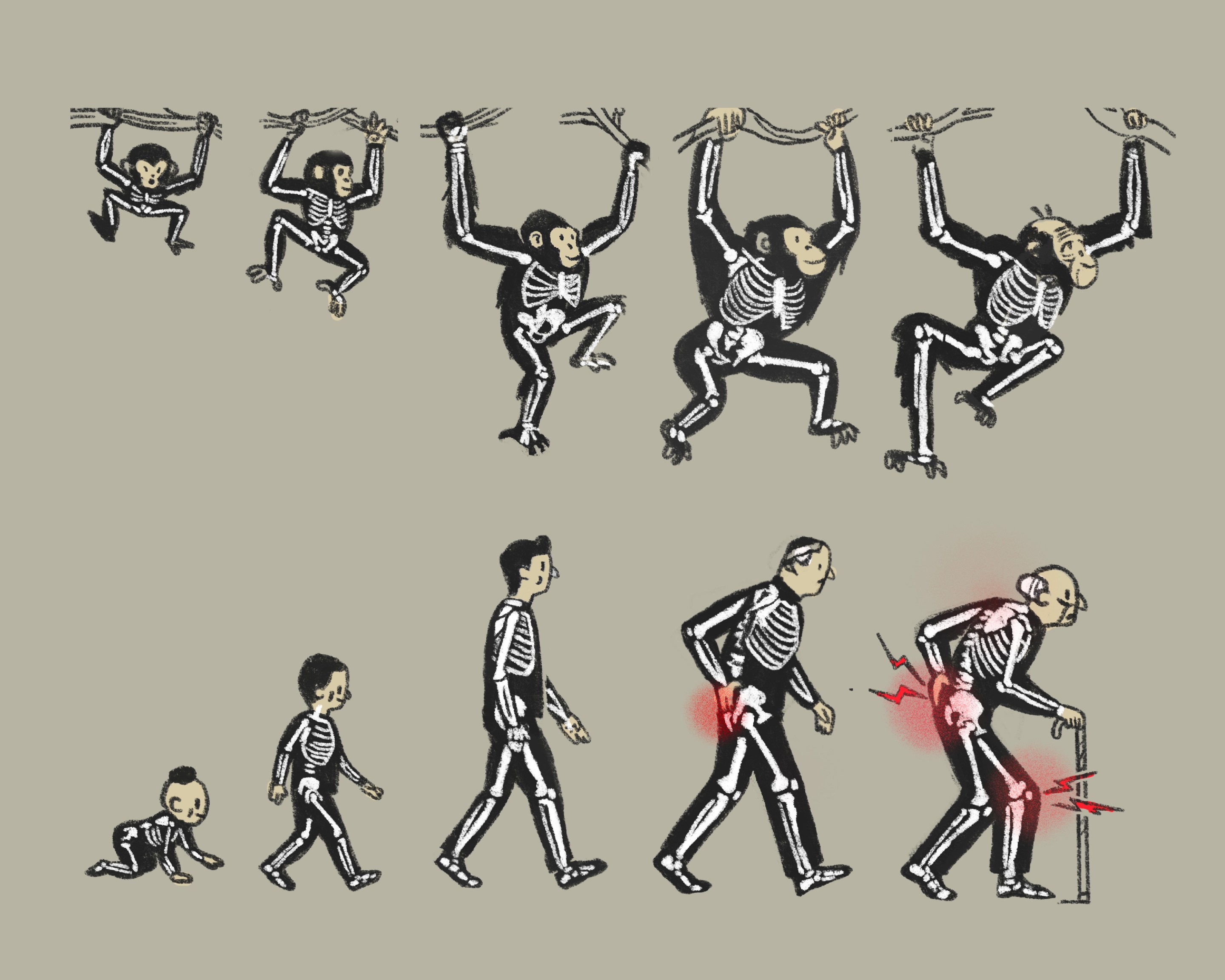
How are your knees doing? Do they crackle like a campfire when you get off the couch? Do they send sharp, nagging pains reminding you to sit down if you’ve been standing too long?
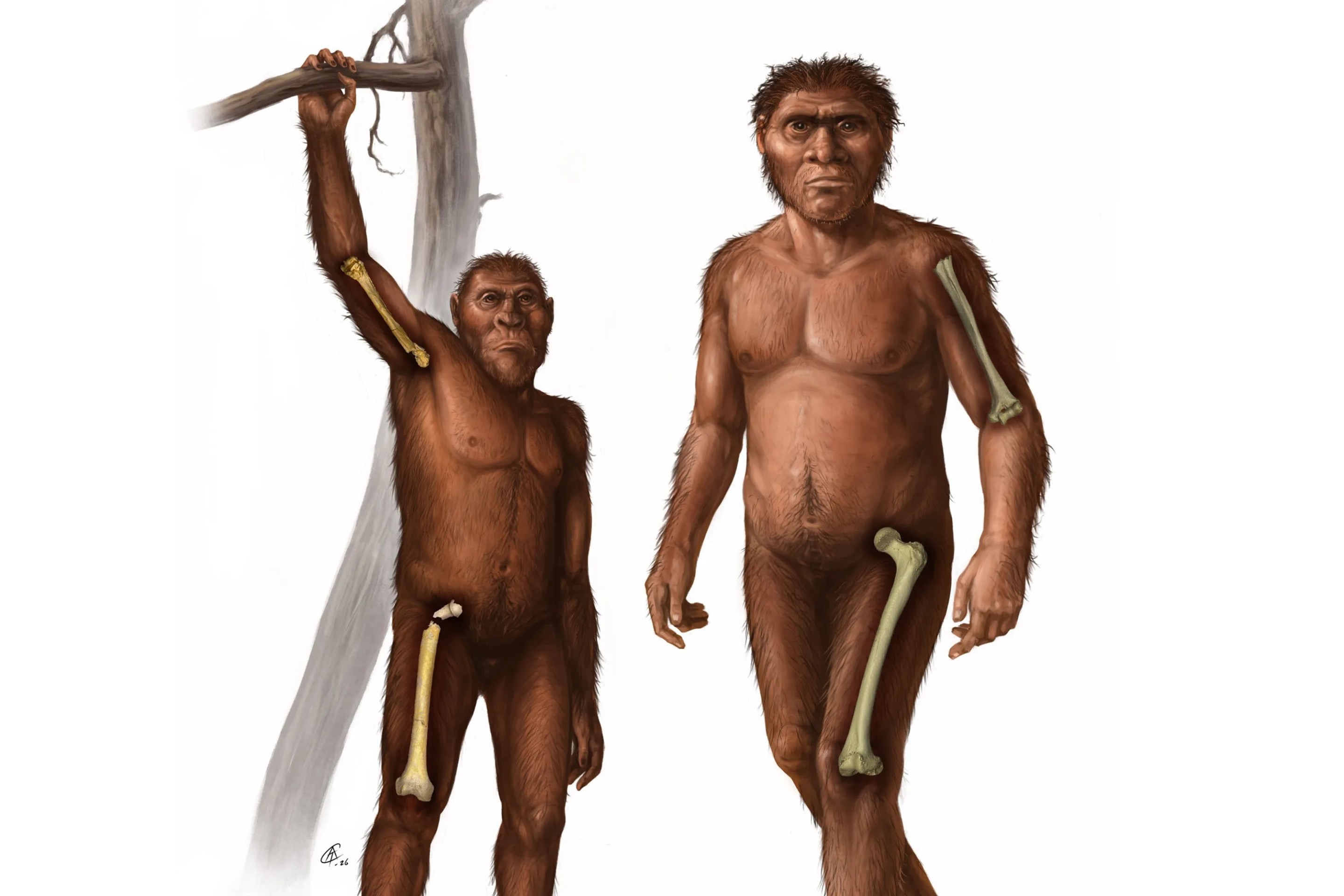
You’re not alone. For a species that evolved to spend so much time on our feet, we have remarkably poorly designed joints in our legs. Great apes, for example, don’t have the same knee problems, and according to a new study published in Nature, it’s got nothing to do with their arboreal lifestyle.
Read more: “Evolution Is Written in Our Joints”
“Unlike the joints of other great apes, whose composition hasn’t changed for millions of years, human joints underwent a dramatic evolutionary shift,” study author David Gokhman of the Weizmann Institute of Science explained in a statement. “That shift made our joints less effective at absorbing shocks and exposed us to skeletal diseases—including osteoarthritis, degeneration of the spinal discs, and herniated discs—that are uncommon in other great apes, including those that reach old age.”
For some reason, natural selection has blessed our species with the ability to walk upright but also cursed us with janky knees. To shed light on this baffling evolutionary conundrum, Gokhman and a team of fellow geneticists investigated the major genetic regulatory elements that contribute to the differences in our skeletons compared to our distant primate relatives using two different techniques.
The team attached genetic barcodes to more than 15,000 different DNA segments, which allowed them to figure out which parts of the genome are promoting or enhancing gene expression. They then created human-chimpanzee and human-gorilla stem cells. These hybrid cells include DNA from both great apes and humans coexisting side-by-side so the researchers could study them under the same conditions. Next, they chemically nudged the stem cells into transforming into skeletal cells so they could examine the differences in gene expression. The result was the first comprehensive atlas of how skeletal gene regulation differs between humans and great apes.
The biggest divergence they observed was in the production of tiny molecules called glycosaminoglycans (GAGs). These feathery polysaccharides consist of a strand with multiple negatively charged branches that attract water like molecular sponges. They’re present throughout the body (for example, they’re the molecules that make mucus mucousy), and they give cartilage its gel-like structure that helps absorb shocks.
“GAGs, along with the water they hold, make up most of the cartilage,” study author Nadav Mishol of the Weizmann Institute of Science explained. “Cartilage cells are like tiny islands floating in an ocean of GAGs filling the joint.”
It turns out there’s an entire group of GAG-producing genes that are less active in humans. A survey of cartilage samples from eight joints in different primate species revealed we have about a third to a quarter of the GAGs that gorillas, chimps, and orangutans have. The result is thinner, less springy cartilage and an increased predisposition to skeletal disorders.
“The drop in the production of GAGs is the most extreme genetic change our skeleton has undergone in the course of evolution,” Gokhman said. “We believe we’ve found an evolutionary basis for why humans are so vulnerable to osteoarthritis.”
Evolutionarily, it sure seems like a raw deal, so why did we get the short end of the GAG stick?
The team has a couple hypotheses. Great apes have more robust skeletons, with thicker bones compared to humans, and a reduction in GAG production could have contributed to our more gracile frames. Our relatively lighter bones may make us more adept at long-distance running compared to sprinting, which could have allowed us to outlast faster-moving prey.
The other possibility involves our magnificent brains. GAGs do more than just help cushion our cartilage, they’re also expressed in neural tissue, stabilizing connections, locking circuits in place, and preventing any rewiring. A global reduction in GAGs throughout our bodies may have made our brains more neuroplastic and better able to learn and adapt.
In other words, an investment in our information sponges may have come at the cost of our joint sponges. It’s something to think about while you’re icing your knees. 
Enjoying Nautilus? Subscribe to our free newsletter.
Lead Image: Itai Raveh