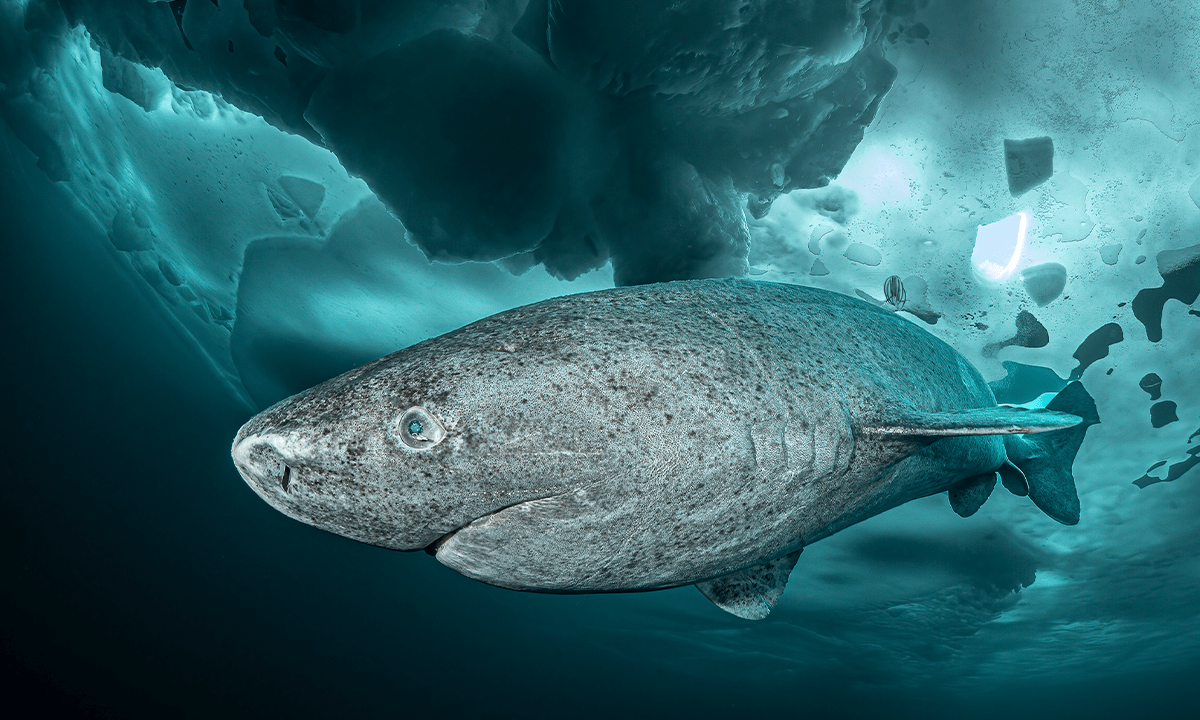
With a lifespan that pushes 500 years, the Greenland shark is the longest-living vertebrate we know of. That means there could be Greenland sharks alive today that swam in the waters Hernando de Soto sailed on his voyage to the Americas—just at much higher latitudes. These sharks also have massive genomes, which presents a conundrum: With so much genetic material, how do they evade the kinds of mutations that lead to cancer?
This counterintuitive situation could be a version of Peto’s paradox, according to geneticists who just published an analysis of the Greenland shark’s expansive genome in the Proceedings of the National Academy of Sciences. Named for the epidemiologist Richard Peto who first described it in 1977, Peto’s paradox observes that the incidence of cancer doesn’t rise with the number of cells a species has (that is, how large they are). For example, elephants and whales get cancer at much lower rates than humans, who have lower rates of cancer than mice.
But in their analysis of the Greenland shark genome, the researchers discovered another apparent paradox. The sharks have fewer genes from the families H2AC20 and HSPA8. The former are involved with reorganizing genetic material in chromosomes, and the latter help make sure proteins are folded correctly—both are typically associated with longevity.
Read more: “How These Long-Living Sharks Keep Sharp Vision for Centuries”
According to the researchers, the lack of these longevity genes could represent an adaptation to its ecological niche, the frigid northern oceans. In addition to living in glacial waters, Greenland sharks have glacial metabolic rates, too, and the researchers think the loss of these gene families—both involved in the logistics of gene expression—could point toward a model of “low-maintenance-cost longevity.”
Put simply, because they live slower, they’ve shifted their genomic control toward stability.
But that’s not all. Researchers also found an expansive set of genes associated with immune control, as well as ferroptosis, a mechanism of programmed cell death involved in tumor suppression. The Greenland shark’s “exceptional longevity,” the researchers wrote, “does not arise from a single genetic switch, but rather from a multi-layered genetic architecture shaped by coordinated evolutionary processes.”
In other words, it takes more than a few tricks to survive for half a millennium in the cold, unforgiving ocean. 
Enjoying Nautilus? Subscribe to our free newsletter.
Lead image: Lars von Ritter Zahony / Ocean Image Bank