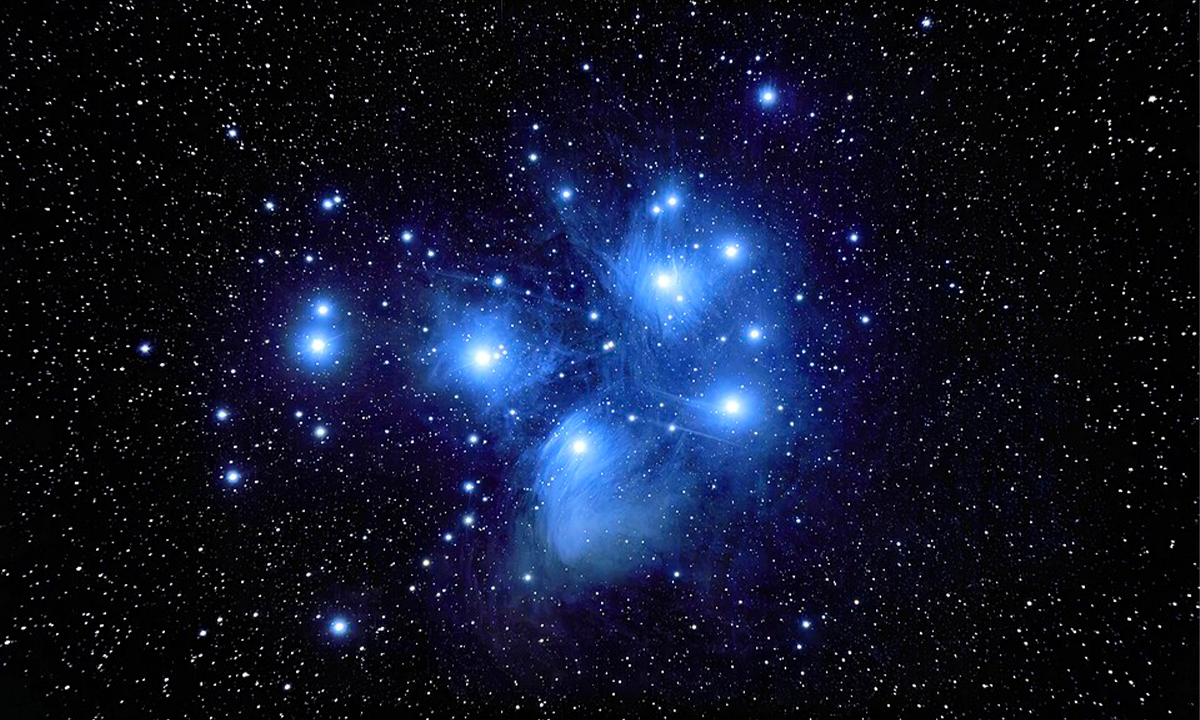
The Maori called them Matariki; to the Celts in Ireland they were Streoillín; their Hebrew name, Kimah, appears in the Bible multiple times. We call them by the same name the ancient Greeks did—the Pleiades, or “Seven Sisters”—a brilliant cluster of stars that captivated numerous cultures throughout antiquity. Now, thanks to new research published in The Astrophysical Journal, the sisterhood just got a lot bigger.
Around 440 light-years away, the Pleiades are just a short jaunt from Earth on an astronomical scale. They’re relatively young, too, formed when clouds of cosmic dust and gas collapsed during our planet’s Cretaceous Period only 120 million years ago. Following that event, scientists at the University of North Carolina and the Observatories of the Carnegie Institution for Science in California found Pleiades-associated stars spread much farther than previously thought. Altogether, there are more than 3,000 stars associated with the constellation spread out over 1,950 light-years.
Once they leave their stellar nursery, it can be difficult to determine where stars originated, but unlike the ancient stargazers, these scientists weren’t limited to terrestrial observations. Instead, the study authors relied on physical data on the motion of the stars from two spacecraft, NASA’s Transiting Exoplanet Survey Satellite (TESS) and the European Space Agency’s Gaia, as well as chemical information from the Sloan Digital Sky Survey (SDSS) to get a more complete idea of the stars’ origins.
Read more: “Star Siblings Tell Tales of Galactic Chaos”
“It was only by combining data from Gaia, TESS, and SDSS that we were able to confidently identify new members of the Pleiades. On their own, the data from each mission were insufficient to reveal the full extent of the structure,” co-author Andrew Boyle, a graduate student at the University of North Carolina, said in a statement. “But when we integrated them—linking stellar motions from Gaia, rotations from TESS, and chemistry from SDSS—a coherent picture emerged. It was like assembling a jigsaw puzzle, where each dataset provided a different piece of the larger puzzle.”
Thanks to this new research, we now have a new name for the Seven Sisters—the Greater Pleiades Complex. It’s a testament to what humanity can achieve when we keep our gaze fixed on the stars. 
Enjoying Nautilus? Subscribe to our free newsletter.
Lead image: KillarneyDiscovery / Wikimedia Commons