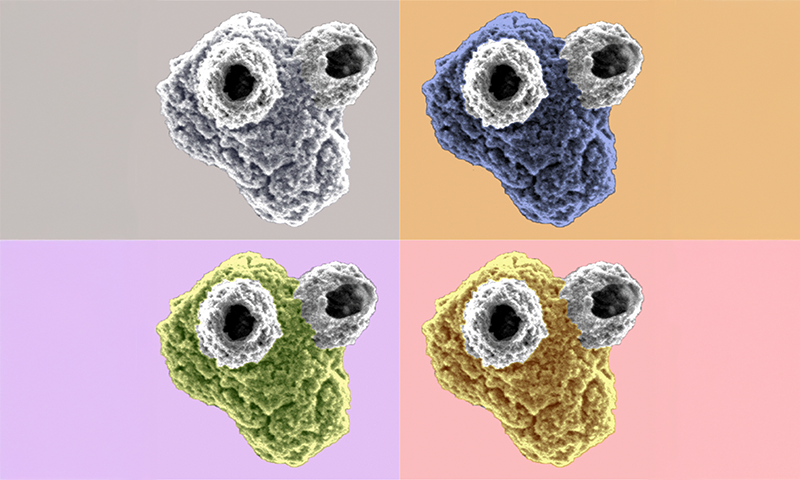
While this might look like an Andy Warhol portrait of a beloved Muppet, the Kermit-y resemblance is purely coincidental. You’re actually looking at what might become a key component of the brain-like computers of the future—and one of the winners of the Department of Energy’s recent Art of Science Image Contest.
“It was a cute surprise to see those eyeballs, two micrometers in diameter, staring back at me through the electron microscope,” materials scientist Donald Robinson of Sandia National Laboratories told Nautilus via email.
This “Kermit head” is composed of a battery material called ruthenium hexacyanoruthenate Prussian blue analog (RuPBA). Robinson and his colleagues, led by materials scientist Alec Talin, turned RuPBA into a memory device that mimics a synapse, the structure that enables our neurons to communicate.
This technology, called Electrochemical Random-Access Memory (ECRAM), can both store and crunch data—this cuts out the current need to shuttle information between memory and processing components, which could save time and energy as data centers proliferate around the world. ECRAM is capable of holding magnitudes more information than devices used in conventional computers by storing it within a spectrum of electrical conductivity, rather than the binary on-and-off states of our current transistors.
In this image, our frog friend was created by growing RuPBA via chemical reaction on a silicon wafer covered with gold electrodes—but Kermit defied the plan and cropped up on a part of the wafer that was gold-free. As seen in the four squares, RuPBA can shift from white to blue, yellow, or green, depending on how it’s tweaked in the lab. In the future, Robinson and his co-authors write, such a device could make its way into a brain-computer interface—these futuristic systems are being developed to help people living with paralysis speak and move, among other feats. 
Lead image: Donald Robinson