Paleontologists piece together ancient animals primarily from bones. The vast majority of the time, these animals’ soft tissues have dissolved and left no trace in the fossil record. And so, divining the morphology of an extinct creature is largely about assembling its skeleton, comparing the structure to modern relatives, and deducing its outward appearance.
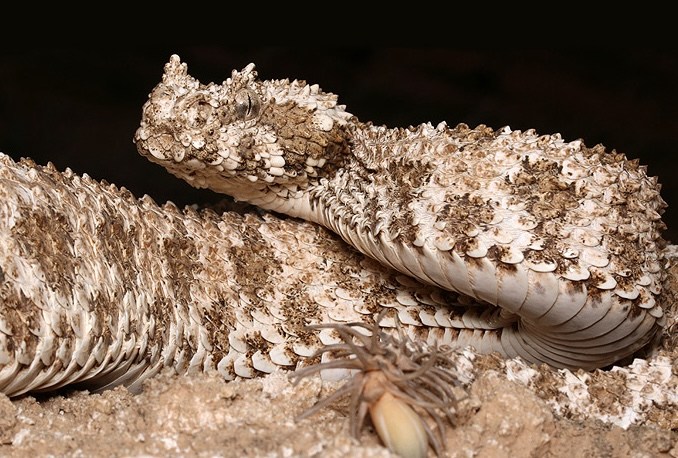
A paper published today in The Anatomical Record drives home the difficulty of ascertaining animal appearance in the absence of soft tissue. Led by the Polish Academy of Sciences, it documents the vertebral morphology of the unusual spider-tailed horned viper (Pseudocerastes urarachnoides).
Read more: “Why Snake Embryos Form in Spirals”
Recently discovered in Iran in 2006, the viper has a big, spiked knob on its tail that it can inflate to such an extent that the spikes end up looking like legs, seemingly to lure its prey. “I remember being a PhD student in about 2008 and first seeing the videos of this snake in the wild,” said Sara Ruane, senior author of the study and a herpetologist at the Field Museum in Chicago, in a press release. “The appendage at the end of its tail is so outrageous, I remember thinking it was so cool.”
Georgios Georgalis, lead author of the study and a paleontologist, aimed to get a closer look at the tip of the viper’s tail. In some other snakes, the vertebrae underlying the tail are unconventional, like the blunt vertebrae of a rubber boa that make its tail look like a head. As such, Georgalis expected to see unique vertebrae supporting the bulbous part of the horned viper tail. Instead, CT scans of a 1968 specimen housed at the Field Museum revealed a completely normal-looking tail morphology.
“There was nothing in the snake’s skeleton that would suggest how extreme its tail looks on the outside,” explained Georgalis.
In fact, the bulbousness resulted entirely from soft-tissue modifications. Once again then, the bones of an animal only tell part—the inside part—of the story. “It’s one of the, let’s say, frustrations of the life of a paleontologist,” said Georgalis. “We’re trying to put together puzzles with some of the pieces missing.” 
Enjoying Nautilus? Subscribe to our free newsletter.
Lead Image: Omid Mozaffari