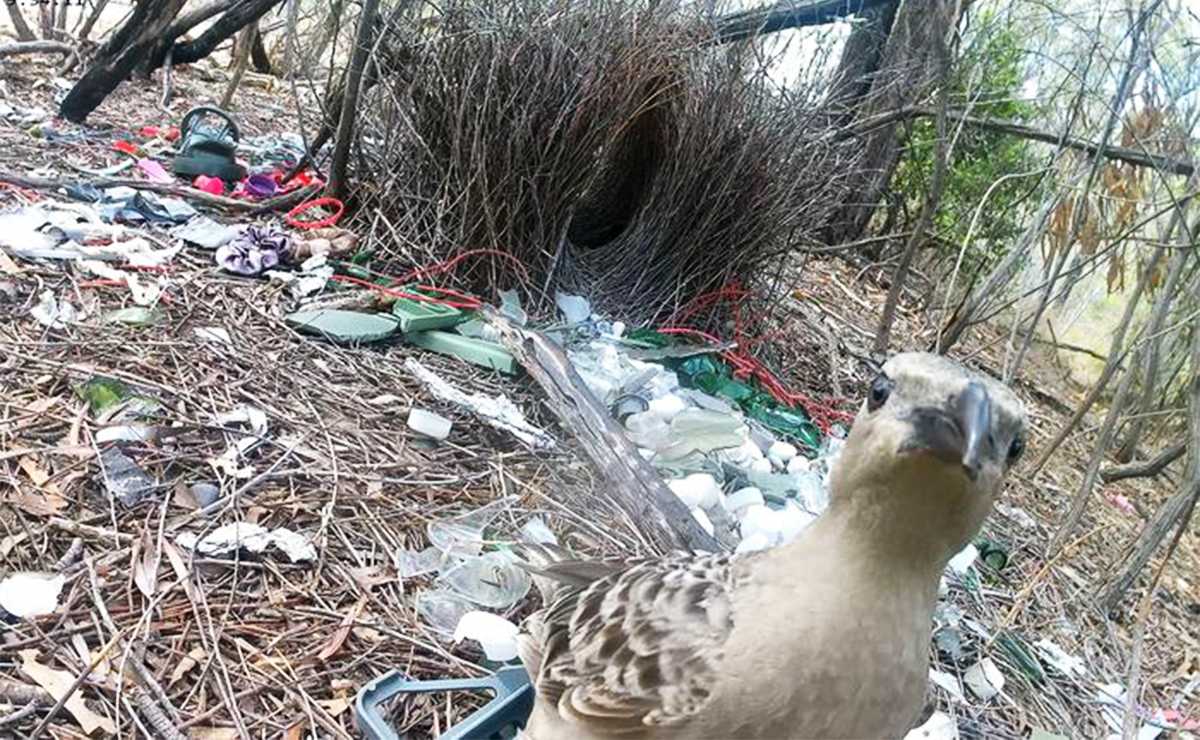
Bowerbirds are named for the elaborate structures the males build to charm would-be mates. Although they’re intricately woven from twigs, bowers aren’t nests. Instead, they’re ornate tunnel-like bachelor pads built to advertise a male bowerbird’s prowess. The birds spend hours embellishing the exterior with every eye-catching object they can find. Of course, the available decorations can differ quite a bit depending on the territory, and new research published in Royal Society Open Science shows how male bowerbirds’ environments affect their courtship strategy.
During the mating season, behavioral ecologists from Exeter University monitored the bowers of the great bowerbird at urban and rural sites in Queensland, Australia. For rural bowerbirds, the most common decorations were usually leaves, seeds, and the odd piece of green glass, which made for a more rustic display compared to their cosmopolitan counterparts. City bowerbirds had a kaleidoscope of refuse to choose from, and adorned their bowers accordingly.
Read more: “Why Females Decide What’s Beautiful”
“Glass, plastic, and wire were common choices, but we also found items including a pair of handcuffs, medicine jars at bowers near a hospital, and fluorescent mouth guards from a site near an Australian Rules football ground,” study author Caitlin Evans said in a statement.
The researchers also found that urban bowerbirds collected more objects, around 90 on average, compared to the minimalist rural bowerbirds, who gathered around 20. The two populations also showed clear color preferences, with city birds opting for bright red decorations and their country cousins choosing green.
But do these contrasting design choices reflect the birds’ preferences or merely their surroundings?
To find out, the researchers conducted a simple experiment. They randomly selected 10 objects from rural bowers and 10 from urban bowers and let birds from both groups pick their favorites. Both urban and rural bower birds showed a strong preference for human-made items.
This preference for garbage, the researchers say, has the potential to put bowerbirds at risk, both from entanglement injury and ingestion. On the other hand, because human-made items tend to last longer, incorporating them could afford the birds more time to tend to their bowers.
“We don’t yet know whether this has any negative or positive impact on them, but it’s a reminder of how human activity is changing the natural world in unanticipated ways,” Evans said.
One man’s trash is another bird’s treasure. 
Enjoying Nautilus? Subscribe to our free newsletter.
Lead image: Caitlin Evans