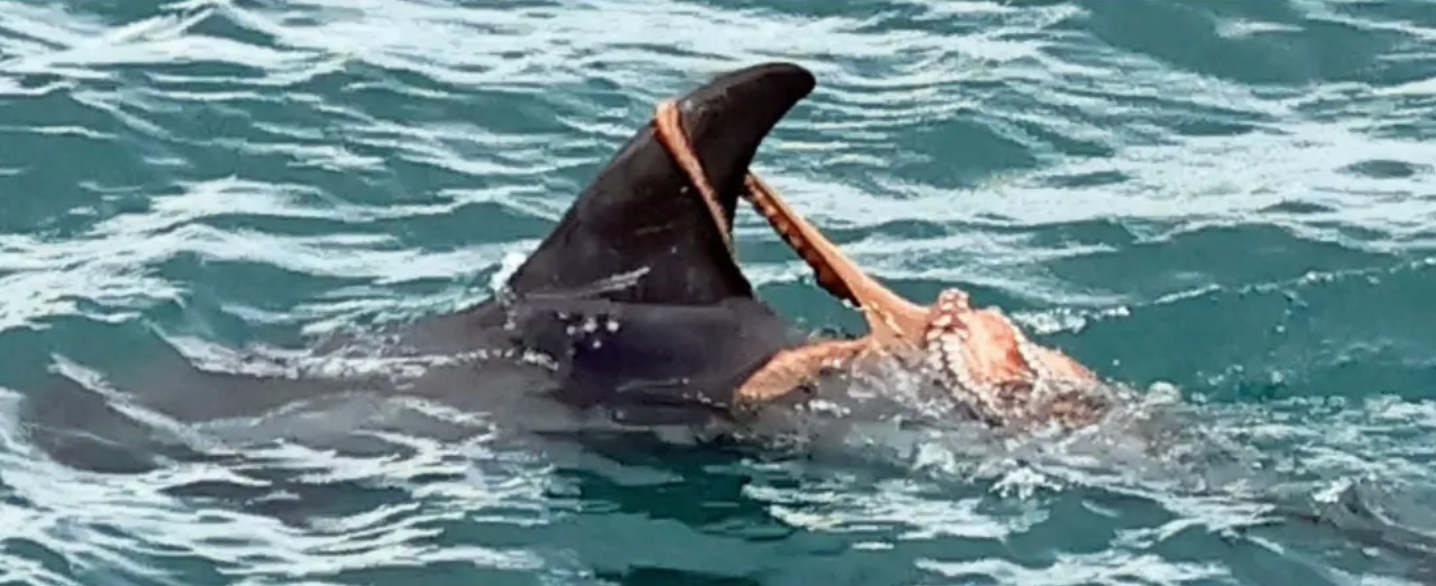
It’s a sight you don’t see often, or ever: a common octopus (Octopus vulgaris) apparently hitching a ride on the back of a Risso’s dolphin (Grampus griseus) by clinging onto its fin.
The photo was taken off the coast of the U.K. by Bill Coulson from the citizen science initiative Risso’s Dolphin Project.
We don’t know what this unusual interaction means, but we do know that warming waters around this part of the southwest coast of England are leading to a bloom in octopuses. While Risso’s dolphins usually feed on squid, they’re quite partial to octopus as well, and so the interaction captured here is unlikely to be a friendly one (don’t expect a Pixar adaptation).
Dolphins usually spend their time in deeper waters further from the coast, but experts think the abundance of octopuses—a marine animal that lives much closer to the shore—might be tempting the Risso’s dolphins to new feeding grounds.
Read more: “Dolphins Eavesdrop on Their Prey—and Each Other”
“These photographs offer a fascinating glimpse into the feeding ecology of Risso’s dolphins and the changing marine environment around our coasts,” the University of Exeter’s Josh Symes said in a statement. “Risso’s dolphins are closely associated with cephalopods, and sightings like this help us understand how they’re responding to changing prey availability.”
Symes is part of a team investigating the octopus bloom—the biggest in 75 years—which not only provides extra food for dolphins, but also threatens the crabs, lobsters, and scallops that the cephalopods feed on. It’s believed that the creatures have moved from breeding grounds in the Channel Islands and northern France, encouraged by warming temperatures at higher latitudes.
Work is continuing to better understand how these shifts are impacting the marine ecosystem as a whole, and scientists need as many photographs and data points as possible to get a full picture. In fact, contributions to the project are often posted to its Instagram page. “The images also highlight the value of citizen science, as observations from volunteers are helping us build a clearer picture of marine wildlife across the southwest,” Symes said.
In other words, any evidence of dolphin or octopus activity is useful—whether they’re locked together in an unusual embrace or not. 
Enjoying Nautilus? Subscribe to our free newsletter.
Lead Image: Risso’s Dolphin Project South West