
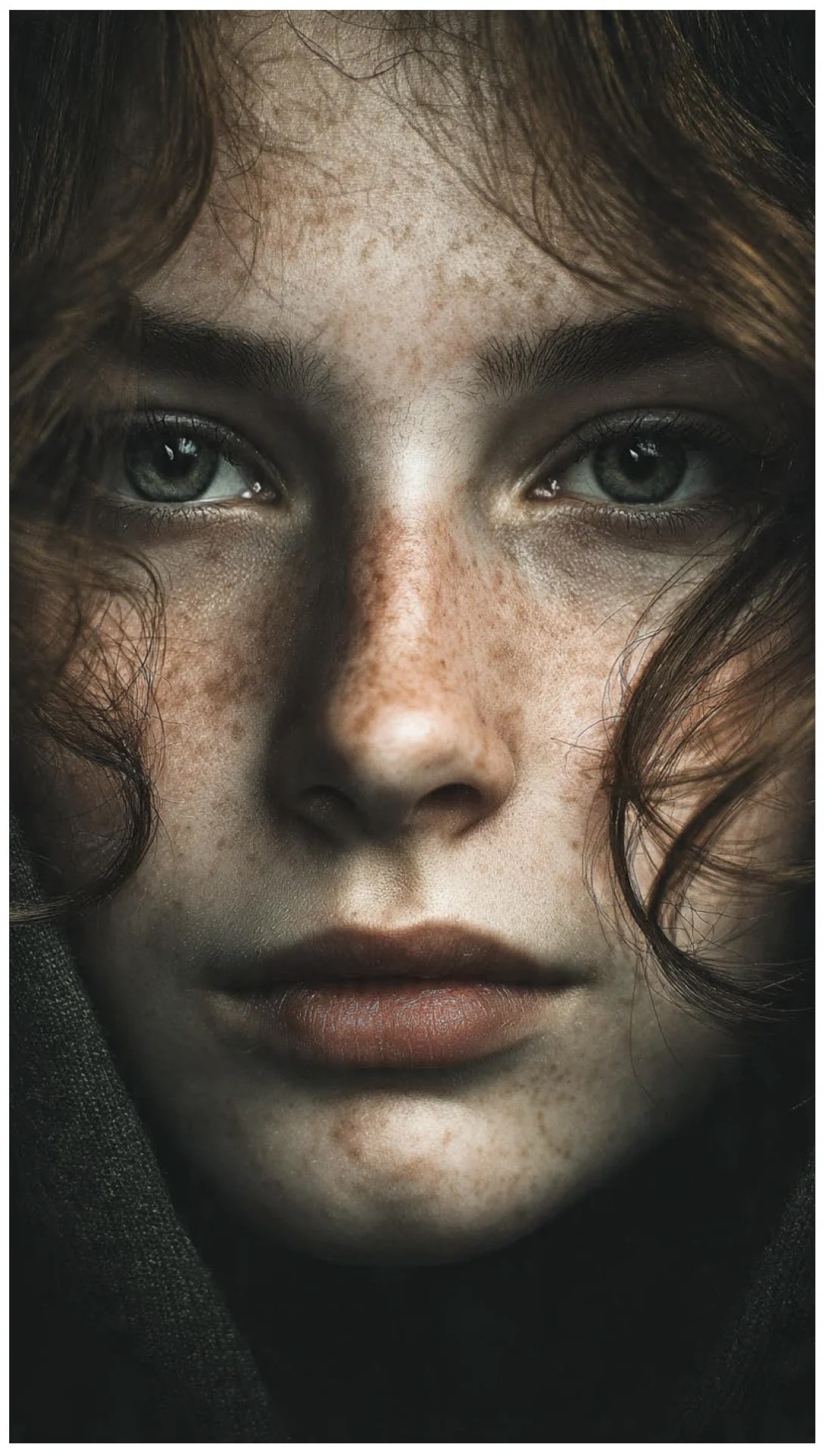
Framed by long, crisp eyelashes, her grey-blue eyes gleam out from underneath defined eyebrows. Locks of auburn hair fringe her face like curtains as freckles stretch across flawless skin and adorn a delicate snub nose. Full, pouted lips give her a defiant expression. The most striking thing about this model-worthy image, though, is that it was generated entirely by artificial intelligence— and in response to the prompt “young ugly female face.”
In fact, this was among 50 AI-generated female faces that recently won a beauty contest against 50 photos of real human models, even though the AI image generators had never been asked to generate attractive features. In an experiment published this April, three plastic surgeons—who weren’t told that the dataset contained AI-generated images, although they told the study leaders that they suspected as much—gave the fake faces an average of 7.8 on a 10-point attractiveness scale. By contrast, actual, human models scored 6.9 on average.
Read more: “Beauty Is Physics’ Secret Weapon”
In study after study, published this year, people consistently find AI-generated faces more appealing than real ones. Scientists are now trying to understand AI’s strange affinity for beauty and its societal consequences. As such images become increasingly widespread across social media, advertisement, and adult entertainment, they could influence how people interact with AI-created personas as well, raising the bar for human beauty standards and shaping how we judge our own and other people’s appearances.
Research on beauty image filters has long illustrated the damaging effects of unrealistic beauty standards, especially for girls and young women, worsening their body image, self-esteem, and mental health. But while image filters tweak real, biological features, AI doesn’t have such constraints, creating an even less achievable aesthetic ideal. “If it’s unattainable, it’s unrealistic, but it’s all over social media,” says Nitzan Kenig, a plastic surgeon and AI researcher at CEU Luis Belda University in Mallorca, Spain, who led the experiment with plastic surgeons. “We’re creating even more unrealistic beauty standards for generations of younger people.”
AI image generators don’t have an intrinsic understanding of beauty, so why do they gravitate towards producing faces that humans perceive as attractive? To start with, says computational sociologist AJ Alvero of Cornell University, the AI models are largely trained on images from the internet, which already represents an unusually attractive subset of human faces, as people selectively upload appealing photos, and attractive people are more likely to be photographed, mainly for marketing purposes.
Another possible reason for the uncanny attractiveness of AI-generated faces is that, as AI models learn what a human looks like, they’re essentially combining features that are most common across all of the faces they’ve been trained on. So in contrast to real faces—which have distinctive and unique constellations of features created by the random recombination of genes—AI-generated faces look more average and prototypical. As a result, they look more familiar, a characteristic that correlates with attractiveness, explains neuroscientist Alice Mado Proverbio of the University of Milano-Bicocca in Italy.
Human input may also play a role in pushing AI faces closer to a broadly shared ideal of attractiveness, Alvero adds. As human evaluators gave feedback to the initial outputs of AI models during their training, they may have—intentionally or not—encouraged the generation of faces that reflect western beauty standards.
The eerie beauty of AI-generated faces could affect not only beauty standards and self-esteem, but also how we perceive AI-generated personas. In general, people deem attractive faces to be more trustworthy, and research published early this year suggests that female university students are more likely to build deeper relationships with attractive AI agents. Proverbio suspects that the appeal of AI-generated faces may make it harder for people to tell they’re fake, potentially making users more vulnerable to believing AI-created deepfakes or scams. Proverbio and her colleagues published a study in June that assessed how people responded to AI-generated faces. The researchers reported that participants correctly identified AI-created faces as fake only 33 percent of the time, while they identified 62 percent of real faces as real. “Faces are central to how we form impressions of other people,” Proverbio says. “If artificial faces seem especially familiar, appealing, or trustworthy, they may influence our judgments before we have consciously evaluated their authenticity.”
Importantly, artificial faces may also influence how harshly people—especially young people—judge their own, natural appearance. No one single feature makes AI-generated faces so unattainably attractive, though they tend to be slimmer and more symmetrical, while having flawless skin, strong cheekbones, and unusual patterns of spacing between the eyes. Rather, it’s how these characteristics combine to produce faces that are more prototypical. “What is really unattainable is the frequency in which all these features come together,” Kenig says. “It’s just hard to believe that so many real humans would have these features at the same time.”
“If highly polished, prototypical faces become increasingly common in the images people encounter, distinctive features and ordinary imperfections may come to seem less desirable by comparison,” Proverbio adds.
A new, AI-generated beauty standard could even have direct physical consequences: Plastic surgeons, including Kenig, increasingly report young people coming to consultations with AI chatbot-created recommendations for desired features, like smoother skin or improved symmetry. Though in Kenig’s view, this isn’t necessarily dangerous—and can even help patients think through reasonable cosmetic changes—AI-generated images can also risk creating unrealistic notions of what’s possible in plastic surgery.
The rise of AI-generated faces could also influence how people judge one another. A preprint recently published by Alvero and his colleagues reported that people shown AI-generated faces not only deem them to be more trustworthy than real ones, the images caused people to downgrade how trustworthy they judged real humans presented in photos to be.
In the study, which has not yet been peer-reviewed, 570 mock recruiters were shown job applicant profiles paired with photos, some of them AI-generated some of them real. If the recruiters saw a profile with an AI-generated face, they subsequently rated the real-photo candidates 0.15 points lower on hireability, 0.17 points lower on trustworthiness, and were less likely to advance them to an interview. While it remains to be seen if this finding and the bias it suggests applies to real world settings, it shows how exposure to AI-generated images can shape our perceptions of one another.
And the well-documented racial and gender biases of AI show up in the realm of beauty as well. Alvero found in a different experiment associated with the same study that, in line with western hierarchies of beauty that tend to discriminate against non -Caucasian ethnicities, participants ranked AI-generated Caucasian faces to be more attractive than AI faces of other ethnicities. And male participants rated AI-generated female faces as significantly more attractive than women rated male AI faces. “The racial and gendered beauty hierarchies that people have long studied are being totally reproduced at a massive scale with AI,” Alvero says.
Potentially, things can be done to mitigate these effects, including labeling AI-generated images as such, raising awareness around these biases, and encouraging young people to reduce their screen time or exposure to social media. But in a world where AI-generated images continue to inundate the media around us, Alvero worries about the future of young people—his 7-month-old daughter included—and their development, self-esteem and abilities to discover and celebrate their unique identities. “I really worry about that for her as she’s growing up,” he says. 
Enjoying Nautilus? Subscribe to our free newsletter.
Lead Image: rom Kenig N., et al. Facial Beauty According to AI: Algorithmic Aesthetics and the Transformation of Contemporary Beauty. J. Interdiscip. Res. Appl. Med. 2026