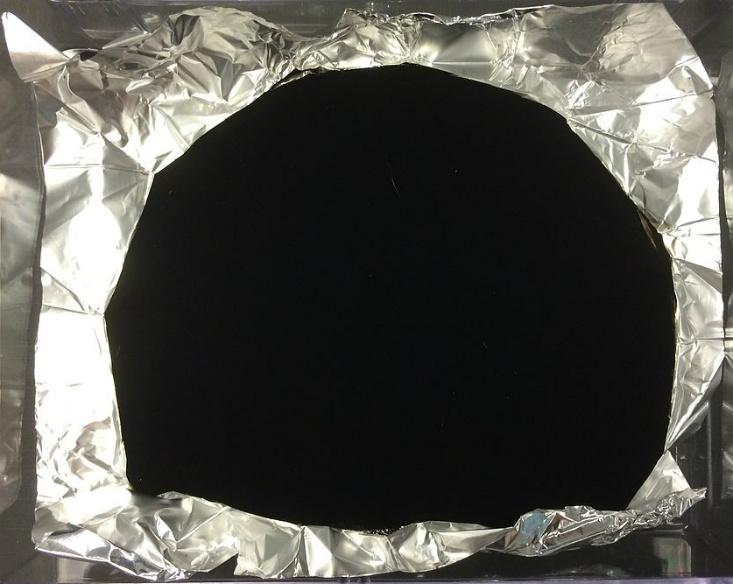
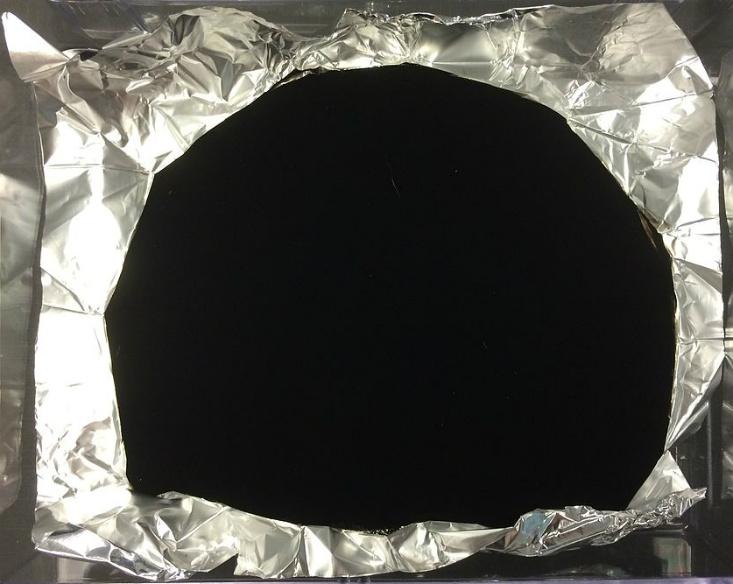
Color is such a powerful and evocative sensation—one of the first that we learn to describe as children—that we don’t often think about what it really is. In a sense, color is information: It’s whatever light isn’t absorbed by an apple, a leaf, or a page, reflected into your eye. What we call the color of an object is just whatever wavelengths of light it doesn’t soak up, rocketing into our corneas and telling us something about its properties. Most things, even things that are very dark, still reflect back some light, imparting useful information. You can see creases even in the blackest velour.
But a material called Vantablack, being refined in labs now, , traps light so completely that practically none escapes. The substance captures a full 99.96 percent of the light that hits it, which the human visual system perceives as deep, textureless blackness. Even when it’s applied to aluminum foil and then wrinkled, the part covered with Vantablack looks just as flat as can be, with no discernable silvery creases. It’s eerie, to have the physical world line up so poorly with expectations. It’s also potentially very valuable—making it look like there’s nothing where there’s really something is a long-time goal for defense departments.
Concealing spy planes or stealthy warplanes isn’t the only potential application, though it’s one that certainly seizes the imagination. Coating infrared detectors with black—that is to say, extremely light-absorbent—materials makes them more sensitive, because they can pick up on even very small changes in the radiation that strikes them. The black coating has got to transmit that energy very efficiently, as well, so it gets through the coating to the actual detector with a minimum of waste and fuss, and Vantablack gets high marks there as well. For a while it was only possible to use it on substances that the carbon nanotubes could be coaxed into growing on. (“Vantablack” stands for “vertically aligned carbon nanotube arrays.”) But in 2012 researchers reported that they had figured out a way to transplant a pre-grown nanotube forest to other substances, a step forward in making Vantablack as versatile as more traditional, spray-on black coatings.
For the purposes of disguise, Vantablack would of course be limited to night-time use. (A black, plane-shaped hole in the sky would be, um, noticeable.) A material that could change hues to blend in almost instantaneously with its environment, like the skin of color-changing cephalopods—squids, cuttlefish, and octopuses—would be far more versatile. And this week, in fact, some researchers reported on a material inspired by cephalopods that can change color when light passes over it. It’s a far cry from real squid skin, which contains molecules also found in the cornea that may help the skin sense color without needing to involve the nervous system. And the more simple version made by engineers is an early-stage experiment, far from any practical use. But it’s exciting to see humans taking steps toward imitating such beautifully evolved camouflage.
Vantablack is farther along in its development, and a company called Surrey NanoSystems announced, at an industry expo last month, that it will soon begin scaling up production for industry. In their release, the company writes that they expect to use the coating to help shield telescopes from stray light that makes it harder to see distant stars, among other uses. As people line up to use this extremely black substance, it’s unexpected proof that nothingness can at times be just as useful as something.
Veronique Greenwood is a former staff writer at DISCOVER Magazine. Her work has appeared in Scientific American, Popular Science, and the sites of Time, The Atlantic, and The New Yorker. Follow her on Twitter here.