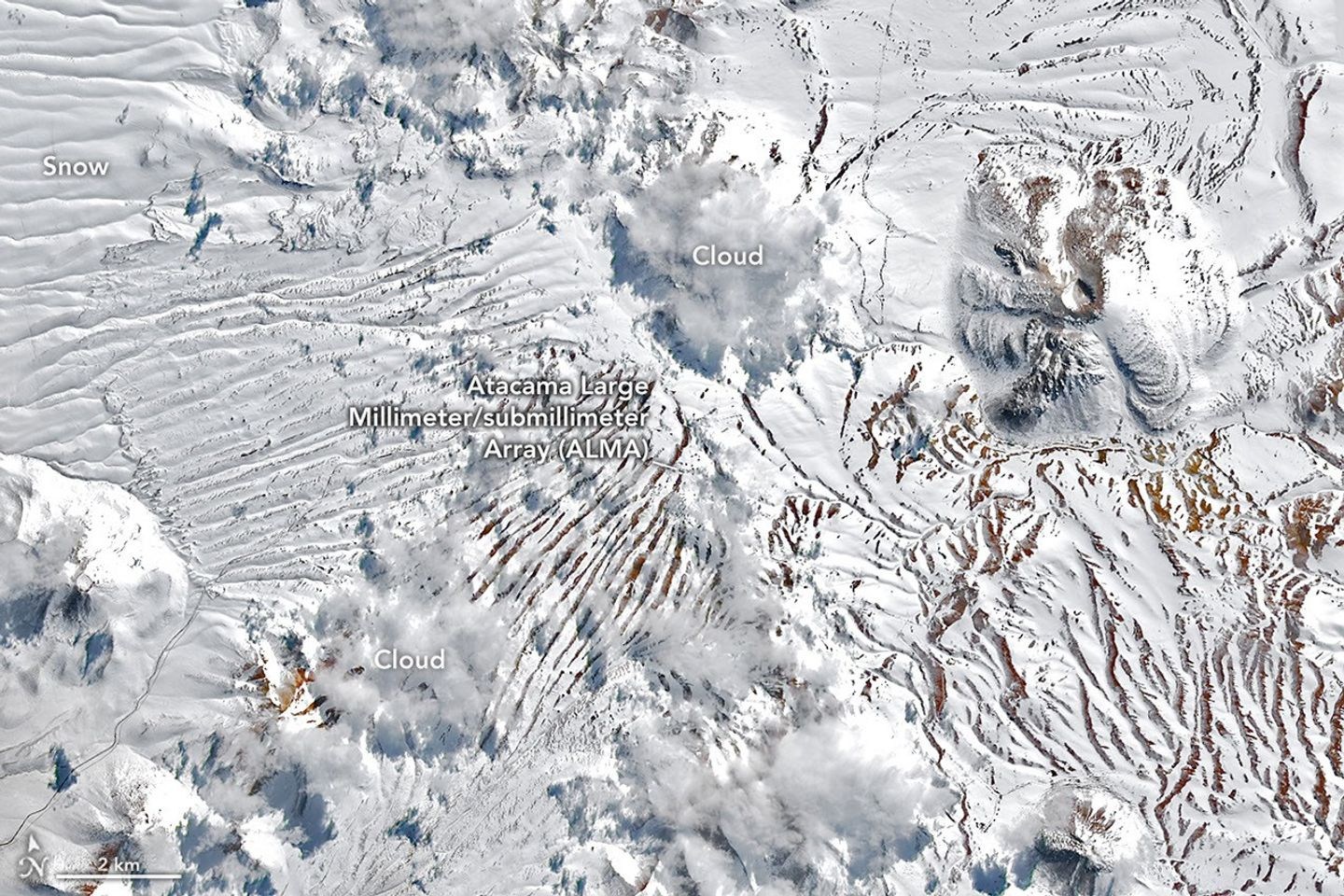
The Atacama Desert in northern Chile isn’t a complete stranger to snowfall, but it’s rare you see this kind of snowfall.
As captured by the NASA Landsat 8, Landsat 9, and Terra satellites, the snow is actually the result of two recent storms just days apart. On the ground, the meteorological disruption was enough to temporarily shutter the powerful Atacama Large Millimeter/submillimeter Array (ALMA) radio telescope, which switched to a protective survival mode on the Chajnantor Plateau.
The snow cover stretched from the Andes Mountains to the Pacific coast. Some areas got rain rather than snow, with the city of Taltal experiencing almost 1.6 inches of rain across three days—or 10 times the annual mean rainfall.
The Atacama Desert would normally expect to only see around 0.6 inches per year. In fact, it’s considered the driest non-polar desert in the world, with fog supplying much of the moisture that the animals and plants there need to survive. (For context, the driest parts of the Sahara get about 0.8 inches per year.)
Precipitation in the region is triggered by “cutoff lows,” or low-pressure systems that break away from the jet stream winds to the south, leaving drifting areas of cold air on top of warm air that then generate rain and snow. This time, the cutoff low came from a particularly large trough of low atmospheric pressure, which led to the extended snowfall.
Read more: “This Paradoxical Desert Landscape Is Filled with Fresh Water”
There’s evidence of climate change here too. A stronger El Niño system in the Pacific has nudged storm systems closer to Chile, leading to abnormal levels of rainfall that triggered destructive mudflows and flash floods.
The same scenario brought snow to the Atacama last year as well. Before that, it hadn’t been found in the region since 2011. “We see these kinds of events only a few times, if any, per decade,” said René Garreaud, an atmospheric scientist at the University of Chile, in a statement.
It’s a veritable winter wonderland—in a desert. 
Enjoying Nautilus? Subscribe to our free newsletter.
Lead Image: Lauren Dauphin / NASA Earth Observatory