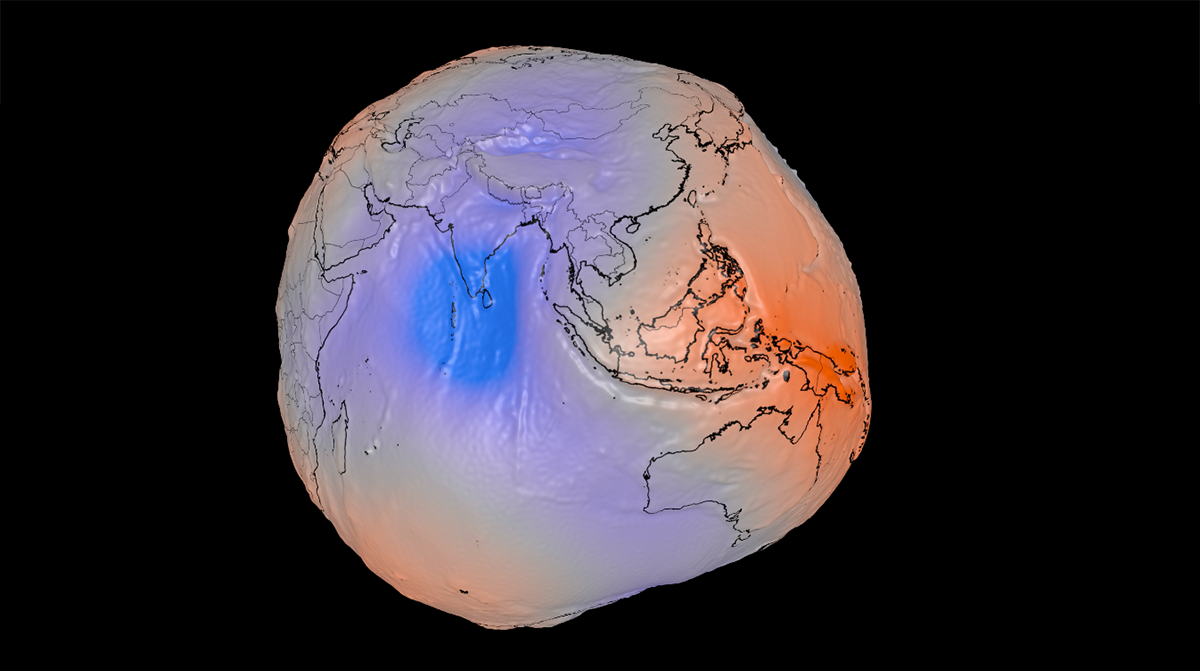
As the crew of Apollo 17 zoomed toward the moon, they looked back and snapped a photo of home. That image, the famed “Blue Marble” photo, shows Earth from the South Pole to the Mediterranean Sea, in all its spherical glory. Now NASA has released a new image of our planet, and let’s just say it’s not as aesthetically pleasing.
If you’re thinking to yourself, “that’s not what Earth looks like!!!” you’re right (so calm down). It’s not a photo, it’s an image of what Earth’s gravitational field looks like, compiled from more than a billion observations from 19 satellites (and exaggerated by a factor of 10,000 for effect). If you were somehow able to fill all the fissures and trenches with spackle and sand down the mountains, this is the (again, exaggerated) shape the ocean would take.
Why is it so lumpy? Because Earth’s gravitational field fluctuates slightly depending where you are on the surface. In some places, like Iceland, the tug of gravity is a tiny bit stronger than average and in others, like India and Antarctica, it’s a little weaker.
Read more: “What Happens to Google Maps When Tectonic Plates Move?”
These localized fluctuations aren’t surface-level effects, they’re caused by differences deep inside our planet. The Earth’s mantle isn’t uniformly spread out like the inside of a smooth chocolate truffle, there are “nuts” in there—blobs of rock, metals, and other materials (perhaps even the remnants of another planet). Because gravitational pull is a function of mass, these uneven distributions of stuff translate to an uneven pull.
Of course, we’re talking about relatively minuscule fluctuations—people in India aren’t bounding around like astronauts on the moon—but even small changes can have big effects on the surface, especially over geological time periods. For example, studies have found the “gravity hole” beneath Antarctica started growing stronger 30 to 50 million years ago as pockets of density in the mantle shifted. As it did, Antarctica experienced increased glaciation and changing climate patterns.
We’re all living on a (gravitationally) lumpy planet—love it, or leave it. 
Enjoying Nautilus? Subscribe to our free newsletter.
Lead image: Scott Luthcke/Mark SubbaRao/NASA/GSFC