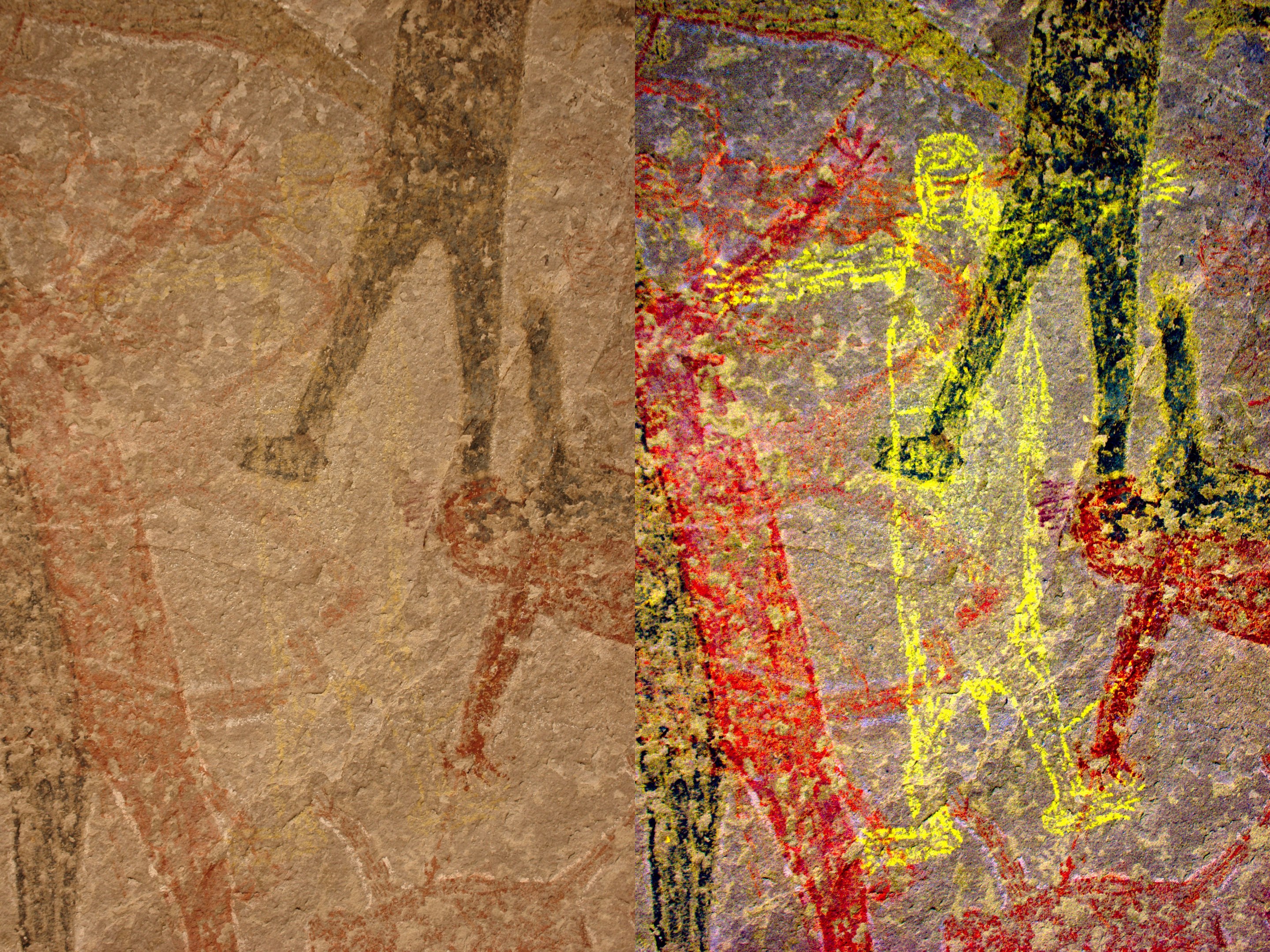
What do cavemen and NASA researchers have in common? Both of their work benefits from the decorrelation stretch technique—a method of image processing originally developed by NASA scientists to tease out details of satellite imagery, including photos of Mars. Now, though, it’s also being used to reveal hidden cave art here on Earth.
While the intricacies of the process are complex, it reveals details that are difficult to see to the naked eye by remapping the colors of a picture across a greater range of shades. A faint red and a slightly darker red can suddenly become a bright red and a bright green, depending on the information in the image. Basically, it’s a high-powered contrast enhancer.
Read more: “The Best Mars Photos Taken by the Curiosity Rover”
Rock art enthusiast Jon Harman is largely to thank for the land-based application of this NASA technology. PetaPixel reports that Harman, who has a background in medical imaging and a PhD in mathematics, came across the technique at a rock art conference in 2005, when a fellow attendee showed him photos using decorrelation stretch taken by NASA’s Mars Exploration Rover.
“I googled it and found a NASA paper that explained how to do the algorithm,” Harman explained. “I knew from my medical imaging experience that I could do it, so I did.”
That paper was written in 1996 by Ronald Alley, from NASA’s Jet Propulsion Laboratory, which developed the process for the Advanced Spaceborne Thermal Emission and Reflection Radiometer (ASTER) launched on board the Terra satellite in 1999.
A more primitive version of decorrelation stretch had already been tested by Alley and a team of geologists on lava flows in Hawaii. That version was eventually refined and improved to be made faster and more accurate.
Then, it was adapted by Harman—first in the form of a DStretch plug-in for the open-source ImageJ editor used for analyzing scientific images, and next as apps for Android and iOS that anyone can download.
DStretch ultimately helped Harman reveal an almost invisible figure on rock art in the Cave of San Borjitas in Baja California, Mexico. Since then, it’s been used to enhance imagery on a cliff in Norway, inside an Egyptian tomb, and in an outdoor park in Canada.
One of the most notable case studies involves the remains of the Angkor Wat temple in Cambodia. There, in 2014, researchers used decorrelation stretch to reveal more than 200 paintings that had previously remained hidden. Pictures of elephants, lions, gods, boats, and buildings suddenly appeared from the temple walls.
As always, there’s often more to something than first meets the eye—whether on the surface of Mars or in the ancient temples of Earth. 
Enjoying Nautilus? Subscribe to our free newsletter.
Lead Image: John Harman