The Curiosity rover has been trundling around Mars since it touched down on the Red Planet exactly 14 years ago today (Aug. 6, 2012), spending all that time gathering intel and images to send back to scientists on Earth.
It’s approaching 5,000 sols (Mars days) of operation, having only originally been commissioned to work on the Martian surface for a couple of years. But despite this expected lifespan, Curiosity is still fully operational (albeit with a few knocks and scrapes) and still communicating with Earth.
To celebrate 14 years of Curiosity’s Martian adventures, join us on a journey through the most striking and scientifically important images that it’s ever captured.
SNAP A SELFIE: Curiosity loves a selfie, and this one was taken at the Duluth sample site, on the lower slopes of Mount Sharp in the Gale Crater. Credit: NASA/JPL-Caltech/MSSS, June 15, 2018.
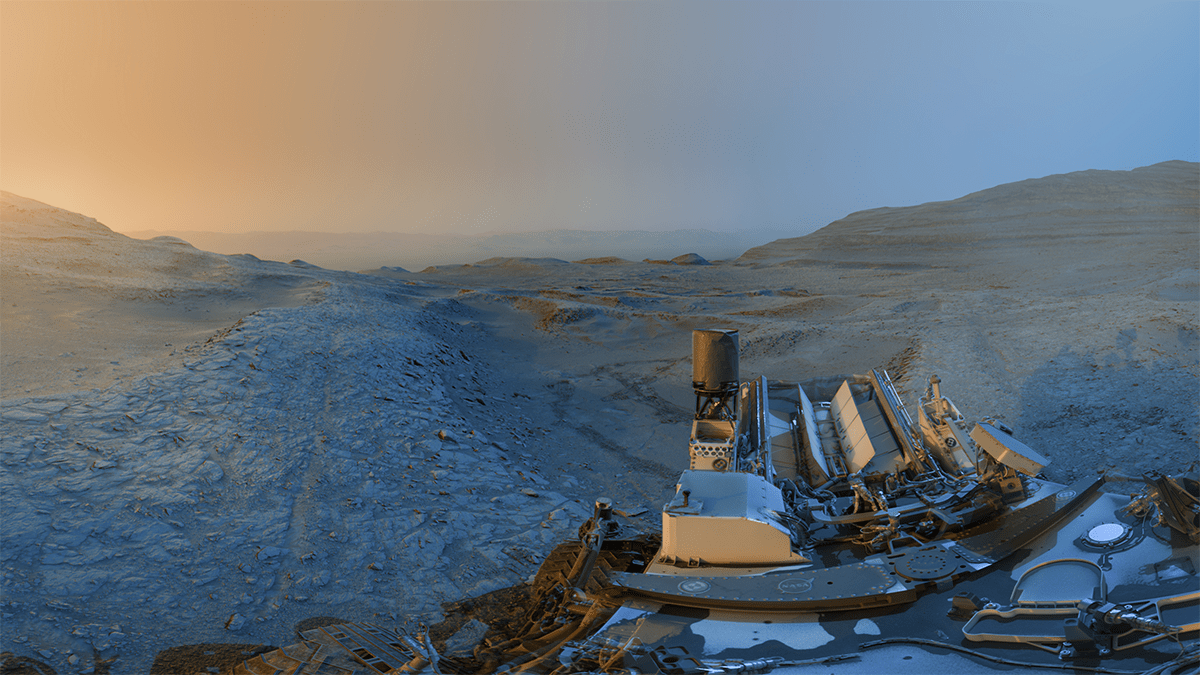
THE LONG VIEW: There are actually 17 cameras on Curiosity, which can be combined to great effect—as with this 1.8-billion pixel panorama of the Martian surface. Credit: NASA/JPL-Caltech/MSSS, Nov. 24 through Dec. 1, 2019.DRILL IT DOWN: To date, Curiosity has collected and analyzed 42 powderized rock samples on Mars. Here are all 42 drill holes. Credit: NASA/JPL-Caltech/MSSS, composite image created Aug. 27, 2024.SIGNS OF LIFE: These pea-sized nodules are evidence of groundwater drying out on Mars billions of years ago, part of low ridges called boxwork. Credit: NASA/JPL-Caltech/MSSS, Aug. 21, 2025.SPACE SAND: A sand-capped butte nicknamed “Miraflores,” estimated to be about 20 feet tall. The surrounding rock has eroded away over time. Credit: NASA/JPL-Caltech/MSSS, June 11, 202
A DAY ON MARS: A composite of two images blended together and colorized, showing late afternoon and morning in the foothills of Mount Sharp. The photos were taken in black and white, and later colorized, with yellow representing the morning and blue the afternoon. Credit: NASA/JPL-Caltech, Nov. 18, 2025.MARTIAN NIGHT: A rare night shot of Mars, as Curiosity uses its robotic arm LED lights to illuminate a drill hole. Credit: NASA/JPL-Caltech/MSSS, Nov. 13, 2025.MUD SLAB: This Martian rock slab is known as “Old Soaker,” and experts think it may have formed from the drying of a mud layer more than 3 billion years ago. Credit: NASA/JPL-Caltech/MSSS, July 8, 2021.IN THE CLOUDS: Sometimes, Curiosity gets to look up: These are Martian clouds swirling over the top of Mount Sharp. Credit: NASA/JPL-Caltech/MSSS, May 28, 2021.
SHADOW LOCATION: The first image Curiosity took with its navigation camera, showing the shadow of the mast against the sun. Credit: NASA/JPL-Caltech, Aug. 8, 2012.SULFUR SURPRISE: After driving over this rock and cracking it, Curiosity found yellow crystals made of elemental sulfur—the first time that kind of sulfur had been found on the Red Planet. Credit: NASA/JPL-Caltech/MSSS, May 30,2024.MOUNTAIN PASS: One of the more spectacular landscapes captured by Curiosity, showing the Paraitepuy Pass where the rover would head after this image was taken (specifically to the circled boulder). Credit: NASA/JPL-Caltech, Aug. 5, 2022.
METEORITE ON MARS: The stunning iron-nickel meteorite nicknamed “Cacao,” around a foot across, found on Mount Sharp. Credit: NASA/JPL-Caltech/MSSS, Jan. 28, 2023.WORTH THE CLIMB: A dramatic 360-degree panorama of Gediz Vallis Ridge, made up of 136 individual images stitched together. It took the rover four times to crest the ridge—it had to triumph over sharp rocks and a very steep slope. Credit: NASA/JPL-Caltech/MSSS, Sept. 18, 2023.CLUES TO THE PAST: Curiosity looking back at its tracks at the Ubajara site, where the rover discovered the mineral siderite on Mars for the first time. The mineral may help explain what happened to the planet’s thicker ancient atmosphere. Credit: NASA/JPL-Caltech/MSSS, April 30, 2023.
David Nield has written about science and technology for more than 20 years. His work has appeared in a wide range of publications, including Wired, Popular Science, The Guardian, and Gizmodo.