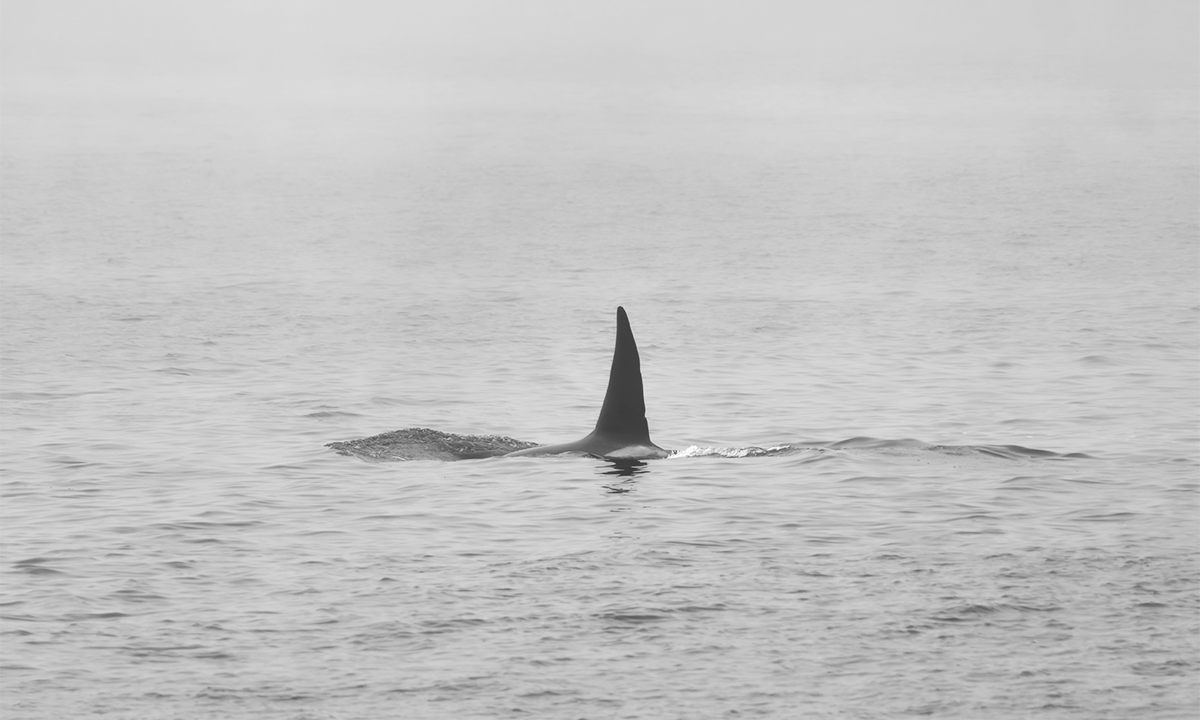
How do you explain a 1.5-foot-tall severed black fin with jagged bite marks on its surface?
The fin is from a killer whale, and the tooth marks are also from a killer whale, which begs the question of whether killer whales are cannibals. A recent study assessed the hypothesis that killer whales (Orcinus orca) are preying on their own species.
Researchers found two examples of severed killer whale fins bearing telltale marks of killer whale bites, both on Russia’s Pacific coast off Bering Island. Discovered just over a mile apart, the fins were from a juvenile killer whale and an adult female or juvenile male, respectively. The spacing and size of the fresh bite scars pointed to an act of killer whale predation.
An obvious question is whether the bite marks were evidence of a fight rather than premeditated murder. But, “if it was just aggression, they wouldn’t bother to tear off the fin,” reasoned study author and whale biologist Olga Filatova in a press release. When killer whales hunt, they tend to go for the richer body parts like organs, leaving fins and other low-energy parts behind. So, the detached fins suggested an act of predation—a fin torn off to access the soft body parts.
Still, the study authors questioned whether these killer whale feeding events counted as “cannibalism,” which is defined as an animal eating a member of its own species.
Read more: “An A to Z of Hungry Killer Whales”
Killer whale populations in the North Pacific include both resident fish-eaters (that stay near the coast in large family clans) and transient “Bigg’s” killer whale groups (that roam around in social groups hunting marine mammals). Due to their distinct social structures, the fish-eating residents and mammal-eating Bigg’s have recently been designated as separate subspecies. DNA analysis identified the two salvaged fins as belonging to residents (O. orca ater). So, arguably, if the bite marks were from Bigg’s (O. orca rectipinnus), these aren’t acts of cannibalism.
“They almost certainly do not perceive themselves as belonging to the same species. For the transient groups, the resident killer whales are simply prey,” said Filatova.
Indeed, the study authors hypothesized that the cohesive clans of resident killer whales are an adaptation against predation by Bigg’s whales. Large groups of resident whales have been observed chasing off groups of Bigg’s whales. Because resident whales are closely related to each other, they have a higher genetic incentive for group defense.
“Most likely, this predation pressure forced them to develop their unique, tight-knit family structure, where they protect each other and thus increase their chances of survival,” explained Filatova.
To date, there’s no evidence that the resident whales are interbreeding with the roaming Bigg’s whales. They may be headed, evolutionarily, to become different species. And so, these killer whales, at most, are accidental “cannibals.” 
Enjoying Nautilus? Subscribe to our free newsletter.
Lead image: Eleseus / Shutterstock