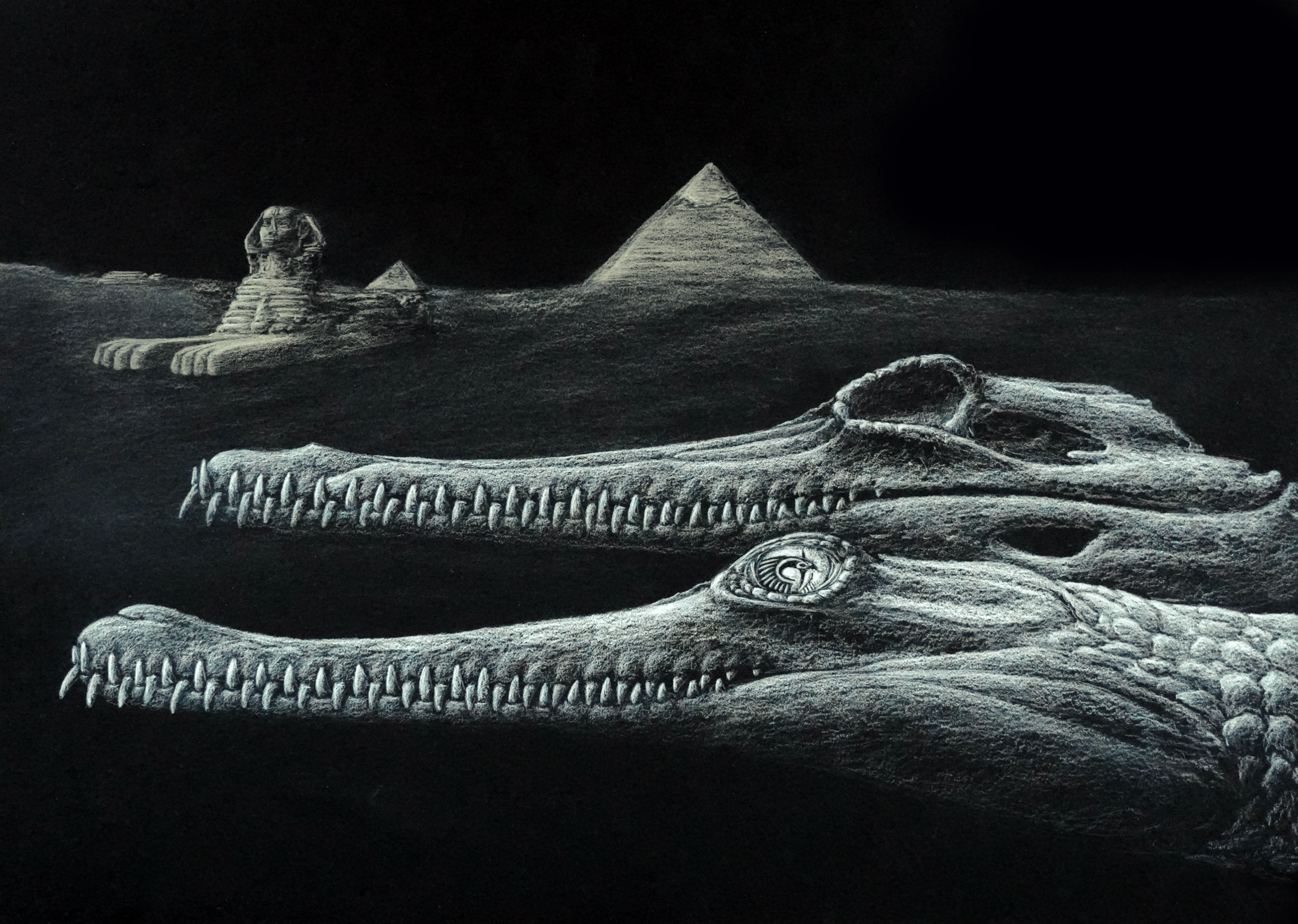
One of Egypt’s most iconic reminders of the Old Kingdom is the Great Sphinx, which was carved right out of the Giza Plateau’s limestone bedrock, a collection of ancient seabed sediments that accumulated at the bottom of what was then the warm, shallow Tethys Sea. That same material—from the Mokattam Formation east of Cairo—has now yielded a new species of crocodile: Herugavialis cairensis.
According to a study published this evening in the journal Royal Society Open Science, a team of researchers from the U.K., Sweden, Germany, and Egypt determined that Herugavialis cairensis’ skull shape marked it as “gavial,” or a fish-eating crocodile characterized by a long, skinny snout. Only this one was missing the tip—or at least the fossilized remainder of it. “Given this coincidence with the famously missing nose of the Great Sphinx, we decided to name the new crocodile after the Egyptian god Heru,” explained lead study author Paul Burke, a paleobiologist at University College London.
Its fossil bones had previously led paleontologists to identify it as another ancient gavial from Egypt: Tomistoma cairense. But the study authors got a deeper look at the skull by CT-scanning it and found differences that warranted the new species classification. For example, its bony eye sockets protruded out from its skull like the opening of a telescope, and its cheek bone (“squamosal”) was a strip shape rather than a wedge.
This gavial lived about 45 million years ago during the Eocene, based on the age of the rocks it was buried in, alongside at least two other gavial species. “Throughout much of the last 50 million years, the Mediterranean region hosted a high diversity of crocodiles, including gavials,” explained Burke.
But as climate cooled through the Eocene, locking up more water into ice, gavial diversity took a temporary nosedive. Their diversity recovered during the Miocene as the climate warmed again, but then, about 6 million years ago, gavials and all other crocodiles in the Mediterranean region went extinct.
In interpreting the causes, the study authors pointed to the “salinity crises,” when the Mediterranean Sea dried up entirely after continental shifts closed the channel that linked it to the ocean. That obviously was the end of Herugavialis cairensis, too—although it took another 6 million years for humans to get a good enough look at its bones to figure out what sort of animal it was. 
Enjoying Nautilus? Subscribe to our free newsletter.
Lead Image: Karim Zanaty