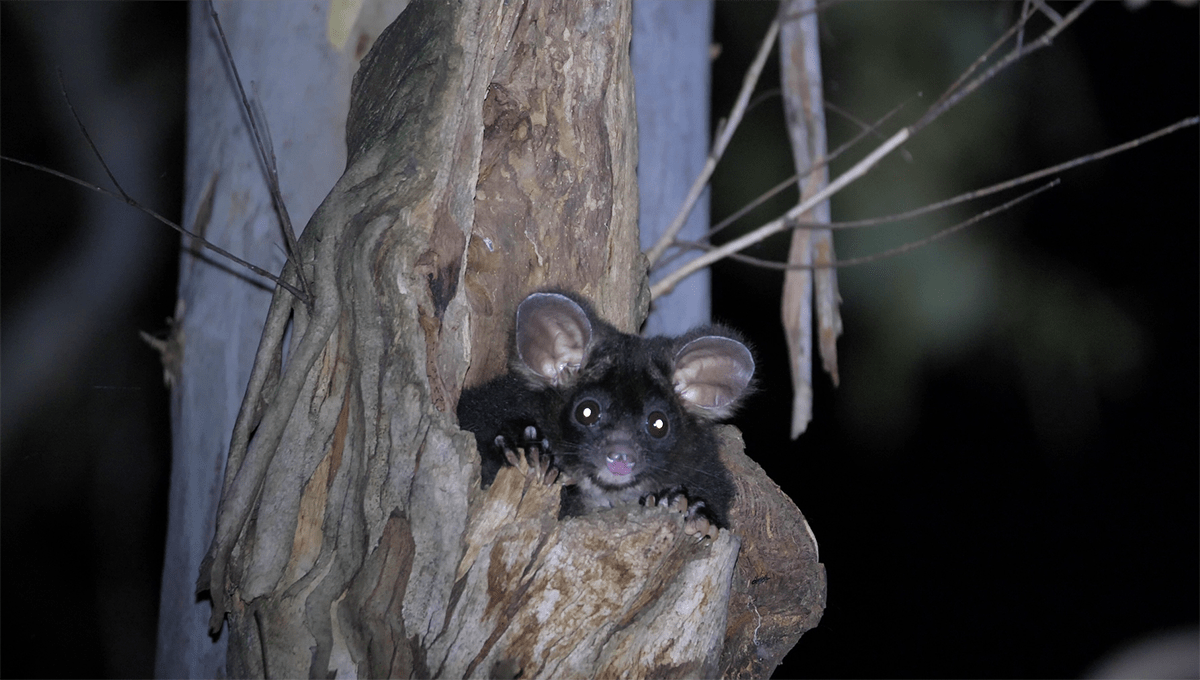
The southern greater glider (Petauroides volans) is a nocturnal marsupial native to the forests of southeastern Australia that’s capable of gliding from one tree to another thanks to a flexible membrane fixed between its forearms and hind legs.
In a new study published in Australian Mammalogy, researchers recorded 41 such tree-to-tree leaps. The animals launched from an average height of 71.5 feet, landed at an average of 15.4 feet, and covered an average distance of 62.7 feet.
Those are impressive jumps through space, especially when you add in that the maximum horizontal distance covered in a glide was 162.7 feet.
There’s a problem though: The glide distances aren’t as great as zoologists previously thought. An older report from 1941 is all that experts have been able to go on as far as this species is concerned, which estimated gliding distances up to 328 feet.
The “greater” in southern greater glider is actually about its size rather than its gliding capabilities. It’s the largest gliding marsupial in Australia, and based on this data, it has the steepest and least efficient glide, too (though not quite the shortest).
Read more: “Why Bats Are Flying Machines”
P. volans is already classed as an endangered species, and if it has to spend more time on the forest floor rather than leaping from tree to tree, it becomes more vulnerable to attacks from predators.
Human activity only exacerbates the issue, as logging projects and new road construction pose deadly threats. Furthermore, as the trees southern greater gliders call home are removed, it leaves them more spread out and isolated.
“Habitat gaps exceeding the gliding capabilities of gliding species can act as barriers to movement and lead to a disruption in population processes,” the researchers wrote in their published paper.
Potential solutions include installing tall wooden poles or canopy bridges to help the animals cross between trees, but it remains to be seen how readily the gliders will use these artificial substitutes. 
Enjoying Nautilus? Subscribe to our free newsletter.
Lead photo by Ana Gracanin