Just like humans, chimpanzees are adept at problem-solving. If you hang a banana out of reach and give a chimp some boxes (as psychologist Wolfgang Köhler did in the early 20th century), they’ll stack them into a makeshift ladder so they can grab it. According to research published today in Science, bumblebees are capable of the same goal-oriented problem-solving.
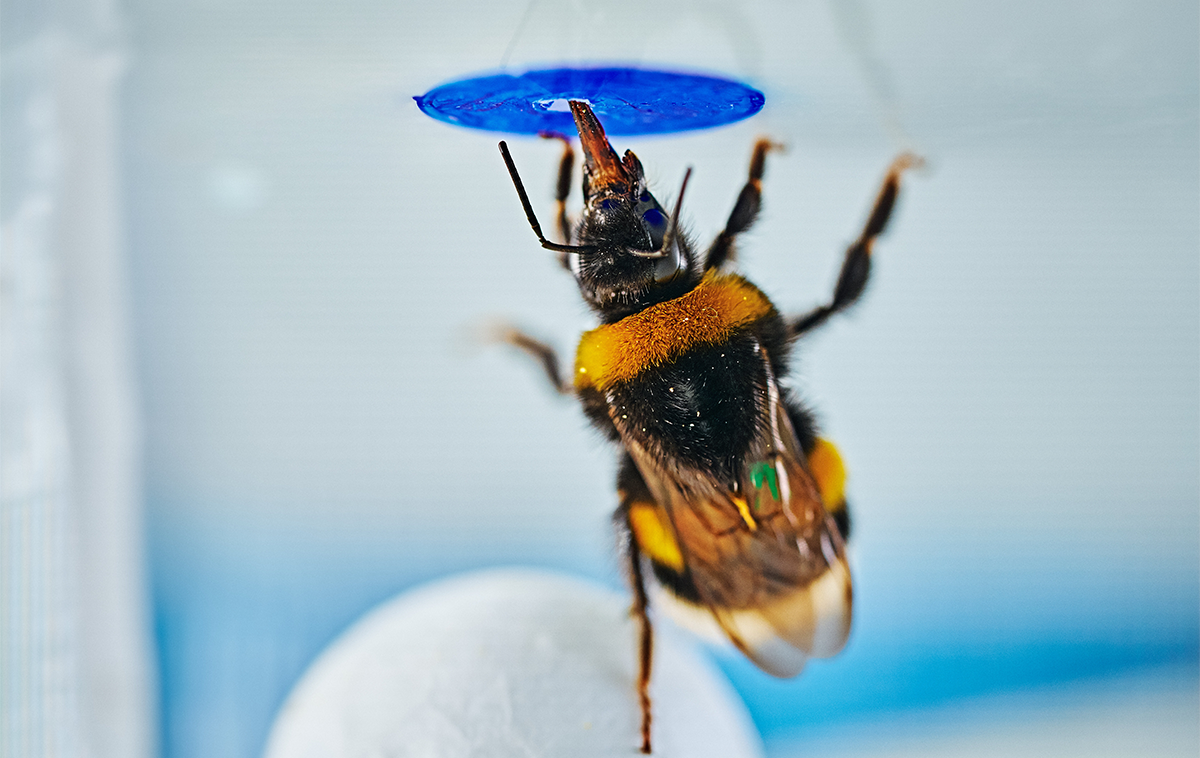
To test the cognitive abilities of the tiny insects, biologists from Finland’s University of Oulu taught them to associate a blue dot on their enclosures with a sugary reward and provided them with a small styrofoam ball to roll around. When they placed the blue “flower” on the ceiling, the bees spontaneously rolled the ball underneath so they could reach their snack. Importantly, the bees had never been trained to roll the ball in order to reach the reward. Just like the chimps in Kohlberg’s research, using the tool to solve the problem was the bees’ own idea.
“This is essentially an insect version of the classic ‘box-and-banana’ problem,” study author Olli Loukola said in a statement. “The animal must realize that an object can be repositioned and then used as a tool to reach an otherwise inaccessible goal.”
Read more: “A Group of Ants Beats a Group of Humans at Problem Solving”
Still, in the first experiment, the bees could see the blue dot, so the ball-rolling behavior may have been driven by perceptual feedback rather than a unique insight. To control for this possibility, the researchers put up barriers designed to obscure the goal when the bees were rolling the ball. Incredibly, they still managed to reach their reward.
It’s not the first time insects have demonstrated complex cognitive abilities. Prior research has shown they’re capable of tool use, learning from one another, and solving complex puzzles. But this is the first time they’ve proven they can have insights on par with larger-brained vertebrates. It’s remarkable when you consider the vast difference in brain size: a bee’s 1 million neurons are capable of the same goal-oriented problem-solving as a chimp’s 2.8 billion.
“For over a century, spontaneous object-based problem-solving has mostly been studied in vertebrates,” says Loukola. “Our study suggests insects may belong in that conversation too.”
Welcome to the club, bees. 
Enjoying Nautilus? Subscribe to our free newsletter.
Lead image: Olli Loukola/University of Oulu