
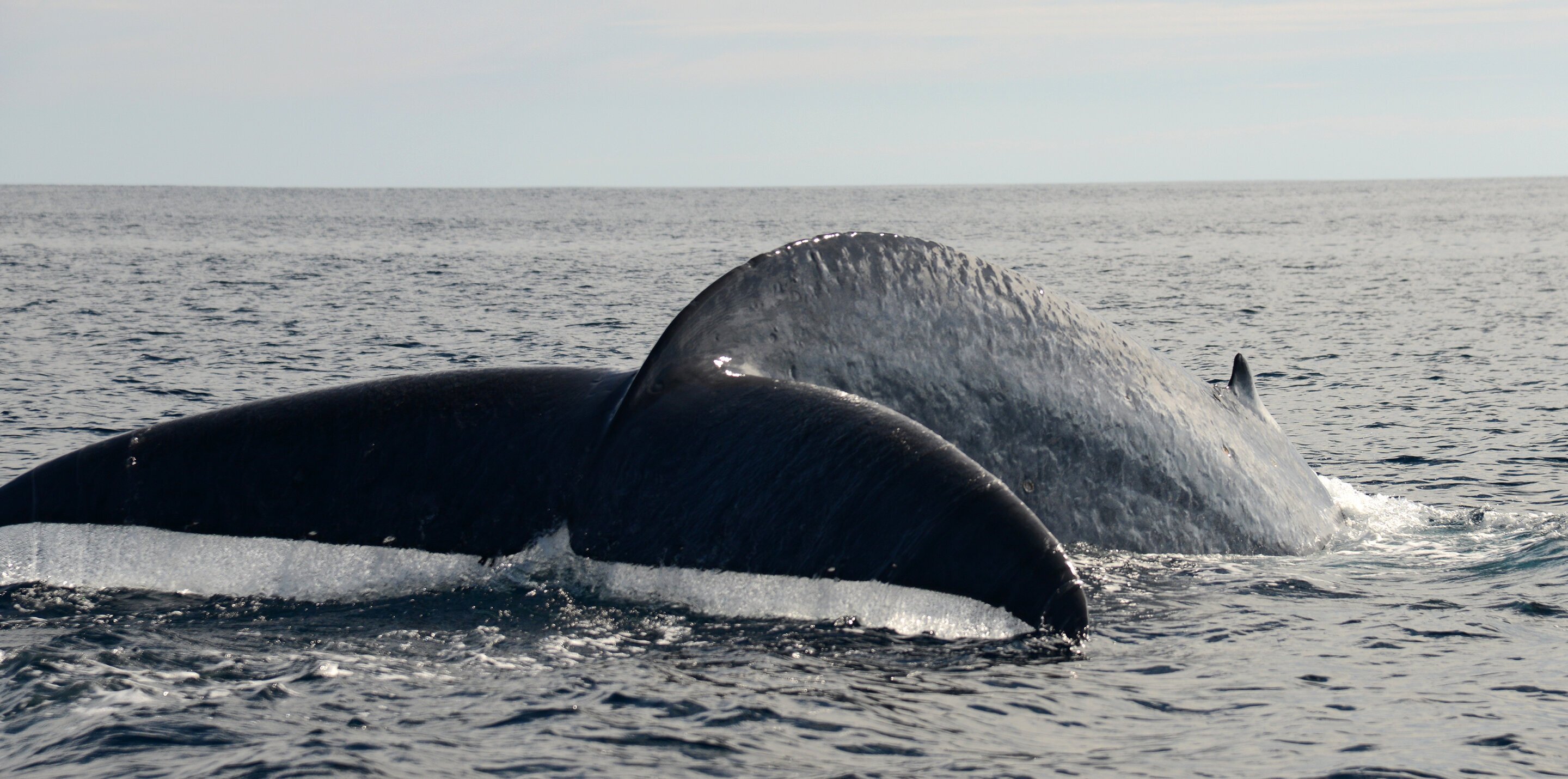
The most abundant whale species in the waters off southwest Australia is a subspecies of the blue whale: the pygmy blue whale (Balaenoptera musculus brevicauda). Yet, despite being more common than other species, they’re endangered under an Australian conservation ruling, failing to recover fully after commercial whaling was banned in 1979.
Pygmy blue whales are hard to spot because they’re smaller than other blue whales and spend most of their time below the surface, filter-feeding on krill with their baleen. But a new study published in the journal Royal Society Open Science provides a method for monitoring pygmy whale feeding activities without needing to see them at all.
Read more: “The Cold War’s Accidental Whale Observatory”
Led by doctoral student Andrew Davenport from Curtin’s Centre for Marine Science and Technology, the study explored the relationship between periods of feeding behavior and whale song since blue whales make sounds while they’re feeding, such as “D-calls” that slide from higher to lower frequency.
Their songs were analyzed from recordings collected passively over three months, with nothing attached to the whales that might alter their natural behavior. The researchers found that this Australian population of pygmy blue whales sang less when they were actively feeding during the daytime, regardless of whether they were in the foraging regions of Perth Canyon, Midwest, or Northwest.
“Just as we can’t talk while we’re eating, pygmy blue whales appear to have less time available to sing while they’re feeding,” Davenport explained in a press release.
And so, whale songs could serve as a proxy for direct monitoring of feeding behavior—at least for pygmy blue whales. Without tagging or observing the whales, researchers can record their daytime singing and assume they’re foraging during the quiet periods. “By listening to when they sing more at night than during the day, we can infer when whales in an area are likely to be feeding,” added Davenport.
Which, of course, will serve as a bountiful feast of data for him and his team. 
Enjoying Nautilus? Subscribe to our free newsletter.
Lead Image: Micheline Jenner, Centre for Whale Research (WA)