In 1986, I got invited to show a film at the Rio Film Festival. It was my first time in Brazil, and though I was familiar with some of the better-known musical artists there, I quickly realized there were many more I’d never heard of. A local music fan offered to take me to a record store in Rio, and I left the store with an armload of vinyl. One of the records I picked up had the word “samba” on the cover and, oddly, an image of barbed wire. Many of the other samba records had pictures of girls in bikinis on the cover or a smiling singer, so this one, I imagined, might be different. The artist was someone named Tom Zé.
As my purchases were all vinyl, I had no idea what they sounded like until I returned to NYC about a week later. Upon listening, I discovered that many of the records were beautiful and important, and I still listen to them today, but it was the Tom Zé record that was a revelation. His music was the kind of experimentation familiar to the downtown NY music scene that I was accustomed to, but with a Brazilian vibe. I’d never heard anything like this—radical boundary- pushing music was happening there too? (I wondered from my NY‑centric point of view.)
Read more: “The Most Precarious Day in the Universe”
I played the record for my business partner Yale Evelev at Luaka Bop, the record label I founded, and he was as surprised as I was. By that time, we’d released three compilations of popular Brazilian music that had been well received, and we thought, “Let’s show them that there’s another side to Brazilian music.” We decided to put out a compilation culled from Zé recordings.
Counter to the prevailing “world music” trend, we packaged the collection as contemporary music rather than something folkloric or ethnographic. In the liner notes, the historical origins were explained, but we didn’t want the first impression of the record to be that it was some academic archival recordings from the past. This was very much contemporary music to our ears, and we wanted to emphasize that in the presentation and graphic design.
The compilation was well received but wasn’t a big seller. But we remained excited, so we suggested he might next do a recording of new material. He did, and between the two releases, it became clear that awareness of him in Brazil was gradually changing—people there were talking about him again. We realized that he’d been somewhat forgotten and had been viewed as a relic of history—but here he was now, making new music.
His deconstructed take on Brazilian music and his clever and incisive wordplay resonated with a younger generation of Brazilians that hadn’t heard those earlier out‑of‑print recordings. Hearing his music for the first time, they sensed that what he was doing was of the moment, relevant to them. And they became fans. He began doing live shows in Brazil and even did some TV appearances. Tom Zé had been rediscovered, not just by me, but by a whole generation of Brazilians, which is what really mattered. I later found out that around the time we met, he was preparing to pack up and go back to the small town of Irará and run a gas station owned by his cousin.
Tom Zé had been awakened and could now be appreciated by a wider audience. Watching this process unfold, I gradually came to understand firsthand how something that was profound and powerful could be “lost”—sometimes briefly, sometimes for a long time—and then brought back to life. It wasn’t just something that happened to offbeat recording artists. Once you recognize the phenomenon, you start seeing it everywhere.
I first saw the term “sleeping beauties” (outside of the folktale or the Disney movie) when I went down a rabbit hole and stumbled on a paper from 2004 called “Sleeping Beauties in Science” by the scientometrics researcher Anthony van Raan at Leiden University. (Scientometrics is the study of the impact and communication of science.) I instantly recognized the phenomenon. He was referring to scientific papers, but this forgetting and then remembering, I knew from my own experience, wasn’t limited to academia. It happens in all kinds of fields and endeavors—music, art, literature, every kind of creative profession. These stories, I realized, have a natural fascination—everybody loves rediscovery, a happy ending, and the sense of eventual justice when something worthwhile gets its due.
“We know very little about the universe.” — Vera Rubin
In science, one of my favorite sleeping beauties is a discovery by Vera Rubin. In the 1970s, the young astronomer uncovered evidence for dark matter, which is estimated to make up a large percentage of the universe, 27 percent. What we can see makes up just 5 percent (the remaining 68 percent is dark energy). The invisible stuff is everywhere. We’re continually being blindsided by these new ideas and discoveries. It seems we barely know the world we live in or what it’s made of.
As a woman in astronomy, Rubin didn’t have it easy. Her struggles began early. Her high school adviser told her not to go into science, but Rubin ignored him, got a scholarship, and went to Vassar College.1 Rubin hoped to then get a doctorate from Princeton, but the astrophysics program there did not admit women, so she went to Cornell, which proved to be lucky. She studied under eminent scientists such as Hans Bethe, Philip Morrison, and Richard Feynman, though they didn’t always support her ideas.
In 1954, while at Cornell, Rubin did a dissertation that showed that galaxies were not evenly dispersed, as they might be expected to be after the Big Bang origin. This discovery raised questions that would later lead to her even bigger discoveries. But first there were more mountains to climb.
Her adviser, William Shaw, suggested her work on uneven galaxy dispersal should be presented to the American Astronomical Society, which must have been exciting and flattering—but then he suggested that he should present the paper in his name, as if he was doing her a favor. He claimed he should present the paper because she was about to give birth and she was also not a member of that society. Rubin wasn’t going to have her work “stolen” because of sexism and insisted her pregnancy didn’t prevent her from presenting a paper herself. However, when she did so, it wasn’t received well by the astrophysics boys—with the exception of Martin Schwarzchild, son of German mathematician Karl, who proved Einstein's field equations involving general relativity. What goes around comes around. Her paper was never published and the idea—that galaxies are not evenly dispersed—was ignored and not taken up again for 20 years.
Rubin, understandably frustrated, decided, like Murdin, to shift her focus to an unpopular area to avoid further conflicts. She decided to focus on galactic rotation, which she thought might be “safer” because it would generate less resistance and controversy from the boys’ club. Was she ever wrong.
In 1965, she applied to work at the Hale Telescope at Palomar Observatory. It opened in 1948, and for 50 years it was the biggest telescope in the world, with the latest technology. That was the place to be. However, the Hale Telescope building, located on a mountaintop, did not have any facilities for women. Stargazing went on all night, of course, and the astronomers there said they couldn’t have women in residence because they didn’t have a women’s bathroom. So Rubin cut a woman’s shape out of a piece of paper and pasted it on a bathroom door. Voilà! The women’s room. And thus she became the first woman ever allowed to observe there.2
In 1970, Vera and her colleague Kent Ford (who had developed a new spectrograph—a means of measuring the movement of stars and galaxies) were looking at the readings of the telescope observations of the Andromeda galaxy, and something didn’t make sense to them.3 The galaxies were rotating too quickly to be held together by galactic gravity of the visible stars alone. There was a discrepancy between how fast they were actually moving and how fast they should be moving, given the size of their visible material. Enabled by these new technologies—the massive telescope and Ford’s spectrography—in 1974, Rubin measured this discrepancy. She demonstrated that in order for the galaxies not to fly apart, there had to be between five to ten times as much invisible matter as visible matter holding everything together.
None of that made sense yet. How could that be? In a Hail Mary search for possible explanations, Rubin began to question even her most basic assumptions—that matter must emit light and radiation. She was a visual thinker, and she used her data to create plots and sketches that revealed patterns within the numbers.
At an early age, she would look out the window and draw the direction of meteor showers. In an interview published in Maria Popova’s The Marginalian, Rubin is quoted as saying, “Months were taken up in trying to understand what I was looking at…. One day I just decided that I had to understand what this complexity was that I was looking at and I made sketches on a piece of paper and suddenly I understood it all. I have no other way of describing it. It was exquisitely clear. I don’t know why I hadn’t done this two years earlier.”
The patterns her drawings revealed provided the explanation for the galaxy rotation problem: “dark matter.” Rubin and Ford realized that this invisible matter had to be spread all around, not just concentrated in the center of the galaxy. I’m trying to imagine what this leap must have felt like. She must have explored every other possible explanation before accepting the idea that the answer was something as bizarre and counterintuitive as “invisible stuff.” But the data said it had to be. Rubin’s study turned out to be the first real confirmation and evidence of dark matter.
In the decades that followed, Rubin’s discoveries were confirmed over and over again, by theoretical physicists and radio astronomers, and more recently via evidence of gravitational lensing, i.e., gravity waves bending light and time. We, and all the other stuff we see—stars, planets, gas clouds—are but a small percentage of what makes the cosmos tick. We still don’t know what most of that invisible stuff out there is, but at least now we know how much of it there is, said Rubin.
This sleeping beauty had to await specific technological developments to be fully confirmed: the powerful Hale Telescope, Kent Ford’s new spectrograph, and the Uhuru satellite, which tracked cosmic X-rays. Did it have to take 40 years for Rubin’s ideas to be confirmed? Did the fact that she, a woman, was an outsider in this field allow her, force her, to think outside the box? Hell, she wasn’t even allowed in the box! Was she forced by culture and circumstances to be more innovative as a result, and was that what allowed her to see what no one else did? There was also the resistance to challenging the almost universal assumption that all matter must emit light—an assumption that makes perfect logical sense if, judging from our human experience, that’s all you’ve ever known and experienced.
Can we only know things that we have perceived and experienced? That question is the basis of science. For millennia, the tiny percentage of knowledge of the universe that our experience lets us see has served us well—so naturally we have tended to believe that’s all there is.
Many people predicted that Rubin would get a Nobel Prize, but she never did. An area on Mars, the Vera Rubin Ridge, is named after her. The Vera C. Rubin Observatory on a mountaintop next to the Atacama Desert in Chile—which employs innovative high tech and a radical design—has begun looking into the past to discover how the universe came to be. It started collecting data in 2025 and amazingly detailed images of things never before seen have begun to appear. 
Enjoying Nautilus? Subscribe to our free newsletter.
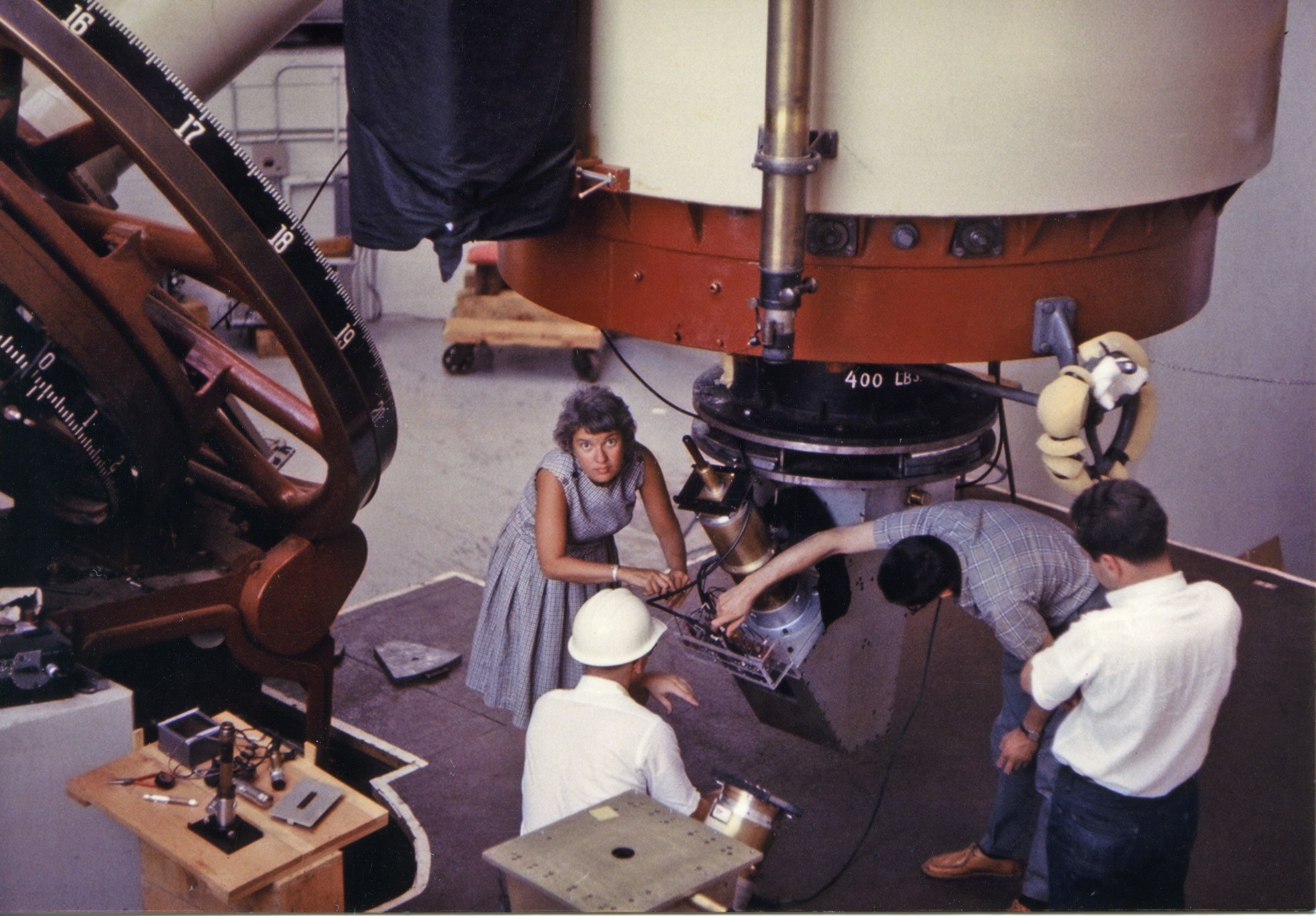
Lead image: Astronomer Vera Rubin at the Lowell Observatory in Flagstaff, Ariz., 1965. Credit: Carnegie Science
Excerpted from Sleeping Beauties: Why Good Ideas Go Dormant and How They Wake Up by David Byrne, published by Penguin Press, an imprint of Penguin Publishing Group, a division of Penguin Random House, LLC. Copyright (c) 2026 by David Byrne.
Footnotes
- Rubin chose Vassar in part because it was the alma mater of Maria Mitchell, the first American to discover a comet.Return to content at reference 1↩
- Have things changed in the world of astronomy? Amazingly and happily, yes, they have. A 2023 survey said that 45 percent of astronomers are women now. A Hubble fellow, Jessica Werk, said in 2015 that the women in astronomy are total badasses and “they really don’t take people’s shit.” Thank you, Vera.Return to content at reference 2↩
- The farther-out stuff from the rotating galaxy center was moving just as fast as the star stuff close to the center—and as anyone who has rolled a ball around a conical shape can tell you, the closer an object gets to the center, the faster the revolutions should be. In our solar system, Mercury, close to the sun, takes eighty-eight days to orbit, while Pluto, farthest from the sun, takes 248 years.Return to content at reference 3↩