
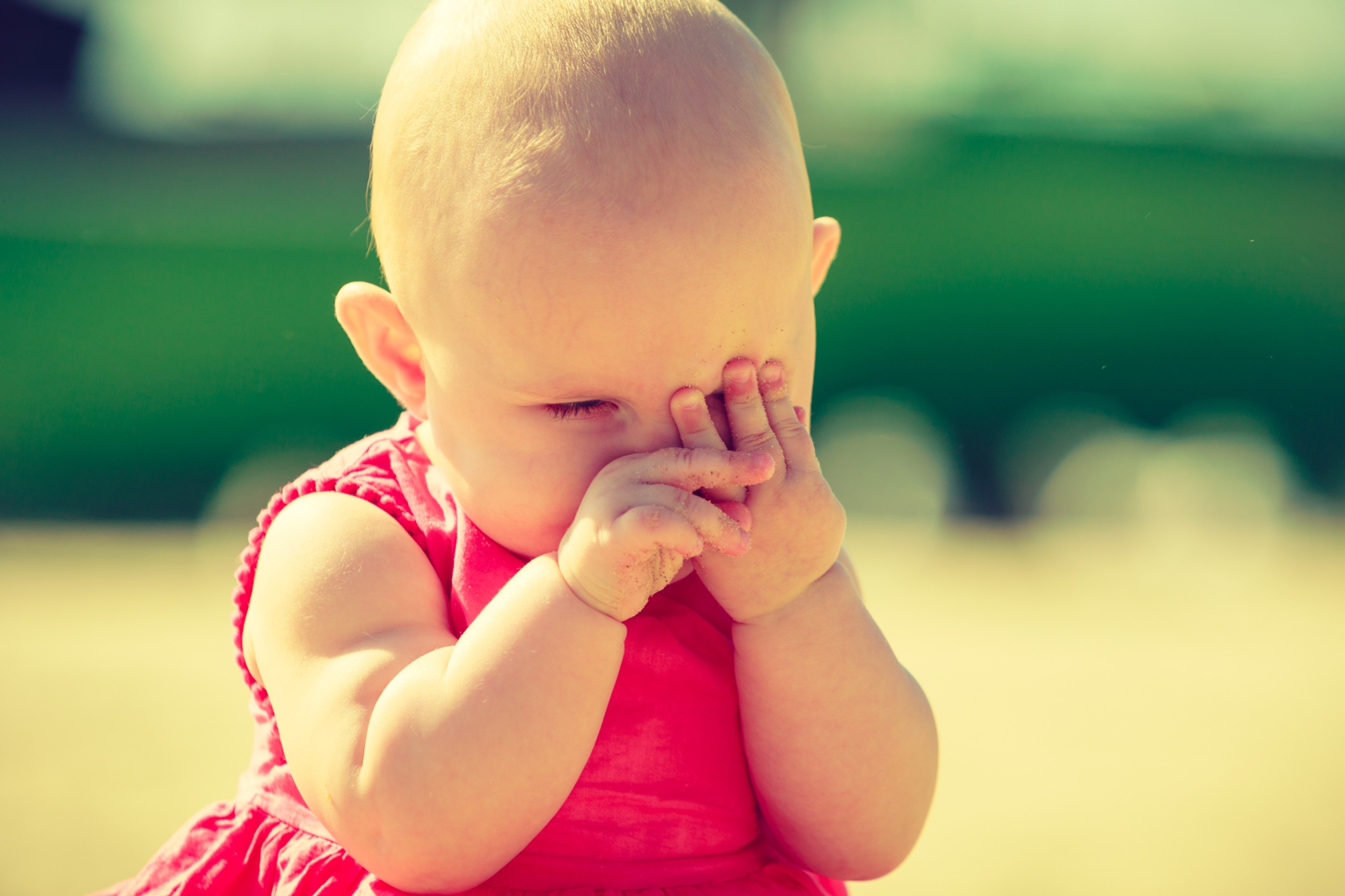
As recently as the 1980s, most physicians, philosophers, and neuroscientists believed that newborn babies were incapable of feeling pain. They were, in some sense, not considered fully human. This changed after a New England Journal of Medicine study published in 1987 found that infants undergoing surgery without anesthesia—then a routine practice—suffered massive, and potentially lethal, stress responses.
The more we look, the more it seems that babies develop many of the powers of adult minds much earlier than we thought. For example, in recent years, neuroscientists have begun to grapple with the possibility that babies not only can feel pain, but possess consciousness.
Read more: “How Does Your Brain Know A Cat Is A Cat?”
Now, some researchers have proposed that infants can experience complex emotions such as pride, shame, and guilt, which were thought to emerge much later, after the first few years of a child’s life.
In a review published in the Royal Society’s Philosophical Transactions B, European developmental psychologists Milica Nikolic and Robert Hepach report that evidence from developmental science suggests these emotions can be seen in the body language of babies—from birth to two years of age—via tiny micro-movements. These so-called self-conscious emotions could be useful to babies for both communication and motivation purposes, they write.
I spoke with Nikolic about the nature of self-conscious emotions, how the findings square with neuroscientist and psychologist Lisa Feldman Barrett’s theory of constructed emotion, what culture might have to do with it, and why emotions so often seem to lead us astray.
You make a distinction in your study between standard emotions and self-conscious emotions. What are self-conscious emotions?
When we talk about self-conscious emotions, usually we talk about emotions that are related to the self, where we think about ourselves as objects of other peoples’ attention, when we become acutely self-aware. Emotions such as embarrassment, shyness, guilt, shame, pride, are all self-conscious emotions—some positive, some negative.
You mention in the paper that these self-conscious emotions are visible not just in facial movements, like standard emotions, but also in posture, gaze, head direction. Why do they differ from standard emotions in terms of their physical expression?
Basic emotion theory proposes that there are emotions that are more universal and shared with other non-human animals, and then there are these more complex social emotions that evolved later, that are probably uniquely human. They also require certain more-complex socio-cognitive skills, such as understanding that we can be observed by other people, and for some more complex ones like shame, internalizing social norms and rules, understanding when we do something good or bad, understanding that when we harm someone, another person can suffer. All these skills are a bit more complex, so it’s thought that they are also expressed differently in the body. According to this basic emotion theory, every emotion is expressed differently in the face and by the voice and so on.
For self-conscious emotions, what we know so far is that most of them are expressed in certain combinations of bodily and facial expressions, but it’s not a one-to-one relationship. It’s not always that when we feel embarrassed, we express it in this prototypical way. However, there is research showing that indeed when there is more embarrassment or more shame, we tend to, for example, look down, collapse our shoulders in shame, or when we are embarrassed, we smile, but then we look away. There are these combinations that suggest certain self-conscious emotions.
You reviewed recent research on the development of self-conscious emotions and found that the current evidence suggests they can come much earlier in a child’s development than we had thought, sometimes as early as the first months of life rather than the first few years. Does this shift change our understanding of human cognitive development or theory of mind in important ways?
The idea was that these emotions develop a bit later because they require such complex socio-cognitive skills. What we find in the research is that these expressions of emotion exist in young children. Whether they really feel them, we cannot say, because these children are pre-verbal. Even when they can speak, they cannot report reliably on their experiences.
We make our conclusions based just on these observable behaviors. Complex skills such as being self-aware, understanding that other people can observe us, but also perspective-taking, understanding that other people can think something that maybe is not true or that other people can suffer, is thought to appear much later in life. But there is also a lot of developmental cognitive science research showing that these skills can actually be found in very young children if we use more implicit measures. When researchers study children not by asking them to verbally report, but rather looking at the time they take to complete certain tasks, where they focus their attention, it appears that they can understand much more from the social situations than we previously thought, which suggests it’s also possible that they can experience these more complex emotions.
The recent research indeed shows that displays of embarrassment can be seen already in the first months of life, when babies are the center of attention, for example, when they receive a lot of compliments. They show something very similar to what an adult would show if they made some small mishap or mistake.
Do your findings lend themselves to understanding whether some animals may feel these kinds of self-conscious emotions, as well?
There are proposals that certain self-conscious-like emotions could be experienced by non-human animals—but there is no real empirical research. The idea that these emotions are uniquely human has been around for a very long time. But we also find nowadays that animals are capable of many things related to social understanding. We do propose that maybe it’s possible to start exploring this, and seeing whether they show similar responses related to experiencing self-conscious emotions.
Your review runs counter to Lisa Feldman Barrett’s theory of emotion, which suggests that emotion is not innate or hardwired, but rather is constructed and depends on the person understanding the concept of the emotion before they actually experience it. Is that a fair reading?
I don’t think that our findings go against this theory, but neither do they confirm it. Barrett’s theory assumes a very big role for language in emotional development and conceptual knowledge. What we try to say is that we see that these emotions are expressed before children really understand the concept of these emotions. According to constructivists like Barrett, children develop an understanding of these emotions later. They get the concept of the emotion later, and use words related to self-conscious emotions much later. It requires a sophisticated vocabulary to use words like shame, embarrassment. You do not expect them in a child who is two or three years old. Some research suggests that they only start understanding the concept of these emotions at the age four or five.
We argue that it could be that this language and conceptual understanding of emotion is not really needed for the emotions to be experienced and expressed. That is not in line with their theory. But we’re not suggesting that the language doesn’t matter. Understanding what this emotion is, what kinds of situations it occurs in, using emotion words, are all going to change how children experience emotions and probably also how they express them and even how often. What we suggest is that this language or understanding is not a necessary condition for an emotion to be there.
You were mostly looking at studies from the West, but is there any evidence that the expression of self-conscious emotion is culturally dependent, even in babies?
No research that I know of, in babies, regarding self-conscious emotions. But some research that we found with kids who were a bit older does suggest similar expressions of emotions. Very often in this cross-cultural research, we find differences in intensity, for example, of the facial expressions. In Asian countries, for example, people find similar expressions, but they are lower intensity. Also, there are differences in what these emotions mean, how they are judged by others, how desirable they are, and in what kinds of situations they occur.
How do you define an emotion?
We use this very broad definition: An emotion is a reaction to personally relevant events. There is something in the environment—visible or not, it can also just be in your head—that happens and it’s personally relevant to you, and that triggers an emotional response. It’s a multi-component process, which includes objective experience, and also subjective or phenomenological experience, which are also called feelings. Nonverbal expression is another aspect, what’s observable or seen, and the physiological reaction that is happening in the body. We can start sweating or our heart rate can go up or we feel really warm in the cheeks because we blush, because we are embarrassed.
Why can emotions so often lead us astray?
That’s an interesting question. How we look at emotion is actually that they are functional. They are adaptive in the sense that they inform you about something very relevant to you. But they can become dysregulated. We can have troubles regulating emotions. They can become very strong and then they also can become dysfunctional if we experience them too often, and maybe also too intensely, and we cannot really regulate them. So emotions themselves are not dysfunctional, the regulatory system can fail if something is really important and very relevant and the stakes become very high, we can experience very strong emotions. As we become adults, we need to learn how to regulate them. What can go wrong is when we cannot regulate our emotions. 
Enjoying Nautilus? Subscribe to our free newsletter.
Lead Image: Voyagerix / Shutterstock