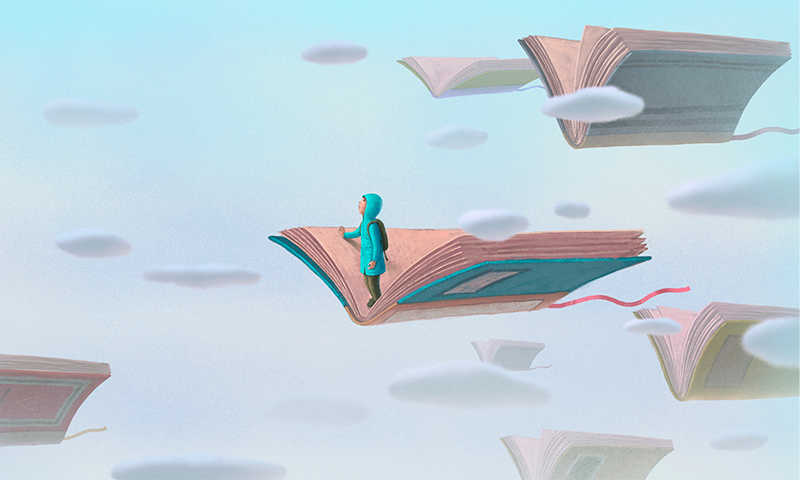
Will Dowd lost his ability to read over a decade ago. He has a condition called binocular vision disorder, which makes it difficult to coordinate his eyes. Words drift across the page, getting tangled up in one another, and the pain of trying to extract meaning from the resulting quagmire gives him debilitating migraines. Dowd had been an obsessive, devoted reader—a poet and MIT-trained science writer who lived mostly in the world of paper and ink—so the condition left him feeling exiled from himself.
The act of dreaming was the only other time Dowd felt the readerly combination of total absorption and flight, and so he wondered: Could there be a connection between the two? Could reading be a kind of lucid dream? He recalled hearing about a device called the Dormio, a targeted dream inception device developed at the MIT Media Lab, and wondered if it could help him simulate the reading experience. A grant from the Woodberry Poetry Room at Harvard University enabled him to test this theory out on himself over the 2022-2023 academic year. The resulting project is called Dreamfall.
How do you use the Dormio to simulate reading through dreaming?
I listen to recordings of the first lines of poems that are unfamiliar to me and use those as seed phrases to push my dream in a certain direction. After I listen to the first line, I go to sleep, and when the Dormio wakes me up, I write down every sensory detail I can remember, every leap of logic. Then I listen to the rest of the poem, and one of my favorite things is to see how they intersect. More often than not, there are some strange intersections, and I think that may say something about the shared human imagination. But I’ve also found that the seeds have only a glancing impact on the dream. It’s never literal. You can often find traces, but what I’m discovering through the process is that dreams naturally do not like to be controlled. They live in the realm of the trickster.
Can you give me an example?
I think I remember this most vividly because it was my first one, but I listened to a line of a poem by an Irish poet, Padriac Colum. The narrator is a man living in a tower, and the first line is about seagulls flying around the tower. In the dream that I had, I was a child on a beach and I confronted this magician, who was showing me all kinds of Christopher Nolan Inception-style tricks that he could perform—drawing an invisible circle in the sky so that suddenly you’re seeing into another place where it’s snowing. At the end, there was an invitation to follow, like a magician’s apprentice, leaving the regular world, like I was getting my letter to Hogwarts. When I listened to the rest of the original Irish poem after writing this all down, I found it was about a young girl going to the tower to meet an older poet, who was very much like the magician, an older kind of mentor figure. But in that case, the poet refuses to be the mentor. He turns the girl away and recommends that she take flight on her own. That mentor relationship was not in the seed phrase, so it’s just an example of some of the synchronicities that come up. I don’t try to get too mystical about that because I’m more interested in creative dialogue, but it was a fascinating start to the project.
You’re never going to fully understand or control what happens.
Has this approach satisfied your longing for the experience of reading?
So far it feels as though those two experiences of reading and dreaming do diverge in a very fundamental way. And it has to do with the fact that when you are reading, even if you’re immersed in the book, you have an understanding of yourself as a reader and the world and experience as being crafted through your imagination, but ultimately from the foundation of the author. In dreams, the author is occluded and mysterious, and you don’t know who’s behind that curtain. And so this idea I had that maybe I could become a new type of writer, a specialist in dream seeds who would design these perfect lines or phrases that could grow into beautiful reading-type experiences inside other people’s dreams, like a haiku-dream bonzai-sculptor—that is falling away. The dream has its own agenda and there can still be an interaction there, but you’re never going to fully understand or control what happens. The subconscious hand sculpting these dreams will always be inaccessible to the part of me that’s speaking right now, the ego.
Is that a disappointment?
Not at all. I think it’s healthy to learn some humility. I have less fear now that the dream world is gonna be somehow gentrified or paved over and turned into a strip mall, that our dreams will be incubated with product advertising through sleep apps. It’s a relief to realize that there’s a territory of the human experience, of the mind, that is untameable and will always remain out of the reach of our gadgets. 
Lead image: Jorm Sangsorn / Shutterstock