In its pursuit of explaining things that previously seemed beyond words, does reason stifle the imagination? Can rationalism coexist with a reverence for mystery?
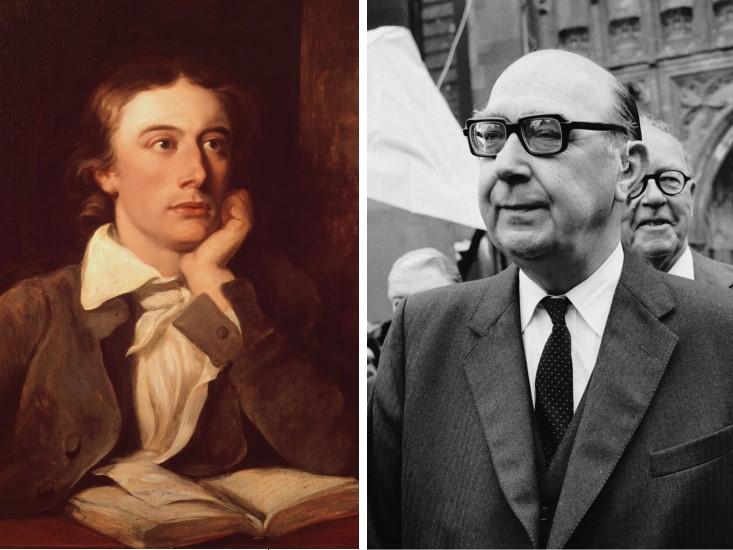
Two great poems with opposing views, composed over 200 years apart—“Lamia” by John Keats and “Water” by Philip Larkin—address these vexed questions through the entangled concepts of water and light.
The romantic poet John Keats, one of the most sensuous masters of the English language, proclaimed his objection to science when he derided Sir Isaac Newton for “unweaving the rainbow.” During a drunken Christmastime dinner party in 1817, in the approving presence of the poet William Wordsworth and the writer Charles Lamb, Keats raised his glass to drink, facetiously, to “Newton’s health, and confusion to mathematics.” (Newton had died almost a century before.) He endorsed Lamb’s view that “Newton had destroyed the poetry of the rainbow by reducing it to a prism,” and that the eminent scientist was “a fellow who believed nothing unless it was as clear as the three sides of a triangle.”
Two years later, in his long love poem Lamia, Keats returned to his lament about how cold science had stolen the sheen from the “awful rainbow” (“awful” being used in the old sense of “full of awe”):
There was an awful rainbow once in heaven:
We know her woof, her texture — she is given
In the dull catalogue of common things.
Philosophy will clip an angel’s wings,
Conquer all mysteries by rule and line,
Empty the haunted air, and gnomed mine,
Unweave a rainbow…
Keats’ reactionary attitude may seem surprising and disappointing for an intelligent and worldly young man who had been training to be a surgeon. All Newton had done, after all, was to reveal the natural machinery of water and light that created a rainbow, with droplets of water acting as billions of tiny refracting prisms that break rays of light into seven soft hues. One might think that Keats, an ardent apostle of truth and beauty, would be enchanted by this explanation that fused the two. His own poetry sparkled with references to water: Dewdrops are the “early sobbing of the morn,” and the delicate epitaph he composed for himself as he lay dying in Rome read, “Here Lies One Whose Name was writ in Water.” Surely the image of water and light conjoining in an airy ballet to create a band of colors would amplify rather than diminish his sense of wonder?
Keats’ resistance was rooted not in specific religious belief (he despised organized religion and said the sound of the bells of St. Paul’s gave him the creeps) but in his reverence for the pagan forces of nature. To him, the synthesis of the rainbow was a celestial drama that should be accepted as is, “without any irritable reaching after fact and reason.” In short, he wanted to let sleeping rainbows lie. His beautiful if wrong-headed phrase, “unweave a rainbow” was chosen by Richard Dawkins as the title of his 1998 book, Unweaving the Rainbow, in which he argues that science actually supplies a kind of poetry, that it lets us better appreciate the wonders of the world.
If Keats is England’s most sensuous poet, Larkin is its most bitter. Though both men were agnostic, their views on science were as divergent as their poetical styles: Keats with his voluptuous lines that bordered on the cloying; Larkin with his gloomy, acerbic, and workaday diction that, in lesser hands, would have verged into doggerel, but in his, was transfigured into poetry. Never more so than in the case of his poem “Water.”
Larkin wrote the piece in April 1954, just before Easter. Though there are unmistakable references to the Christian festival, such as renewal rituals of drenching and sousing, the poem itself has a somber secularism, imagining as it does a pagan religion composed around light and water. Written in the first person, it has a touching intimacy. The poem is short enough to reproduce here in full:
If I were called in
To construct a religion
I should make use of water.
Going to church
Would entail a fording
To dry, different clothes;
My liturgy would employ
Images of sousing,
A furious devout drench,
And I should raise in the east
A glass of water
Where any-angled light
Would congregate endlessly.
The closing quartet says it all—a seamless fusing of the vocabulary of science and religion to create a tableau vivant of awe. Larkin’s choice of the verb “congregate” is simply, to play on the idea of light, brilliant: If he had used the hard, scientific term “refract” instead of “congregate,” the poem would have lost its power. “Congregate” invokes the image of the faithful shuffling into church—except here, it is light that is streaming into a slender glass of water, in an endless commingling of miniature rainbows.
Nina Martyris is a freelance journalist.