By about 16,000 years ago, humans were living in the Americas. Whether the Clovis people of North America centered in New Mexico, or the Fishtail Projectile Point people of South America concentrated in Patagonia, humans spread rapidly throughout the continents.
But how?
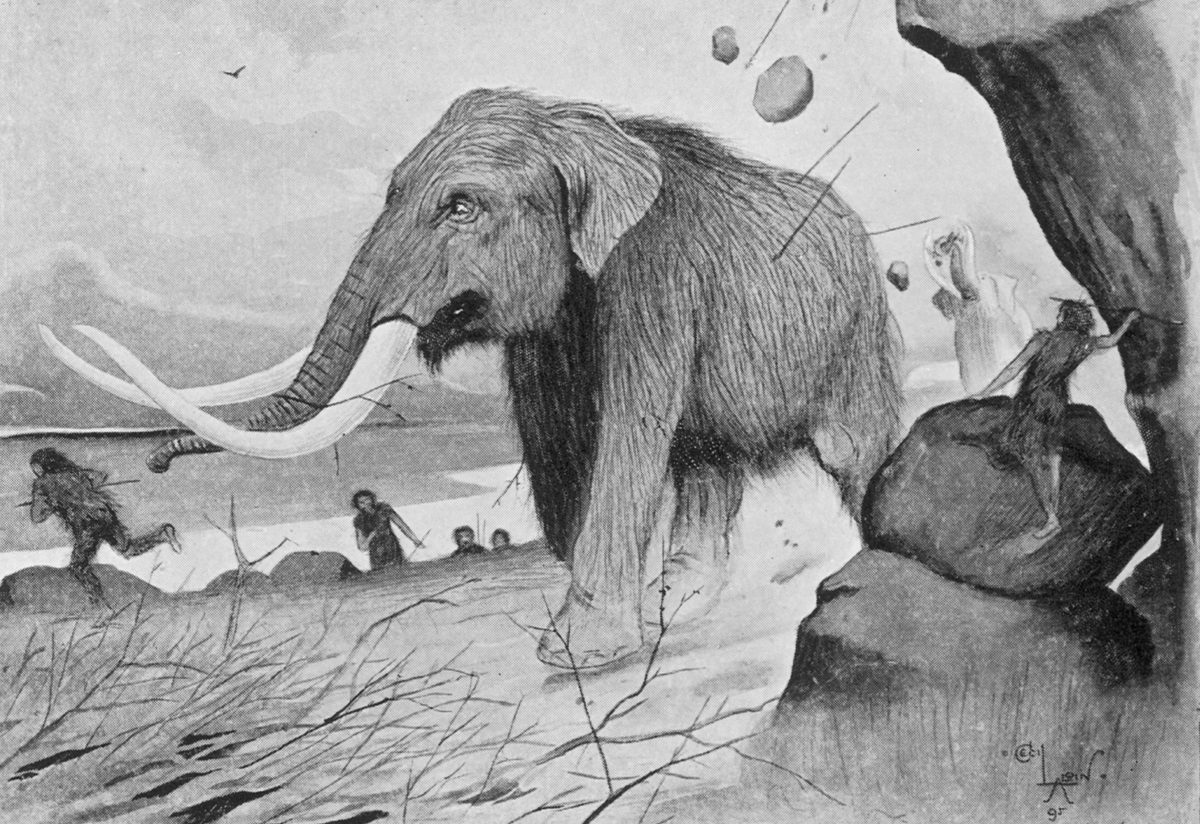
For decades, anthropologists have debated whether these early peoples subsisted by taking down the massive mammals of the time or foraged on a mix of whatever they could find. A recent study published in Science Advances argues the former over the latter—that megafauna such as woolly mammoths and giant ground sloths sustained Paleoindians after their arrival in the Americas. The study authors write that a “focus on megaherbivores facilitated rapid human expansion into different ecosystems,” until they were later forced by large mammal extinctions to diversify their diets.
A team of researchers from the United States, Argentina, and Canada evaluated zooarchaeological records of animal remains at human sites from several areas: the Eastern Beringia entry point, where people crossed into North America from Asia; the North American hub of the Clovis people; and the South American Fishtail Projectile Point region. They found that for all three regions, at least 98 percent of the food came from large mammals.
Read more: “Beer Domesticated Man”
“Except for the likely opportunistic consumption of easily obtainable fruits or nuts, these highly mobile Early Paleoindians apparently consumed a diet mostly of meats, including both protein and fat,” write the researchers.
Based on the evidence of butchery, these peoples were likely enjoying the meat and fat from newly killed animals, but not processing the bones for marrow, a strategy that suggests megafauna were plentiful.
The study traces the dietary pathway of Paleoindians starting from the time they entered Eastern Beringia (13,300 to 14,000 years ago) and fed on woolly mammoths (Mammuthus primigenius) that roamed on grasslands as far south as the Midwest. From there, the Clovis people (12,800 to 13,400 years ago) shifted their focus to a similar Columbian mammoth (M. columbi), supplemented with the mastodons (Mammut spp.) that preferred swampier settings in Central America. The Fishtail Projectile Point populations in South America “tracked similar megafaunal prey, including large ground sloths (mylodonts and megatheres) and gomphotheres, and other megafauna such as camelids and equids,” explain the study authors.
Basically, large mammals served as a one-stop shop for the earliest humans and their mega-meat-heavy “keto diet.” 
Enjoying Nautilus? Subscribe to our free newsletter.
Lead image: Archivist / Adobe Stock