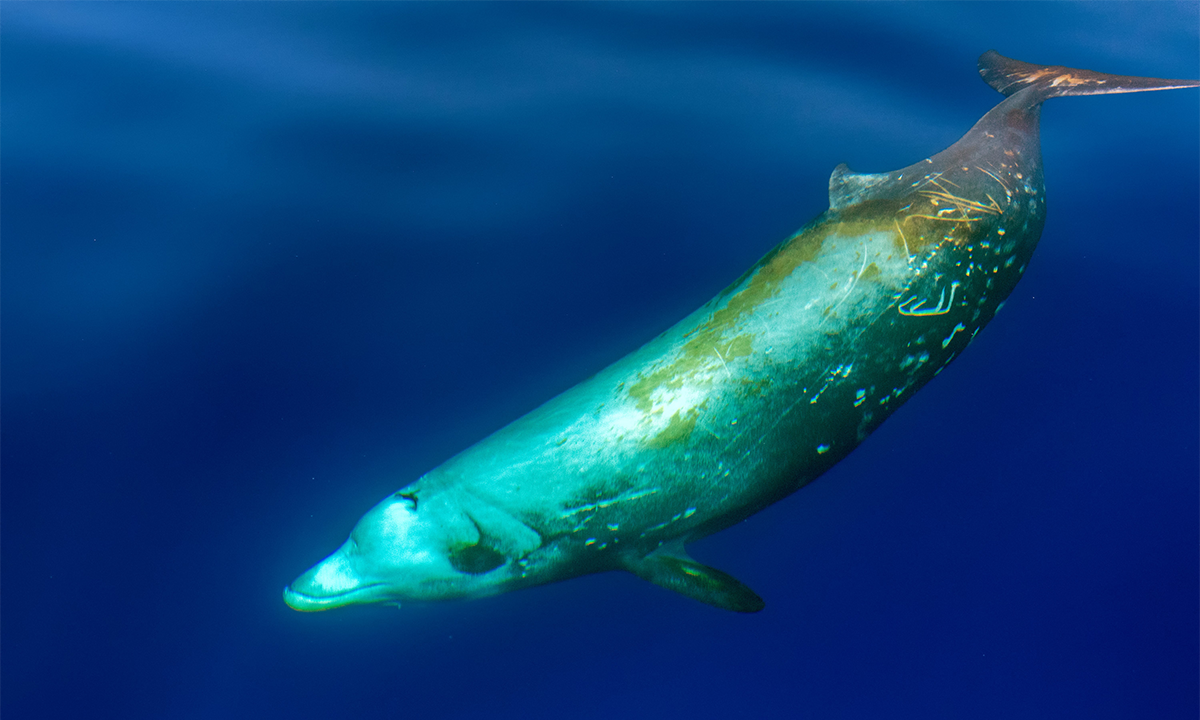
Beaked whales, named for their long snouts, are one of the least-studied marine mammals because they spend a lot of time foraging in the deep. Their dives can last more than two hours, during which they can descend to nearly 10,000 feet. Even when beaked whales surface for air, they remain elusive because their blowholes spray water more forward than vertically. A paper published yesterday in PLOS One, however, gleaned information on beaked whales off the coast of Louisiana by following their sounds for six months.
Several beaked whale species, all in the family Ziphiidae, inhabit the Gulf of Mexico, including goose-beaked (Ziphius cavirostris), Gervais’ (Mesoplodon europaeus), Blaineville’s (Mesoplodon densirostris), and possibly Sowerby’s (Mesoplodon bidens) beaked whales.
Researchers from the University of Miami and NOAA studied beaked whales by listening in on their hunting conversations. As they search for fish and cephalopod prey, the whales continually send out echolocation clicks. Two 4-channel High-Frequency Acoustic Recording Packages were deployed at about 3,600 feet down, yielding 3-D recordings. In this mode of passive tracking, species could be distinguished by their species-specific click frequencies.
Read more: “Hunting the Most Elusive Whale”
Typically, whale behavior is studied through active tracking, using equipment such as hydrophones towed by whales, which are expensive to deploy. One benefit of passive tracking is getting much larger sample sizes. While you can’t track individual behavior as well, the array of recording packages in this study allowed triangulation to assess the distribution of individuals across depths and directions of their movements.
The recordings revealed three species foraging off the Louisiana coast: goose-beaked, Blainville’s, and Gervais’ beaked whales. For the latter, this study is the first detailed description of their movements up and down the water column. Over the 200 days of recording, goose-beaked whale clicks were detected in 29 events, Gervais’ beaked whale clicks in 54 events, and Blainville’s beaked whale clicks in two events. Goose-beaked and Blainville’s beaked whales were often found swimming alone, whereas Gervais’ beaked whales were in groups of at least two individuals.
The researchers reconstructed individual paths of diving whales from their clicks using an existing toolkit called Where’s Whaledo. They found that the dives of Gervais’ beaked whales were notably shorter and shallower than those of the goose-beaked whales. The finding may signal variation in foraging behavior among beaked whale species.
“Acoustic tracking is a reliable alternative to tagging for studying the acoustic and diving behavior of elusive beaked whales in the Gulf,” concluded the study authors. Their estimates of dive depths, swimming speeds, movement direction and pitch, and foraging time were consistent with values found using other methods. Acoustic tracking also provided novel information about the behavior of the Gervais’ beaked whale.
Sometimes just being a good listener pays off. 
Enjoying Nautilus? Subscribe to our free newsletter.
Lead image: Andrea Izzotti / Shutterstock