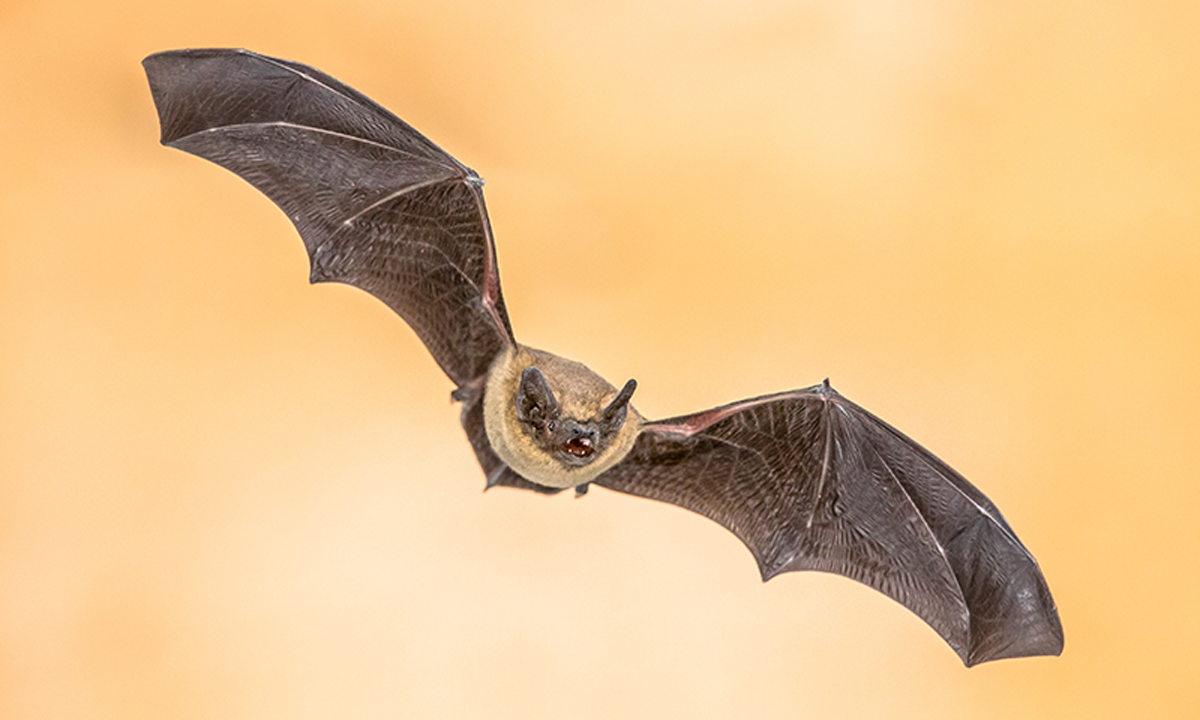
The faster you go on a bike or in a car, the more things appear to visually stream past. Your brain synthesizes this “optic flow” to estimate your speed relative to a cognitive map of your surroundings. Bats face an analogous navigation task as they fly through their environments, except they rely on acoustic inputs as they echolocate in the dark. How they synthesize the myriad individual echoes into a coherent perception of speed relative to surroundings has been a mystery.
A study published in Proceedings of the Royal Society B reported evidence that echolocating bats are using acoustic flow to navigate. “As bats fly and emit their calls, echoes return at slightly different rates depending on how close objects are and how fast the bat is flying. This creates a kind of sound flow,” explained study author and University of Bristol sensory biologist Marc Holderied in a statement.
Holderied and his coauthors designed a bat accelerator machine: a conveyor-belt system with 8,000 revolving panels on either side of an eight-meter section of woodland path. The path was known to be a commuting corridor for wild pipistrelle bats (both Pipistrellus pipistrellus and P. pygmaeus) in Bristol. The panels, covered in plastic ivy leaves for a hedge-like acoustic texture, could either rotate in the same or in the opposite direction of bat flight.
Read more: “Why Bats Are Flying Machines”
The researchers tested a trio of conditions: the panels rotating in the same direction of bat flight, rotating in the opposite direction, or not rotating at all. Over three nights, 104 bats flew the whole length of the panel array. When the panels were rotating in the direction of flight, they flew faster on average. In contrast, when the panels were rotating in the opposite direction, bats flew significantly slower by up to 28 percent.
“We know bats fly swiftly, but we’ve shown that we can make them fly even faster with our corridor of ‘revolving hedges’—our bat accelerator,” concluded study author and aerospace engineer Shane Windsor. The phenomenon is a spin on the principle of Doppler shift, wherein the bats are using motion-induced changes in echo frequency to regulate their flight. Because the effect was the strongest as bats approached the fake hedge rows, they’re likely interpreting echoes from several meters ahead of their flight path.
The experimental results demonstrated that bats rely on acoustic flow for speed control, which may serve them in navigation. Compared to sonar-based robots that perform poorly as soon as you add clutter to their paths, bats can apparently use Doppler information to estimate their self-motion.
Robots, eat your hearts out. 
Enjoying Nautilus? Subscribe to our free newsletter.
Lead image: Rudmer Zwerver / Shutterstock