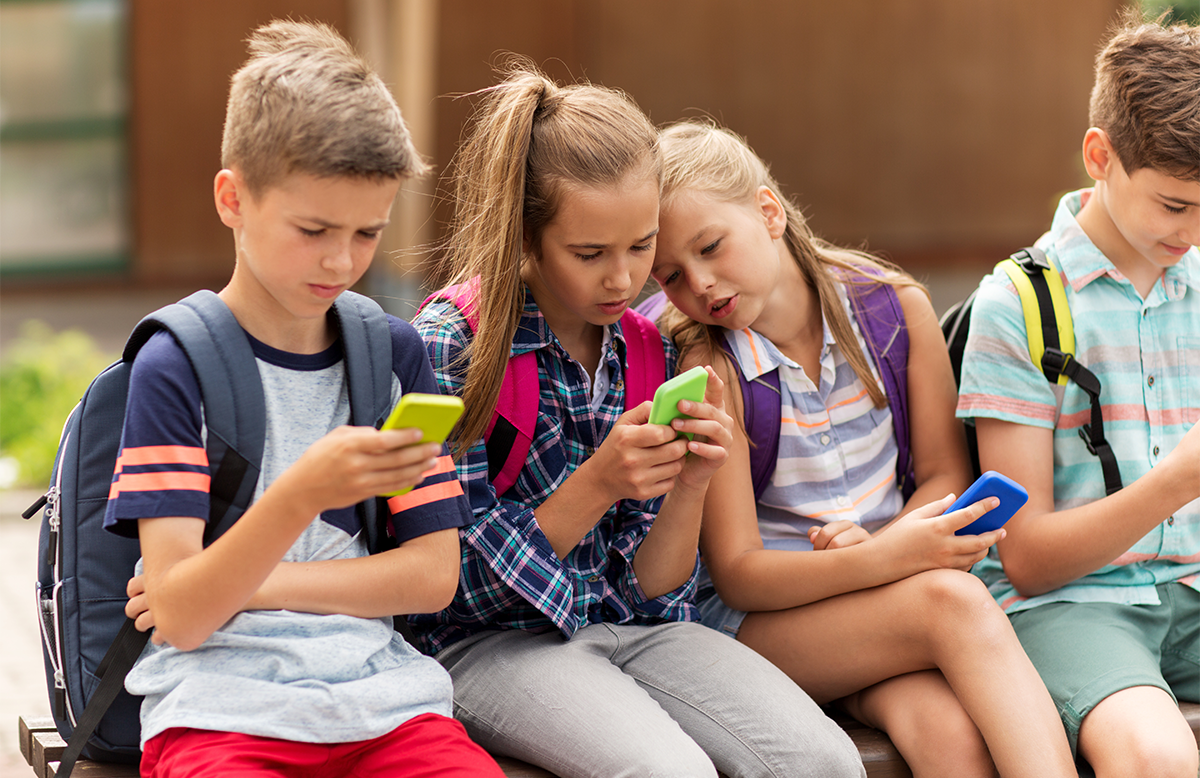
When Illinois kids go to school next year, they’ll have to make do without their cell phones. Governor JB Pritzker just signed a bill directing school districts in the state to implement a “bell-to-bell” ban on the devices. But according to a new study published in Behavioral Sciences, cell phone bans may not help raise test scores.
Psychologists from the University of California, Los Angeles recruited a group of 55 sixth-graders and 51 third-graders, some who owned phones and some who didn’t. Those with phones took two reading comprehension tests, one with their phone present and one with their phone taken away. They also all completed a survey about cell phone use and ownership after the tests, including questions about when they received their first phone.
Somewhat surprisingly, the presence of cell phones didn’t seem to affect the reading comprehension scores. Those who had their phones out performed about the same as those with no phones. According to the team, this could be because of “nomophobia,” or the anxiety that comes from being separated from a cell phone (and yes, it’s a portmanteau of “no mobile phobia”). The anxiety of having no cell phone, the theory goes, may be just as distracting as the presence of a phone—or not. The researchers also noted that the kids with phones didn’t receive enough notifications during the tests to make much of a difference.
Read more: “Why I Built a Dumb Cell Phone with a Rotary Dial”
Of course, that doesn’t mean their experiment was inconclusive. The researchers found that the mere ownership of a phone was enough to significantly decrease reading comprehension scores, whether it was present during the test or not.
“The children who brought their phones to school had the same reading scores as children who did not have phones at school that day,” study author Patricia Greenfield said in a statement. “So, it’s ownership of a phone, not the immediate presence of one, that correlates with poorer reading comprehension at the elementary school level.”
In other words, school cell phone bans may not make a difference, if these findings hold. But that could be a big “if.” As the researchers note, the study had some limitations, including a small sample size.
There was one interesting wrinkle, however. The group of kids studied were linguistically diverse, with 42 percent coming from a home that spoke English, 28 percent from a Spanish-speaking home, and 30 percent from an Arabic-speaking one. The non-English speakers actually performed better on the reading comprehension tests the earlier they started texting and playing games on their phones. According to the team, it’s possible that these early digital experiences bolster their reading comprehension abilities.
So the jury’s still out on whether cell phones are bad for kids’ test scores, and if so, how bad. But with the number of states embracing school cell phone bans, the sample size of these natural experiments is certainly growing. 
Enjoying Nautilus? Subscribe to our free newsletter.
Lead image: Syda Productions / Adobe Stock