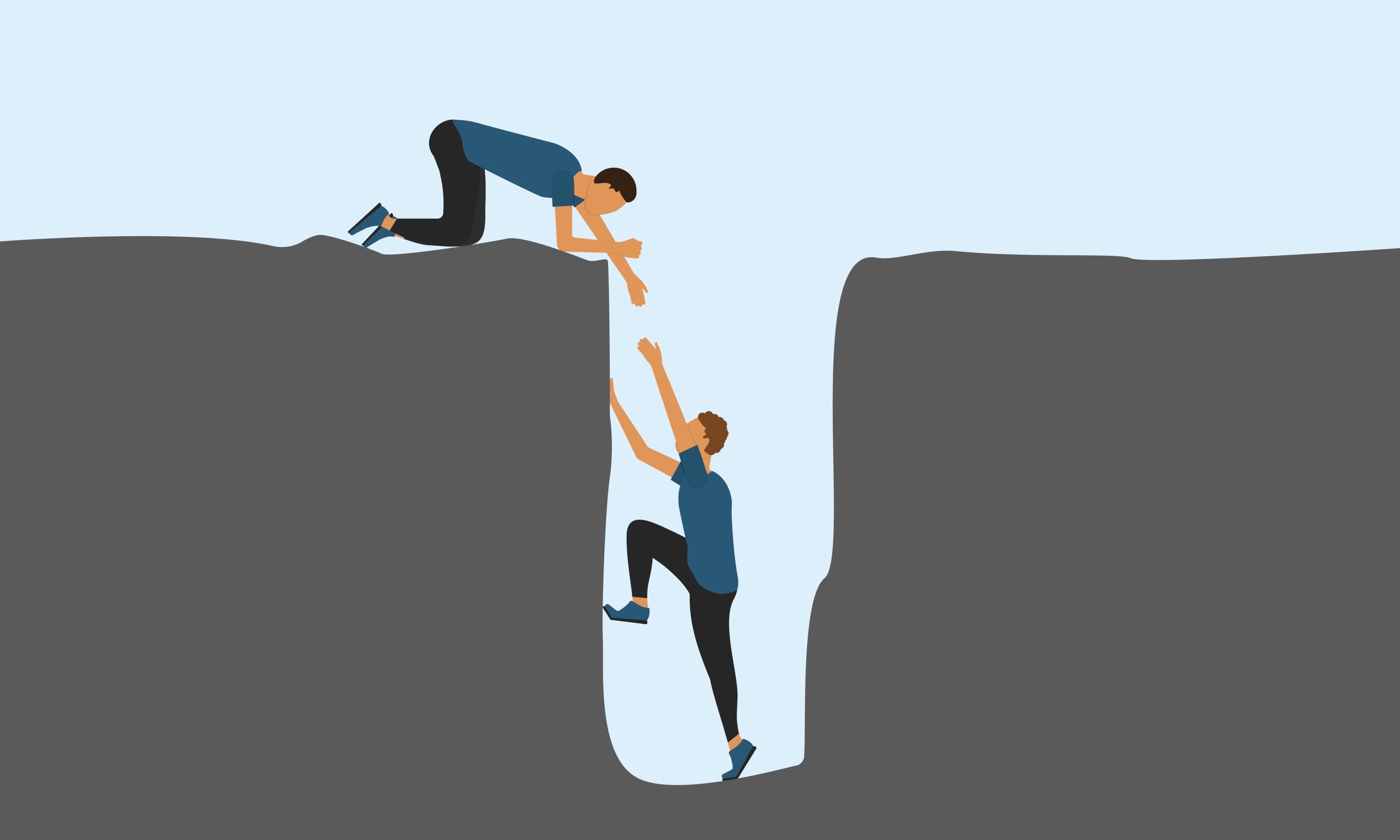
Cooperation is the bedrock of civilization, but how it emerged from the seemingly selfish evolutionary regime of “survival of the fittest” is something of a puzzle. After all, helping someone comes at a cost, and you may not be able to recoup it. So where did it come from?
On a small scale, reciprocal cooperation between two individuals (for example, keeping track of who picks up the check when you and a friend dine out) is fairly straightforward. When you scale up that dynamic to include a circle of friends, a classroom, a university campus, etc., things get murikier. For instance, who deserves being helped?
How we collectively decide that important question is the subject of a new theoretical study published in the Proceedings of the National Academy of Sciences.
Read more: “Does Cooperation Beat Cheating After All?”
Imagine a scenario where a person (Alice) observes another individual (Bob) help someone else (Charlie). Alice may come away thinking Bob is a better person, but how did the exchange change her opinion of Charlie? More importantly, would allowing for any change in Charlie’s reputation facilitate a stable cooperative dynamic?
To find out, researchers from Kobe University, RIKEN, and the Interdisciplinary Transformation University constructed a model that takes into account the reputational changes not just to Bob the Donor but Charlie the Receiver as well. They also investigated whether this information would lead to the development of norms, or “rules” about how to treat people with a certain reputation that might lead to more stable cooperation.
“If Alice sees Bob help Charlie, she may infer that Charlie is someone worthy of being helped, or at least that Bob considers Charlie worthy of help,” study author Tham Yukari Jessica explained in a statement. “In this way, people may gain information about how others view a person simply by observing how that person is treated, without any additional information sharing.”
They discovered that allowing observers of an exchange to update the receiver’s reputation as well as the donor’s helps the group’s evaluations become more aligned (without observers sharing information). In other words, they were better able to reach something of a private consensus on the question of “who deserves to be helped,” which makes cooperation easier to sustain.
The team then used a supercomputer to test more than a million different combinations of norms to find out if the resulting “societies” that adopted them were evolutionarily stable and/or cooperative. This dual private assessment proved to be key. The team found 61 norms that resulted in both high cooperation and evolutionary stability—all of them included some kind of dual reputation update. “This suggests that evaluating the recipient may be a much more general ingredient for stable cooperation than previously recognized,” Tham said.
It’s also a bit of a double-edged sword. “We often judge people not only by what they themselves do, but also by how they’re treated by those around them. Our results suggest that this tendency may help coordinate reputations and thereby maintain cooperation,” Tham explained. “At the same time, the very same tendency could contribute to harmful outcomes such as exclusion or bullying if we treat someone badly simply because we see others treating them badly.” 
Enjoying Nautilus? Subscribe to our free newsletter.
Lead Image: San-Sanych / Shutterstock