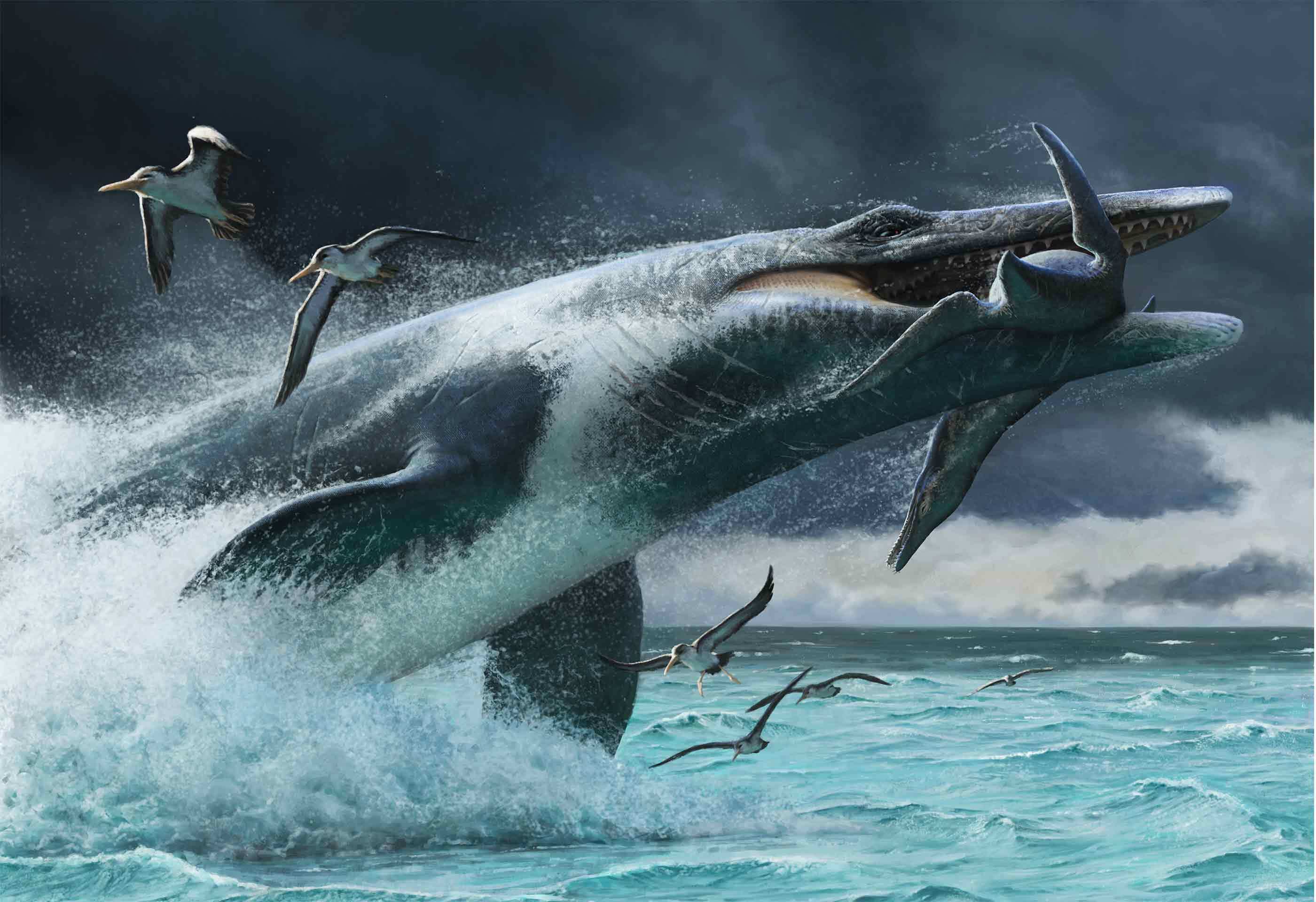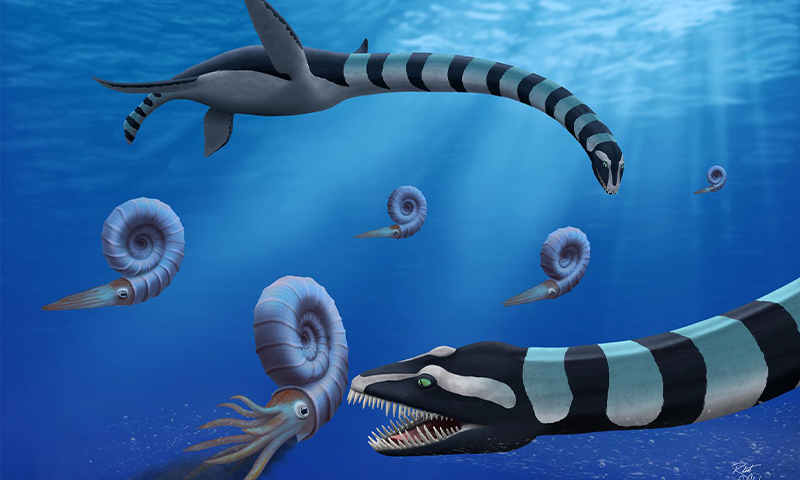
The answer to a famous sea monster mystery has finally bubbled to the surface: Multiple fossils from an 85-million-year-old marine reptile, previously described using the generic term “elasmosaurs,” have received a new genus and species name, Traskasaura sandrae. This creature, which somehow simultaneously resembles a penguin, zebra, giraffe, and a Tim Burton sandworm, stretched nearly 40 feet long, and had super sharp teeth—likely for crunching on shelled cephalopods called ammonites.
Fossil evidence suggests that T. sandrae was unlike any other plesiosaur, a group of ancient marine reptiles that included elasmosaurs and swam the world’s seas and rivers between 200 million and 66 million years ago. The recently minted species had a shoulder joint that opened down, rather than to the side, and flippers that were particularly curved on the top—traits that may have enabled T. sandrae to pounce on ammonites, squid, and fish swimming below. It also helped that the reptile had “very odd” features, such as “a very long neck, almost like a fishing pole,” says F. Robin O’Keefe, a biologist at Marshall University who’s often referred to as “the Plesiosaur Guy.”
This would make T. sandrae one of the first plesiosaurs to hunt from above, according to recent findings published by O’Keefe and colleagues in the Journal of Systematic Palaeontology. T. sandrae might have evolved these features because its lineage lingered near the surface of clear waters, which were “rich in marine life,” O’Keefe says, rather than scanning for the silhouettes of prey swimming above.
The first fossils belonging to what’s now known as T. sandrae were unearthed in 1988 from a geologic formation on Vancouver Island in Canada. These specimens—referred to only as members of a group of marine reptiles known as elasmosaurs—were first described in 2002, and since then they’ve received wide fanfare in Canada. The beloved bones were even declared British Columbia’s provincial fossil in 2023 after a public poll.
But the finds were difficult to pin down to a specific genus—until an “excellently preserved” partial skeleton cropped up in 2020. With this new finding, O’Keefe and colleagues from Canada, Chile, and the United States had enough information to add a new genus and species to the books. 
Lead image: Robert O. Clark