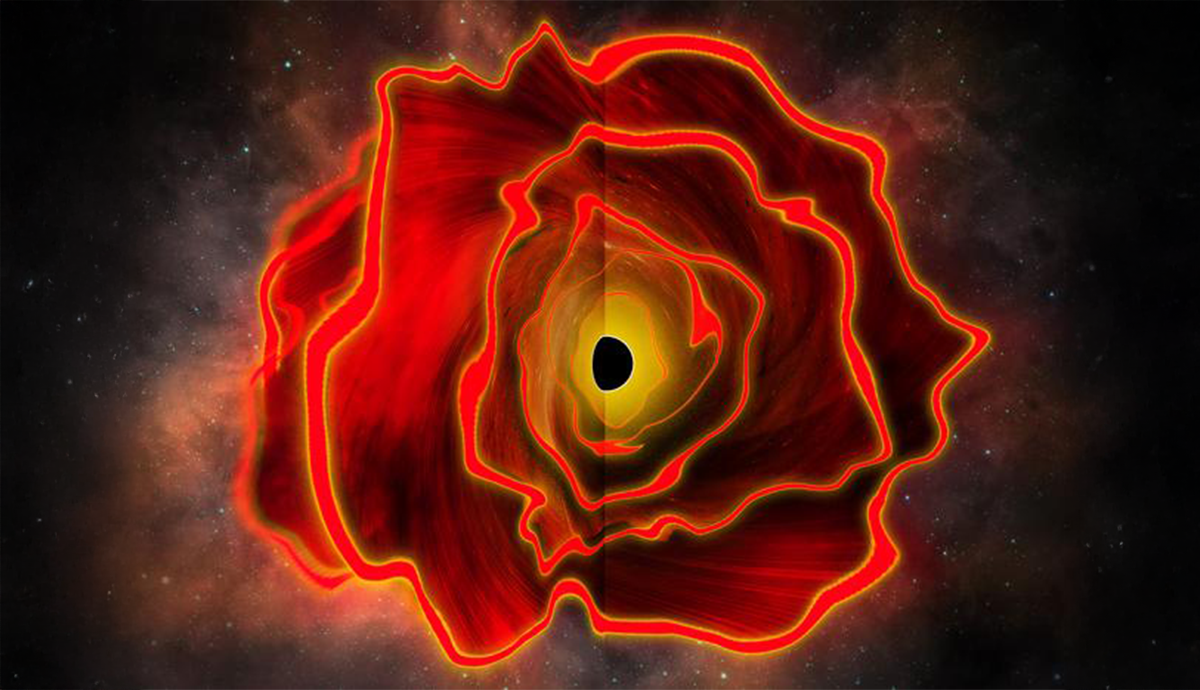
Recently, astronomers using the James Webb Space Telescope (JWST) to peer deep into the history of the universe noticed something strange—a very bright, very red dot. Now, the team behind its discovery has published their analysis of the cosmic oddity in Nature, and it’s unlike anything ever seen before.
According to the international team of astronomers, the bright red dot appears to be a combination of a massive black hole and a star, around the size of our entire solar system. The team arrived at that conclusion after modeling a variety of scenarios to explain the object’s peculiar characteristics.
Typically, redness in a celestial object is a telltale sign of cosmic dust, similar to how wildfire smoke turns the sunset red, researchers say. But other signatures from the object didn’t match up with the dust hypothesis. The astronomers also didn’t detect any heavy metals usually produced by mature stars—only the simple elements hydrogen and helium.
Read more: “A Wild Idea to Solve the Mysteries of Black Holes”
“We started to ask: Could you make something that red using just hydrogen, without any dust?” study author Robert Simcoe of the Massachusetts Institute of Technology said in a statement. “To our surprise, it turns out you can, if you have an extremely dense screen of hydrogen, so dense that it looks more like the surface of an enormous star than a wispy interstellar nebula.”
The only thing that could explain the intense light streaming from the object is a black hole at its core, around 100,000 times more massive than our sun. “You have something that looks a bit like a star but is 100 billion times brighter,” study author Rohan Naidu of MIT explained. “That means you can’t be powering this by nuclear fusion, which is the energy source that sits at the heart of all the stars we have.”
If their findings are confirmed, this would be the first “black hole star” ever discovered, named MoM-BH*-1. It also could shed light on another cosmic mystery. Two years ago, the JWST detected puzzling “little red dots” (LRDs) that existed near the birth of the universe. One prevailing theory is that these LRDs represent primordial galaxies. According to the team, these LRDs may be black hole stars as well.
“Every little red dot is consistent with being a black hole star, embedded in a generic early galaxy,” Naidu said. “But what is special about MoM-BH*-1 is, the black hole star is essentially completely outshining its surrounding host galaxy, such that we’re seeing pure black hole star light.”
A beacon from the dawn of time itself. 
Enjoying Nautilus? Subscribe to our free newsletter.
Lead image: Jose-Luis Olivares, MIT