Few materials are as fascinating as spider silk. It’s stronger than steel, flexible rather than brittle, and light enough to float on the breeze. And vibrations in webs tell spiders, whose vision is not prize-winning, when something delicious has blundered its way into their homes-cum-traps. But how the properties of spider silk feed into spiders’ ability to glean information from the web has not been probed as deeply as you might think. Recently, a team of researchers interested in the evolution of such an unusual material—and how to make man-made versions—looked at how vibrations propagate through spider silk in the lab. They found that the silk transmits an enormous range of vibrations, more so than any other known material, and that spiders could be using the different flavors of vibration to infer what’s happening elsewhere in their webs.
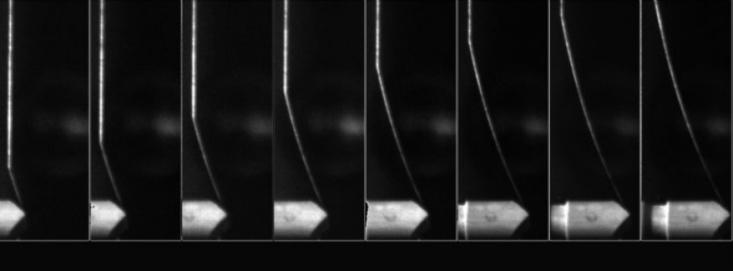
Silk’s dual role as both a telegraph wire and a food-catching net presents a potential evolutionary problem: What’s good for one purpose may not be good for the other. A silk that vibrates just right to send messages, for instance, might tear when an insect cannons into it, while a tougher silk might be worse for gathering information from elsewhere in the web. To get at how this evolutionary balancing act might have played out, the researchers got spiders to excrete single threads of silk, stretched them taut, and bombarded them with sound waves and even plastic bullets.
Using a laser vibrometer and a high-speed camera to watch waves propagate, the researchers found that there were crucial differences between the ways spider silk responds to transverse waves (ones that go side-to-side, like a guitar string) and longitudinal waves (ones that go along the length of a thread). Transverse waves can be caused by all kinds of disturbances, including wind and changes in web tension, suggesting they might be useful for a spider assessing whether the web has been damaged. Longitudinal waves, in contrast, are less sensitive to environmental conditions, including the state of the web, and would therefore be better for detecting caught prey. The researchers suspect that a spider plucking on a thread can tell from the resulting longitudinal waves where its meal is. (Below is video they shot of a spider “almost instantly” detecting the location of snagged prey and quickly running over to wrap it in silk.)
Their findings also reveal that longitudinal waves in spider silk have a wider range of speeds than any other material on record, implying great flexibility in the kinds of messages the waves can transmit. That range makes the vibrations exquisitely tunable: Spiders determine the thread’s properties with the way they spin it, and then pull it to any tautness they desire. And when spider silk gets damp overnight, it contracts, providing a kind of daily reset button that lets spiders re-stretch it to their liking the next day. “Spiders can therefore choose the extent to which the silks are stretched,” the researchers write, “allowing them to shape the balance between mechanical and signaling properties as required.”
For researchers who are interested in making artificial materials with the versatility of function of spider silk, that’s a good insight into a hard act to follow. For the rest of us, it’s a glimpse into a way of life where one’s very house is also a kind of information technology, a veritable antenna humming with signals.
Veronique Greenwood is a former staff writer at DISCOVER Magazine. Her work has appeared in Scientific American, Popular Science, and the sites of Time, The Atlantic, and The New Yorker. Follow her on Twitter here.