If you’re a farmer, you know what a menace birds can be for your crops—eating the fruits, damaging the leaves, and pooping on the plants. The bird droppings are not just an eyesore; they’re a food safety issue. Birds carry pathogens that can harm humans, such as the bacteria Salmonella and E. coli, which continue to trigger food safety concerns. A study published today in the Journal of Applied Ecology proposes a gentler way to deal with winged crop-menaces than nets or spray.
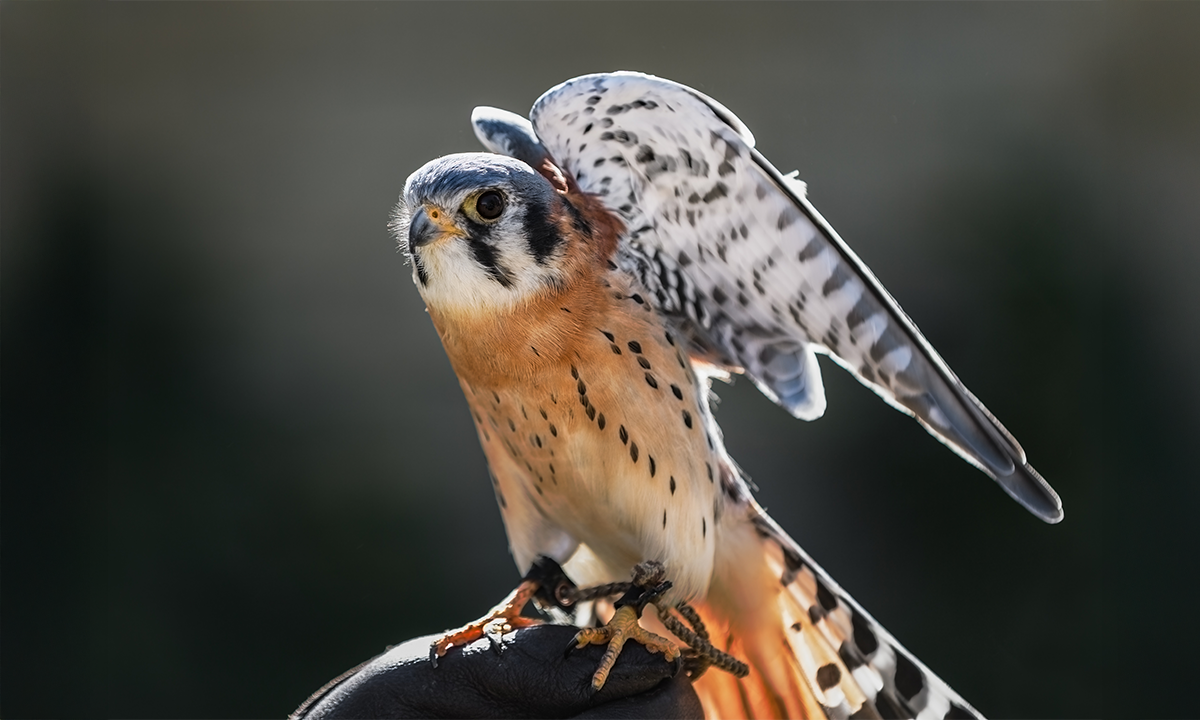
Michigan State University scientists led research that investigated a diminutive falcon, the American kestrel (Falco sparverius), as a living scarecrow for biological control. As the smallest birds of prey in the United States, American kestrels feed mostly on insects but will take down an occasional bird or small mammal. So, the researchers wondered whether roosting kestrels could serve as deterrents to crop-pest birds, such as robins, starlings, and grackles.
The study was conducted in 16 of northern Michigan’s sweet cherry orchards, half of which contained kestrel nesting boxes and half of which didn’t. By surveying birds, bird poop, and crop damage along transects in the orchards, the researchers compared the fields with kestrels to the fields without. Using thin nets to capture pest birds, they collected fresh fecal samples, which were analyzed for bacteria. The researchers focused on the most common foodborne pathogen carried by birds, Campylobacter spp., which causes diarrhea in humans.
Read more: “The Wild, Secret Life of New York City”
The orchards with active kestrel nest boxes had significantly fewer pest birds and a threefold reduction in bird droppings than the sites without. Kestrels apparently make good scarecrows. “They're really good at keeping the amount of poop down,” said study author and agroecologist Olivia Smith in a statement.
About 10 percent of the fecal samples the scientists analyzed contained Campylobacter spp. While that doesn’t guarantee that the bacteria would have been transmitted to humans through the cherry harvest, it highlights a safety risk that warrants keeping birds off crops. Maintaining kestrel boxes could be a win-win for farmers and falcons, since American kestrel populations are decreasing, according to the International Union for Conservation of Nature.
“Our findings suggest that the promotion of birds of prey using nest boxes may be one way for growers to conserve a declining species, reduce crop damage, and reduce in-field fecal contamination that could cause foodborne illness,” wrote the study authors.
Increased food safety with a cherry on top—raptor conservation. 
Enjoying Nautilus? Subscribe to our free newsletter.
Lead image: Geoffrey Kuchera / Shutterstock