Humpback whales (Megaptera novaeangliae) are renowned long-distance migrators. Both females and males travel seasonally from higher latitude summer feeding areas to lower latitude winter breeding grounds. But a new study in Royal Society Open Science found that in rare cases, individual whales take different paths altogether.
Depending on which of the seven populations they belong to, humpbacks typically travel north-to-south along particular coasts. After feeding off Brazil, the “breeding stock A” population journeys southward to a group of remote Antarctic islands. And after feeding off eastern Australia, the “breeding stock E1” population heads southward to the Great Barrier Reef.
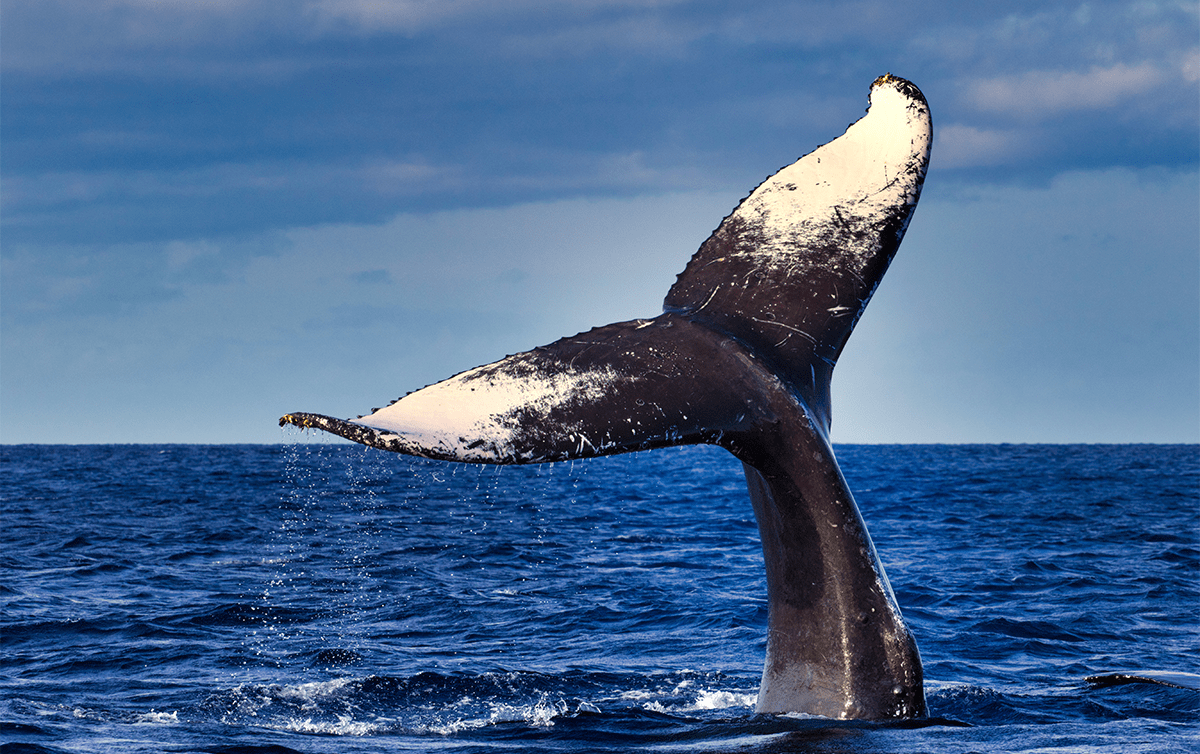
Researchers from Brazil, Australia, Ecuador, and the United States reviewed 19,283 humpback whale photos from 1984 to 2025, images from whale-watching boats and other instances that were ultimately entered in the citizen science site Happywhale.com. Whale sightings most often consist of watching their rear ends as they dive back toward the depths after surfacing for air. Fortunately, experts can individually identify humpbacks by the shape and color of their fluke undersides, giving each whale a distinct ID number.
Read more: “How Whales Could Help Us Speak to Aliens”
Again, most of these whales moved in expected patterns of north-south migration along coastlines, but in two remarkable instances, whales migrated halfway around the world.
One whale photographed in 2007 on the east side of Australia in what’s called the Coral Sea was photographed again 12 years later off the coast of Brazil near São Paulo. That journey encompassed at least 8,800 miles. The other record-setting whale was first photographed in 2003 in Abrolhos Marine National Park, a natural nursery in northeastern Brazil where most baby humpbacks start their lives. In 2025, it was spotted in Hervey Bay on Australia’s east coast, having traveled about 9,400 miles, or more than three times the distance from New York City to Los Angeles.
Their travels, in which they switched from one population’s home range to another’s along an entirely different continent, are obviously distinct from regular migration journeys. Males or females who leave their home population may seek the chance to mate with less-related individuals, like people leaving their hometowns in search of broader romantic opportunities.
“Occasional individuals moving between distant breeding grounds can help maintain genetic diversity across populations and may even carry new song styles from one region to another,” hypothesized Griffith University doctoral candidate and study co-author Stephanie Stack in a press release.
Love truly knows no boundaries in the case of adventurous humpback whales. 
Enjoying Nautilus? Subscribe to our free newsletter.
Lead image: manuel / Adobe Stock