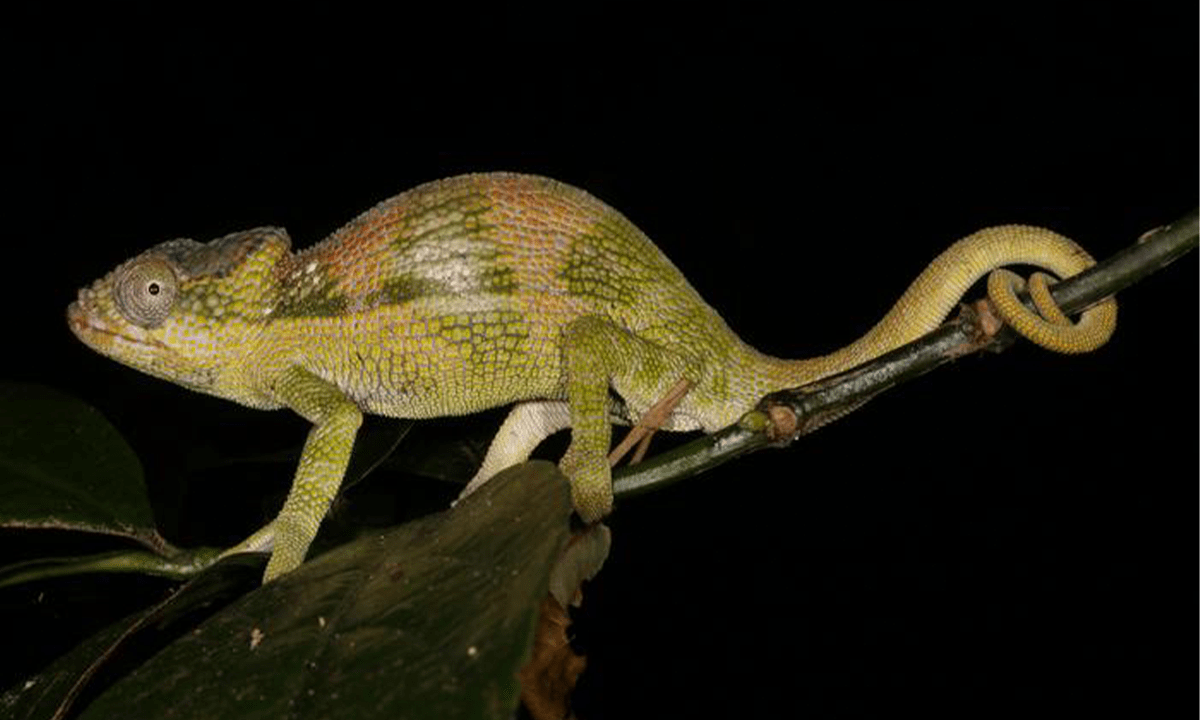
What happens when tropical rainforest patches get isolated on mountaintops that have different environments from the valleys? For example, the largest rainforest in Southern Africa spans about 30 square miles on Mozambique’s Mount Mabu, which towers over the savanna below. Studies have found that Mabu and other “sky islands” harbor exceptional biodiversity. Yet, northern Mozambique, which contains upward of 30 sky islands, has been poorly studied because it’s difficult to access and historically beset by civil war.
The researchers behind a new study in the journal Vertebrate Zoology, however, spent enough time there to report on the chameleon species (Nadzikambia spp.) found on six of Mozambique’s larger sky islands. They compared DNA sequences from 31 chameleons sampled from the mountain forests of Mabu, Mulanje, Chiperone, Namuli, Inago, and Ribáuè. They also compared body features of chameleons collected across these sites.
Based on the combination of genomes and morphology, the research team, a pair of herpetologists from South Africa, determined that the chameleons represented six distinct species, four of which are new to science. While maintaining similar chameleon body shapes that are adapted to forest living, they developed other unique characteristics. Case in point: The chameleons from Mount Ribáuè had more scales on their lower jaws and tall scales along the sides of their heads.
Read more: “This Cloud Forest Should Not Exist”
Two of the chameleon species new to science were named in honor of primate biologist Jane Goodall (N. goodallae) and DNA chemist Rosalind Franklin (N. franklinae).
The suite of six chameleon species tells a story of populations geographically isolated over millions of years. Chameleons don’t tend to stray far from their forests, especially if it means encountering unsuitable habitat, such as the savannas below the mountaintops. With the sky islands surveyed in this study separated by at least 28 miles each, it’s no wonder that there’s been little or no movement of chameleons between them.
“These mountains rise sharply from the surrounding savanna, trapping clouds and rain and creating cool, moist refuges in an otherwise dry landscape,” explained coauthor Krystal Tolley, of the South African National Biodiversity Institute, in a press release. “This results in each forest being isolated, making them true ‘sky islands,’ and because of this isolation, many of their species occur nowhere else on Earth.”
Unfortunately, many of the sky island forests are degrading from logging activities, such as on the slopes of Mulanje, where its endemic chameleon N. mlanjensis has been deemed endangered.
The chameleons of Mozambique face extinction from their misty mountainsides even as they’re just being discovered and named by the modern world. 
Enjoying Nautilus? Subscribe to our free newsletter.
Lead image: Werner Conradie