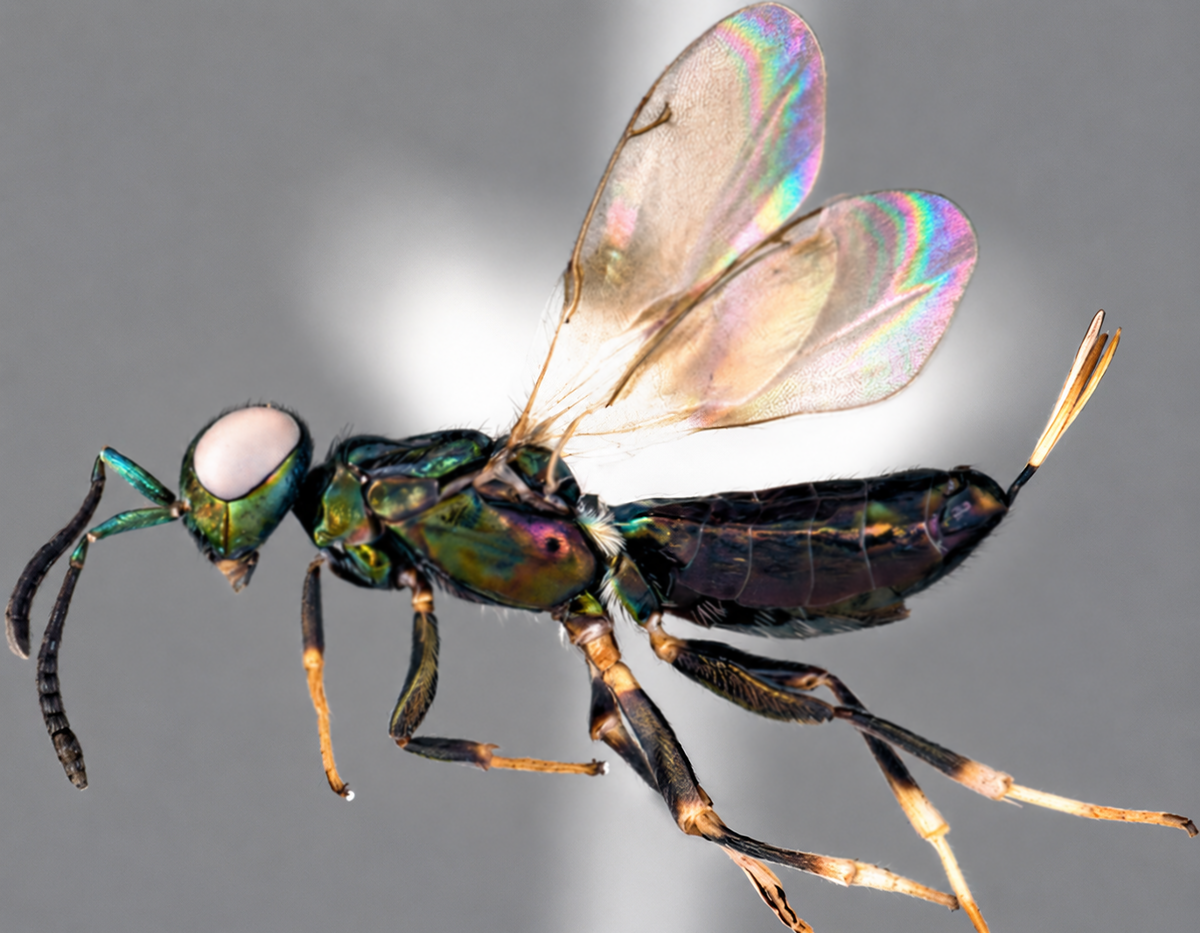
While the jury’s still out on whether social media is a net positive or negative for society at large, it’s still good for some very specific things. For example, crowdsourcing the identification of bugs you might stumble across. In 2018, insect enthusiast and author Kanji Toyosaki posted a photo to Twitter (now X) of a tiny wasp laying its eggs on a praying mantis’ egg case. The photo caught the attention of Japanese entomologist Taisuke Kawano of the Kyushu University Museum, who formally described the male of the species (Eupelmus curvator) for the first time in the journal Travaux du Muséum National d’Histoire Naturelle “Grigore Antipa.”
The wasp belongs to the family eupelmidae, parasitoids that typically lay their eggs in beetle larvae. When the eggs hatch, the much smaller wasp larvae make a meal of the larger beetle grubs, kicking off their own metamorphosis to become adults. Unlike most other eupelmids, however, Eupelmus curvator lays its eggs on other egg cases (or oothecae), targeting the narrow-winged mantis. And it’s a ruthlessly efficient species. In one instance, the researchers discovered 77 wasps on a single ootheca with just a handful of surviving mantis nymphs.
Read more: “New Tarantula Discovered in Unexpected Place”
“While some other genera in eupelmidae are specialized egg parasitoids, most species of Eupelmus attack larvae or pupae of other insects, and only very few are known to develop inside mantis oothecae,” Kawano said in a statement. “This makes Eupelmus curvator a rather unusual and biologically intriguing species.”
Originally from China, the species wasn’t thought to have a presence in Japan until Toyosaki shared his photo to Twitter. “Social media is becoming an increasingly important tool in citizen science,” Kawano explained. “One of its greatest strengths is that it effectively increases the number of ‘eyes in the field.’ These observations often come from places and times that researchers would not normally be able to cover.”
This citizen scientist didn’t go unrewarded either. For his discovery, Toyosaki was granted an authorship credit on the paper his post inspired—a much more durable legacy than mere social media clout. 
Enjoying Nautilus? Subscribe to our free newsletter.
Lead image: Taisuke Kawano et al., 2026