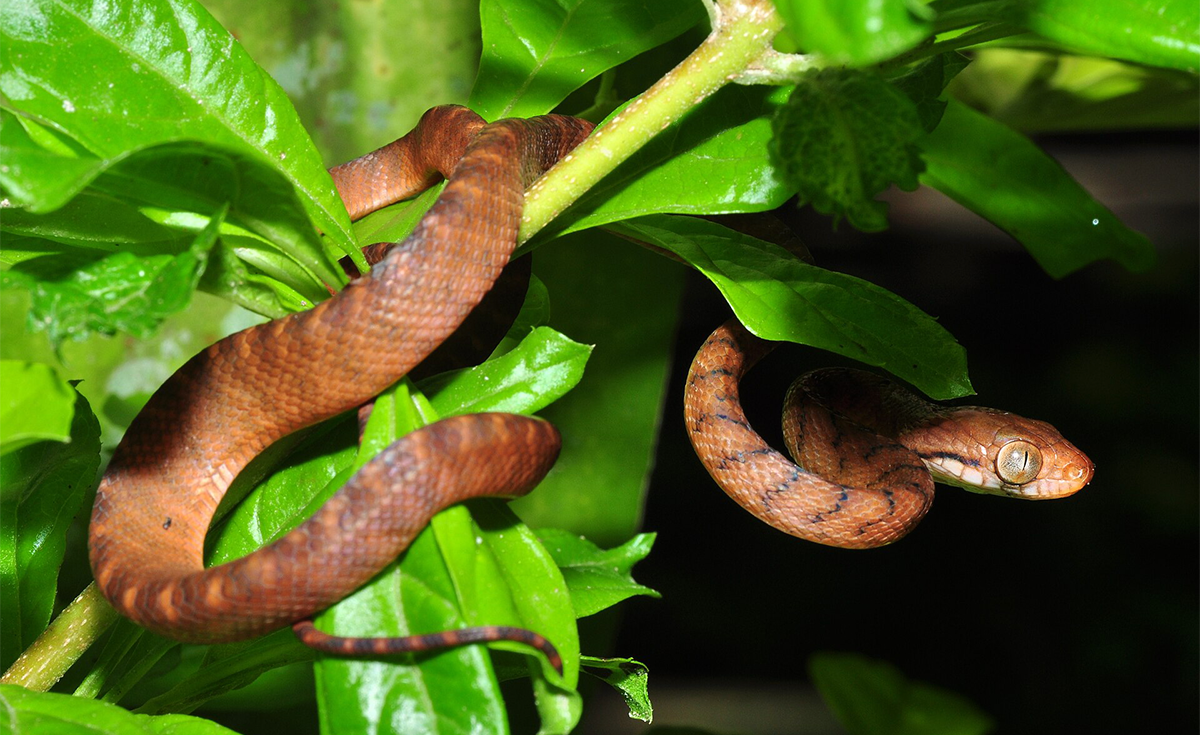
When a handful of brown tree snakes landed in Guam in the 1950s, likely having hitchhiked aboard cargo ships, no one could have predicted their far-reaching effects on local ecosystems. In fact, they became so invasive, so quickly there that they’ve been implicated in the extinctions of multiple species of birds, bats, and lizards on the island.
A study published today in Science Advances hypothesizes that the brown tree snake (Boiga irregularis) attained densities as high as 30,000 snakes per square mile on Guam because of their genes. Biologists from the University at Buffalo and the United States Geological Survey used long-read DNA sequencing technology to gain data that would be missed with traditional short reads. Because short-read sequencing chops up DNA into pieces of several hundred base pairs, it detects changes to single base pairs but not broader “structural variants,” such as entire duplicated, deleted, or translocated sections.
The research team found more than 19,000 structural variants in brown tree snake DNA, mostly clustered in genes that relate to immunity, stress adaptation, and sense of smell. Brown tree snakes rely on smell to locate active prey, and their voracious, undiscriminating appetites have made them formidable predators in Guam. Meanwhile, possessing a robust immune system could have helped them cope with the variety of new pathogens they encountered on the island.
Read more: “On the Trail of a New Understanding of Invasive Species”
Structural variants typically emerge in genomes over generations, and you’d expect brown tree snakes to be highly inbred—that is, with little variation—but the researchers cite recent evidence that population bottlenecks can spur variation, too. “We’re now getting a better understanding of unappreciated sources of genetic diversity that may explain how some inbred species can still respond to their environment,” explained first author Christopher Osborne, a former doctoral student at the University of Buffalo.
While the extra genetic variation may have made brown tree snakes more difficult to control, it could be advantageous if it occurred, for example, in endangered species. “It’s possible that endangered species may have more flexibility in their genes than we realize,” added Osborne, pointing out that how we assess genetic diversity has been “shaped largely by the technology of the day.”
Not that it’s any comfort to the now-extinct species that succumbed to the brown tree snake’s ecological havoc in Guam. 
Enjoying Nautilus? Subscribe to our free newsletter.
Lead image: Pavel Kirillov / Wikimedia Commons