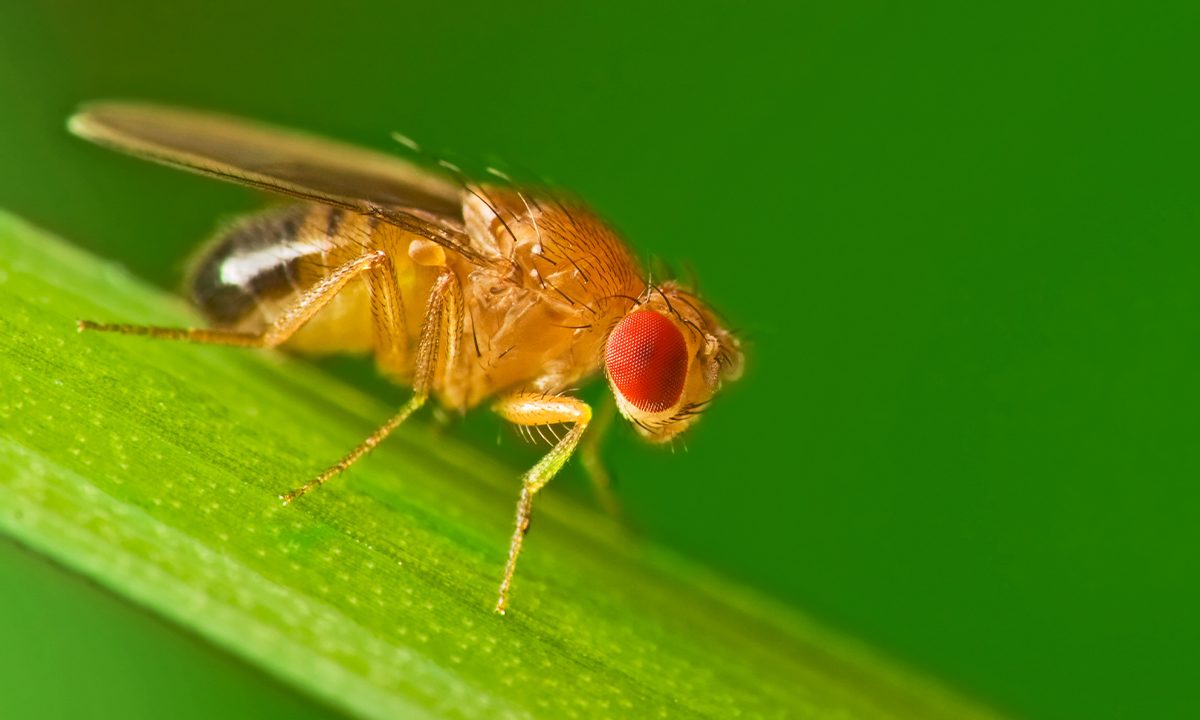
Mobs are generally disorderly. After all, more organisms in a small space make for chaotic crowds. But not so for fly sperm, according to a recent study in Nature Physics. Despite their relatively huge size, the sperm of fruit flies (Drosophila melanogaster) maintain an orderly arrangement within the flies’ seminal vesicles.
Biologists at the Simons Foundation’s Flatiron Institute used high-speed microscopes to peer inside a male fruit fly’s sperm storage organ. Each individual sperm is about eight-tenths of an inch, or almost the length of the fruit fly’s entire body. Pack a few thousand of them into a seminal vesicle just eight-hundredths of an inch wide—the thickness of a human hair—and you’d expect a sperm tangle. Instead, the researchers saw the sperm moving in wave-like flows back and forth across the vesicle.
Each sperm towed its long tail, so “they’re not getting entangled,” explained lead study author Jasmin Imran Alsous, of the Flatiron Institute’s Center for Computational Biology, in a press release. “That’s what really blew my mind.”
Read more: “What You Don’t Know About Sperm”
An individual fruit fly sperm by itself appears to meander aimlessly around, but the group of sperm in the seminal vesicle somehow exhibited a coordinated approach to movement.
Alsous and her coauthors set about trying to figure out how all these sperm could stay in motion without getting all bound up together. Using math, they modeled the vesicle data to tease out the biomechanical principles behind the observed collective flow of sperm. They found that, rather than propelling themselves like human sperm, each fruit fly sperm could push off its neighbors going in the opposite direction to move forward. In such a tightly packed arrangement, the mutual pushing would result in the observed churning of sperm through the vesicle. “Basically, sperm are swimming through a tube made of other sperm,” said Shelley.
Since, in an evolutionary sense, female fruit flies select for larger sperm that can better reach the reproductive organs, these super-long sperm are likely to stay around and continue to make waves in the vesicles.
They’re a miracle mob of (fruit fly) life. 
Enjoying Nautilus? Subscribe to our free newsletter.
Lead image: Studiotouch / Adobe Stock