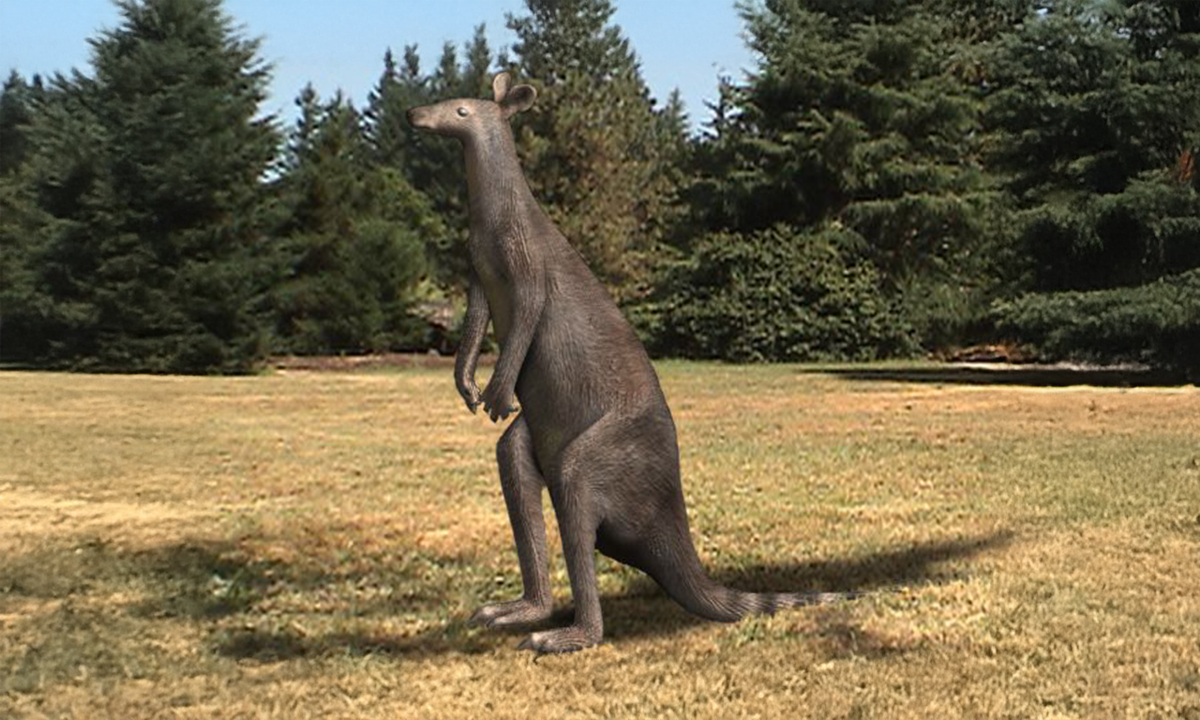
Ancient kangaroos were huge. A modern kangaroo maxes out at 200 pounds, while some of their forebearers were as massive as 550 pounds. Given their size, paleontologists have analyzed whether the ancestors would have hopped in classic modern kangaroo style. The consensus from studies that have extrapolated body scaling proportions of modern kangaroos to ancient ones has been that their ankle and foot anatomy didn’t offer sufficient strength to propel their weight into a hop.
But a study published today in Scientific Reports finds otherwise—their hind limbs were robust enough to support hopping. Post-doctoral student Megan Jones and colleagues at the University of Manchester in the United Kingdom analyzed the rear limbs of 94 modern and 40 fossil kangaroos and wallabies. Collectively, they comprised 63 species, including the several major extinct lineages of huge Pleistocene kangaroos, such as Protemnodon sp. that inhabited Australia and New Guinea until they went extinct about 40,000 years ago.
For each species, they measured hind-limb bone lengths and diameter of the fourth toe, which is extra-long, thought to be an adaptation for hopping. Estimates of body weight were either taken from other published studies or deduced from the bone anatomy. Then, by calculating the minimum size of the tendon required to withstand the forces of hopping without rupturing, they determined whether each species’ heel and ankle bone structure could support such a tendon.
Read more: “What Happened to Ancient Megafauna?”
The results found that the hind limbs of all kangaroos, including the giant ones, were sufficiently robust for hopping. Contrary to earlier studies that deemed giant kangaroo hopping impossible above a weight of about 350 pounds, this study didn’t identify any strict physical limitations that would preclude it. The long metatarsals were strong enough to resist the bending movements that happen during hopping, and the ankle bones were stout enough for insertion of the tendons required to provide resistance during hopping.
That said, efficiency is an important consideration in the movement of wild animals. While hopping was possible, it likely wasn’t efficient for the biggest kangaroos. Hopping locomotion relies on the elasticity of tendons that store and release energy. The thicker tendons of giant kangaroos would have been less stretchy and, therefore, not able to store and return as much energy during hopping. The study authors hypothesize that ancient kangaroos hopped periodically as needed—for example to get away from predators.
After all, Pleistocene giant kangaroos faced hyper-carnivore predators like “marsupial lions” (Thylacoleo carnifex), whose tooth marks have been found on giant kangaroo bones. Even the huge eagles of the time, such as the wedge-tailed eagle (Aquila Audax), might have gone after kangaroos.
So, hopping, even if it couldn’t be sustained in massive Pleistocene kangaroos, could have provided short bursts of movement for emergency escapes. “While hopping may not have been their primary mode of locomotion,” wrote the researchers, “our findings suggest that it may have formed part of a broader locomotor repertoire, for example for short bursts of speed.” 
Enjoying Nautilus? Subscribe to our free newsletter.
Lead image: Nobu Tamura / Wikimedia Commons