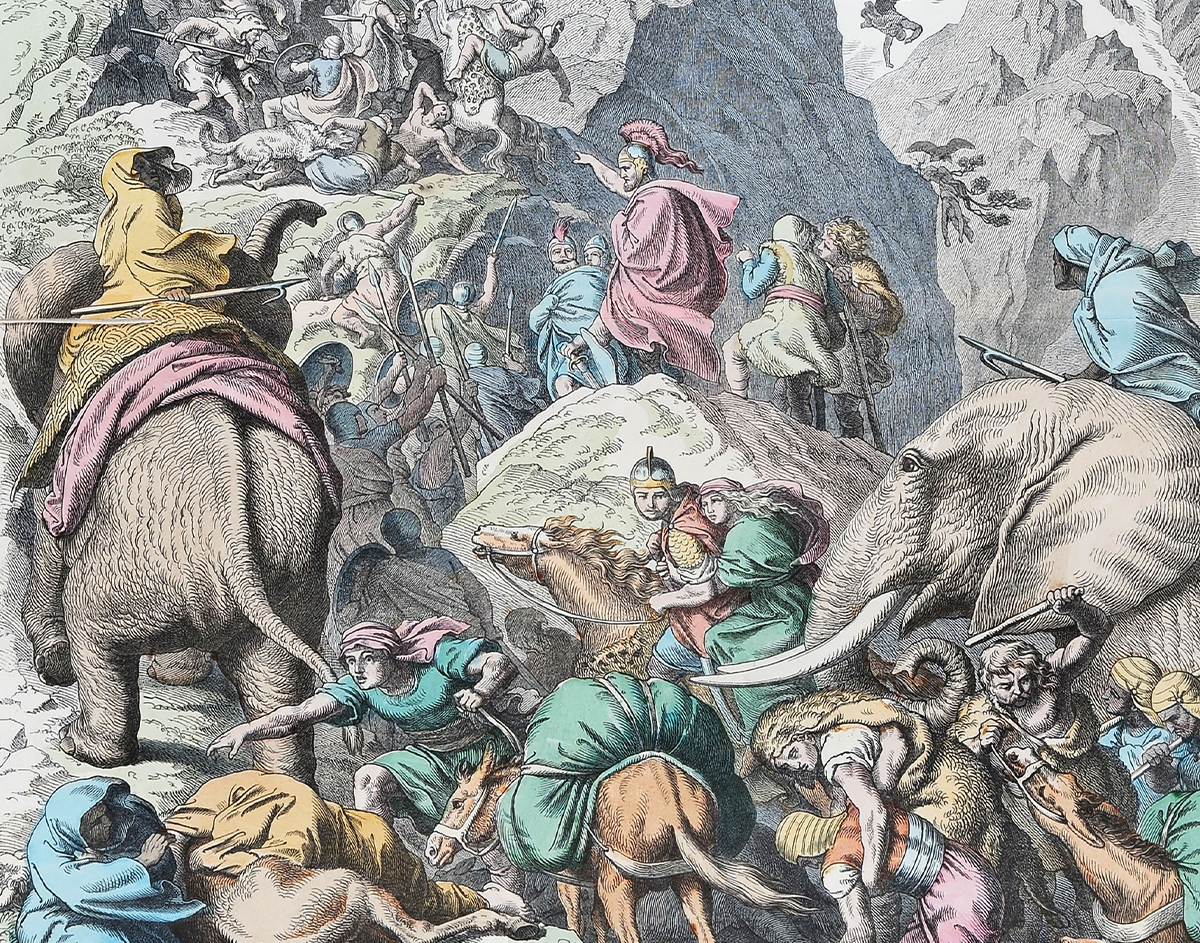
In 218 B.C., General Hannibal, who commanded the forces of Carthage in northern Africa, launched a daring trek crossing the Alps to capture Rome. With him were an estimated 40,000 soldiers, 7,000 horses, and 37 war elephants. The elephants were used like heavy cavalry, carrying supplies and warriors to confront enemy lines head-on. It was an extraordinary feat of surviving steep terrain, snow, and local tribesmen, not to mention limited food supplies to sustain both humans and pachyderms.
The route that Hannibal’s troops took through the Alps in just 15 days has been debated for centuries. Now, based on topographic data, a study published yesterday in Proceedings of the National Academy of Sciences elaborates the most likely path they chose. By analyzing the bioenergetics of the famous crossing, researchers from the University of Oxford in the United Kingdom and Friedrich Schiller University Jena in Germany borrowed a modeling approach from prior studies of African elephants.
Read more: “The Natural World Is an Elephant World”
Considering the energy demands of the soldiers, horses, and elephants, the models revealed that the mountain pass Col de la Traversette constituted the least energy-intensive route across the Alps. At about 9,700 feet in elevation, it was higher than some of the hypothesized alternative routes, such as the Col de Montgenèvre at 6,100 feet, Col du Clapier at 8,127 feet, and the Col du Mont Cenis at 6,834 feet. But Col de la Traversette was the shortest and most energy efficient, requiring an estimated 5.42 trillion joules (terajoules) of energy in all.
The route previously favored by scholars of Hannibal’s journey, Col du Clapier, would have required 16 percent more energy (6.28 trillion joules). For the elephants to consume the calories they needed on the journey over the mountain pass, it would require about 5 to 6 hours of feeding every day, according to the study author’s calculations. Given the travel time, wrote the researchers, “this scenario is highly unlikely, and so we must assume that Hannibal’s elephants would have had to rely on their body fat reserves for the duration of the crossing.”
Thus, selecting the shortest, least energetic route, Col de la Traversette, was an imperative. It would have allowed the elephants to face a severe calorie deficit but still survive. In fact, the elephants’ size was the very thing that saved them—because they had much greater fat reserves than the soldiers, they could overcome the kind of weight loss that killed many of their human travel companions. 
Enjoying Nautilus? Subscribe to our free newsletter.
Lead image: Heinrich Leutemann / Wikimedia Commons