Two decades ago, American journalist and author Richard Louv coined the term “nature deficit disorder” in his book The Last Child in the Woods. Back then, few scientists had studied how alienation from nature affects human health, for children or adults, but in the years since, this question has drawn intense research interest. Extensive evidence now suggests that a walk in the woods can have benefits for sleep, mood, cognitive function, the heart, and many other measures of health.
Louv has just released a new book, Noticing: Intimate Encounters with the Natural World, about how to reconnect with nature in a way that enlivens the mind, body, and spirit. He says humans have at least 30 distinct animal senses, some of which we may not even be aware that we possess, and that these senses can help. Louv advocates for an almost mystical relationship with the Earth and our fellow creatures, something he calls bioenchantment. He argues that this more intimate relationship to nature may be an antidote to the eco-anxiety of our age and could potentially help us save our home planet.
I talked to Louv about the turkeys that got him started on the new project, how humans are like bloodhounds and bats, whether technology always gets in the way of bioenchantment, and how moving to the mountains changed his life.
I wanted to ask you about the turkeys crossing the road.
Yes, Kathy and I moved up to the mountains about seven years ago to try to deal with our nature deficit disorder. I was walking up the road, and I was feeling sorry for myself. This was near the end of the pandemic. For a long time, I worked as a columnist for a newspaper, and I was missing my fellow journalists, but I was also missing the process of noticing. When I’d go into a room to interview some politician, I’d notice she had a red pen in her pocket, and I’d notice how the other people were looking at this politician, detail after detail. I’d bring it all back and put in my stories. I’d been accustomed to noticing details about other humans, and I wasn’t doing that anymore.
But that day on the road, I realized, wait a minute, I was just doing it. I saw these turkeys in front of me crossing the road with the babies, and I saw the iridescence in the feathers on the back of the mother. I noticed how they were interacting with each other and how they were pecking and looking for food. I realized I’d been doing that for a while after we moved up to the mountains. I remembered doing this as a kid. I grew up noticing in a very intense way in the woods and the fields behind our suburban house. I wanted to get that feeling again. I realized I’d never been lonely when I was in the woods. I didn’t feel isolated. I felt surrounded by consciousness. That moment with the turkeys turned into this book.
You suggest that deep noticing could help us address eco-anxiety about the destruction of our home planet. But is there any risk that noticing nature more closely could actually make eco-anxiety worse? If you notice nature, you’re going to notice the degradation more, too.
I wondered that too. I thought that when we moved up here, I’d escape some of that worry about decline in nature, but in fact, I see it more here. Not long after we moved, there was a beetle infestation, due to the drought and probably climate change. You’d drive through this area and you’d see what looked like elephant graveyards because these giant oaks died almost overnight. They were all alive when we moved here. This beetle attacks the biggest oaks first. In the last paragraph from the introduction, I write, “Here is good, but fragile news. Counterintuitively, even as we mourn the destruction of so many species, lands and waters, the natural world offers an antidote to our growing despair. We can find relief right there in our peripheral vision, in a deep and wavering current followed by native trout, in a line of swifts living most of their lives in flight, in the tracks of a mountain lion along a worn path, a path of wonderment.”
That feeling of wonderment helps us get through a lot. Being more in nature helps us with the grief. I’m not sure why that works that way, but many people have said the same thing to me in so many words.
Read more: “How Much Nature Is Enough?”
Early in the book, you cite Valarie Kaur’s gorgeous definition of wonder, as the act of looking at something in nature, including people, and thinking, “You’re a part of me I don’t yet know.” That’s such an intriguing way of thinking about wonder. Why does wonder involve feeling that a part of the self is missing or misunderstood? Maybe it’s about cognitive dissonance. You see something that is familiar to you because it’s part of the natural world and therefore deeply connected to you, and yet maybe it’s different from anything you’ve seen before.
Yeah. And it gets tricky to try to put words to it, though I spent 81,000 words trying. There’s a belief system called panpsychism. It means that the mountain that we see out our front window and the mountain lion that walks through the yard—we’re part of it, and it’s part of us. This isn’t new. Indigenous people have known that for a long, long time. Our ancestors certainly knew it. Our ancestors probably used far more senses than we use today.
The scientists who study the human senses no longer talk about five senses. They talk about conservatively nine or 10 human senses, and some of them talk about 30 or 50 or even 100 human senses. When you get to the outside number there, it gets tricky, because the senses work together to do strange things. Our ancestors were probably much better than we are at using their peripheral vision, which turns out to be more acute in many ways than direct vision. There’s a reason for that. There might be a bear to the left of you in those trees that you can’t see directly, but it’s just invited you to brunch. You may not want to go.
What are some of those other senses that you feel are most undervalued beyond the standard five?
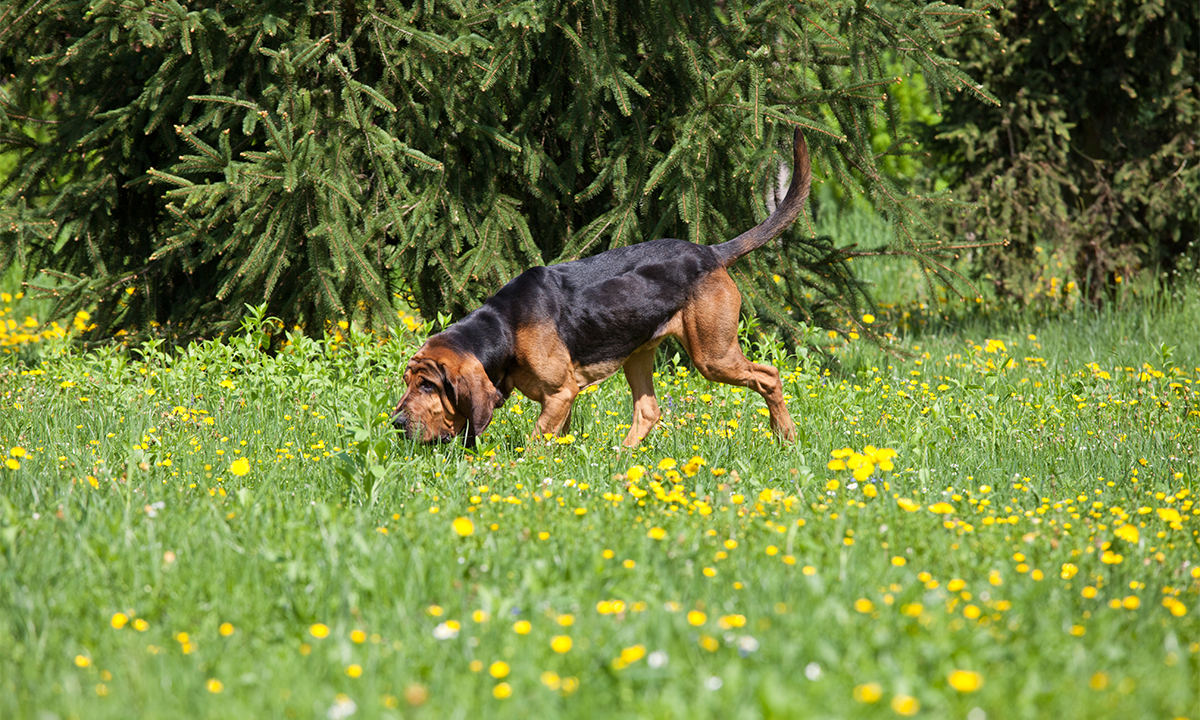
According to scientific studies, humans have some of the powers of bloodhounds. We can track with our noses. In this one experiment, they put college kids out in the woods and they blindfolded them and stuffed their ears. They had already laid down this track of scent through the woods, and asked the kids to get on their hands and knees and follow the scent. And they did. The scientists noted that the kids zigzagged as they followed the scent. That’s what animals do when they make their living with their noses. It’s a kind of radar. We have that ability that we don’t know we have, and we probably use it unconsciously. We also have some of the abilities of bats to make our way through the dark, just by the use of sound. Some people who have lost their sight have learned how to do this on purpose—that the sound bouncing off walls can get us through a dark house. There are many more.
You put forth the concept of bioenchantment. What does this mean to you?
Early on, I was asked to go on a forest bathing expedition. We went up the mountain, and the nature therapist gave us instructions: “Go out and find a tree and sit under it and tell me what you learned, and then come back and tell us.” We all spread out. Then she’d blow her little ocarina, which is a flute. We’d come back and sit in a circle when people would tell their stories of what they’d seen or noticed. I began to think these stories sounded an awful lot like fairy tales. One woman said she went out and found a tree that had fallen. She found she felt the pain of that tree, but she also felt the pain of the trees that had caught it. Story after story unfolded. I wondered, “Where did fairy tales come from?” The theory I developed in the book is what I call bio-enchantment, which is that the forest is enchanted, but not necessarily in the way that our ancestors thought or we think. It’s bio-enchanted, which means there’s so much going on in the woods and our senses pick that up, but we aren’t even fully aware of it most of the time. We anthropomorphize what we don’t understand. It’s a leprechaun, it’s a fairy circle.
Is there some danger in bio-enchantment then?
There can be danger to it. I recount a story in the book about Laurence Gonzalez from the Santa Fe Institute. His grandmother had this ashtray that was made in the shape of a rattlesnake. He loved that ashtray as a kid. Then one day he was out in the woods, and he saw something. He approached it and said, “That’s my grandmother’s ashtray.” He reached down to get it, but it was a rattlesnake—a real one. There can be danger to it, but there can also be other worlds that we explore.
Do you feel that technology and bio-enchantment are fundamentally opposed? Or can technology help us engage with nature? There are those new plant identification apps for instance.
I’m hesitant to blame everything on technology, but the more high-tech our lives become, the more nature we need. It’s a budgeting issue of time and money. A lot of my friends use apps to identify rocks and birds, but for whatever reason, I’m not interested in what my iPhone tells me.
You’re hoping that bioenchantment can drive a kind of cultural shift. What that might look like?
Environmentalism has been stalled for a long time. So much of it is about numbers, sea level rise in inches. William Blake said he had two ways of seeing. One was as a scientist sees: A scientist walks up to a tree and begins to measure it. The second way of seeing is using your imagination. The third way of seeing is to pull back from the tree and see the tree in its whole system. Today, that would mean pulling back and seeing the mycelium underneath the trees that connects all those trees and forests. The fourth way of seeing, he says, is to pull back even further from that, which is when you see the divine.
Today, kids are learning everything on screens, which limits the kind of information they’re getting from the world to two senses. That is the very definition of being less alive. Fundamentally, that’s what I hope I’ve written about in this book, which is to help us become more alive. A kid has to dig. A kid has to climb. If they don’t do that, where is the constituency for environmentalism going to come from in the future? I think the next stage of environmentalism is what I call the New Nature Movement, which has a lot more conversation in it about human health and well-being and how linked these things are.
What’s changed for you in the seven years since you moved up to the mountains to treat your nature deficit?
Partly, it’s a sense of not being so alone. Human beings don’t want to be the only life in the universe. Why else would we look for Bigfoot? Why else would we go to other planets? But the irony is, life is all around us if we can notice it. 
Enjoying Nautilus? Subscribe to our free newsletter.
Lead image: lenkadan / Adobe Stock